 Nepal Visuals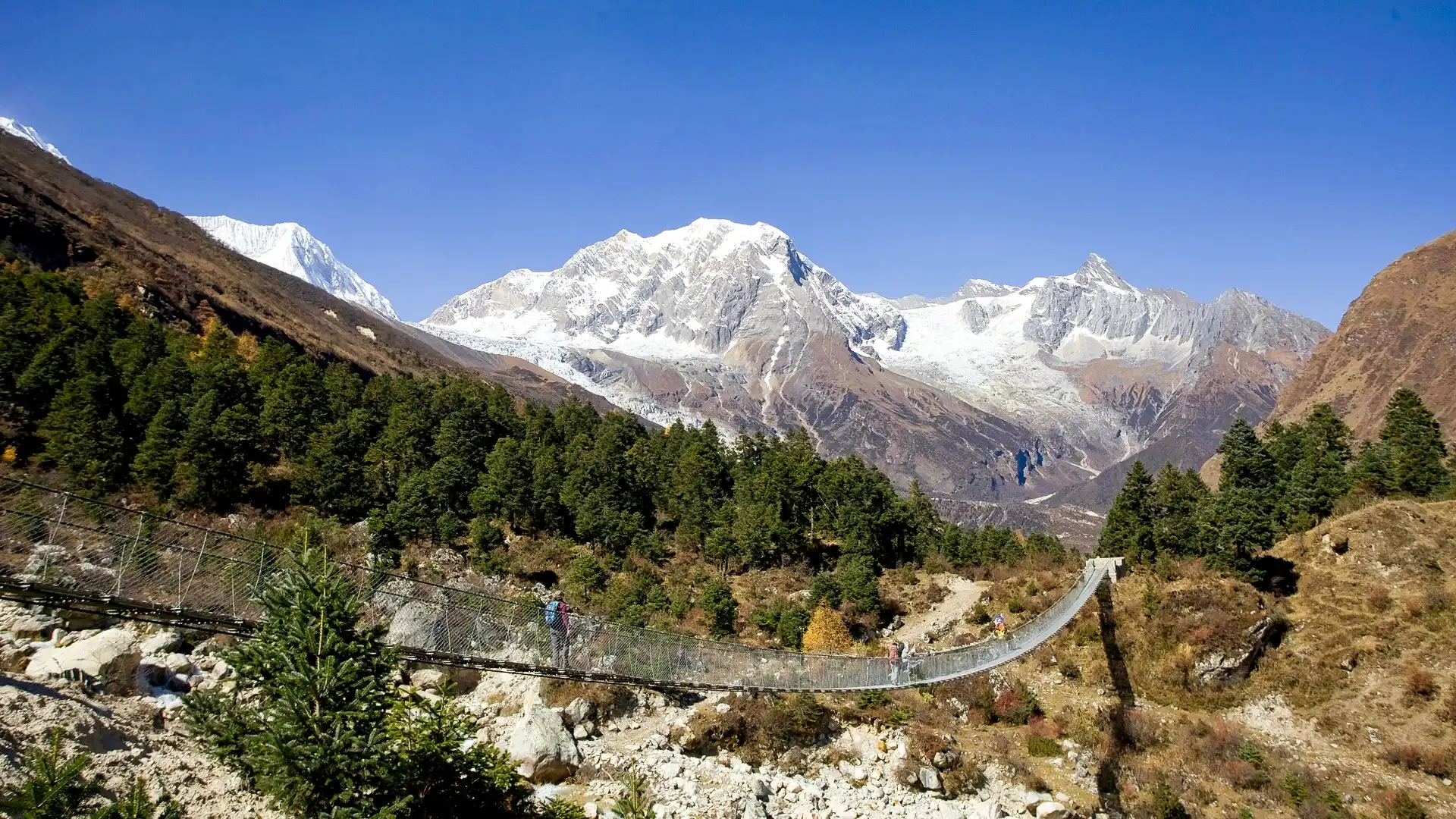
Manaslu Region · Challenging grade
Short Manaslu Circuit Trek
The route
What the walk is.
The Short Manaslu Circuit Trek (10 Days) is a challenging and rewarding Himalayan adventure that circles Mount Manaslu (8,163 m), the world’s eighth highest peak. This trek is perfect for experienced trekkers seeking a remote and less crowded alternative to the Everest and Annapurna regions while still enjoying dramatic mountain scenery and deep cultural immersion.
The journey follows the Manaslu Conservation Area from Machakhola to Dharapani, passing through subtropical forests, river gorges, and traditional Tibetan influenced villages such as Samagaun, Samdo, and Lho. Along the way, trekkers can visit ancient monasteries and experience authentic Himalayan lifestyles that remain largely unchanged due to the region’s restricted access.
A major highlight is the crossing of Larkya La Pass (5,160 m), which offers breathtaking views of Manaslu and surrounding peaks. Another memorable experience is the visit to Manaslu Base Camp (4,800 m), providing close views of the glacier and towering mountain landscapes.
This condensed itinerary requires strong physical fitness and previous high altitude trekking experience. Special permits, a licensed guide, and a minimum of two trekkers are required to enter this protected region.
Overall, this 10 day trek is ideal for adventurers seeking a compact yet authentic Manaslu experience filled with wilderness, culture, and high mountain challenge.
Why Nepal Visuals For The Short Manaslu Trek of 10 Days?
The Manaslu region accessible in a tighter window.
Ten focused days bring you into one of Nepal's most protected and least visited trekking corridors without requiring a two-week commitment from your schedule.
Restricted area permits handled so you can focus on the trek.
The Short Manaslu Trek still falls within the restricted area zone and demands a licensed guide by regulation. We manage every permit layer so the paperwork side of this journey never lands on your plate.
Altitude managed carefully across every stage.
Even on a condensed itinerary the trail reaches significant elevations. Our guides track your health and pace the ascent daily so your body adjusts at a rate the shortened schedule allows for safely.
All transfers, teahouses, and documentation confirmed in advance.
Ground transport from Kathmandu, Manaslu Conservation Area permits, and teahouse bookings along the route are all locked in before you arrive so your 10 days run without unnecessary interruptions.
Complete and honest pricing from the very first conversation.
The multiple permit requirements of a restricted area trek can obscure the true cost if not laid out clearly. We present every charge upfront so your full budget picture is accurate before you commit.
Remote terrain guided by people who know it well.
The Manaslu corridor is genuinely isolated with limited rescue access. Our guides carry emergency equipment, know the route thoroughly, and have the field experience to make sound calls when conditions demand it.
Tibetan highland culture encountered even on a shorter route.
The lower and mid sections of the Manaslu valley pass through Nubri Tibetan communities with traditions rarely seen by outside visitors. Our guides make time for those encounters rather than walking past them.
A preparation plan tailored to the 10-day route.
We send a packing list and fitness guide built specifically around the demands of this condensed itinerary, covering the elevation profile, expected weather, and what each day on the trail will ask of you.
Support available even where the signal is not.
Communication along the Manaslu trail is unreliable at the best of times. Our team stays reachable via WhatsApp, Email, and Zoom in the days before and throughout your trek so reassurance is always within reach.
Your departure is a commitment we honour without condition.
Ten days in a restricted Himalayan wilderness deserves a firm guarantee from the people organising it. Every confirmed Short Manaslu Trek booking departs as planned, regardless of how many trekkers are on the roster.
Day by day
Where you sleep, night by night.
Kathmandu → Bhimtang · highest point 5,135 m
- Day 01Hotel (Twin Sharing) · Welcome Dinner1,400 m
Your Nepal Visuals representative meets you at the airport and transfers you to your hotel in Thamel. Welcome briefing and dinner this evening.
- Day 02Tea-house · Breakfast, Lunch, Dinner900 m
Early departure by jeep through Dhading Bensi and Arughat before the road turns rough toward Machakhola. Follow the Budhi Gandaki River upstream through remote countryside. Arrive at Machakhola, the official trek starting point, by late afternoon.
- Day 03Tea-house · Breakfast, Lunch, Dinner1,340 m
Begin your Manaslu Circuit adventure trekking along the Budhi Gandaki River through lush subtropical forests. Cross several thrilling suspension bridges and pass through Khorlabesi and Tatopani hot springs. Arrive at Jagat, the official entry point into Manaslu Conservation Area where permits are checked.
- Day 04Tea-house · Breakfast, Lunch, Dinner1,860 m
Continue through the Budhi Gandaki gorge, crossing the river multiple times on suspension bridges. The trail passes through Salleri and Sirdibas with views of dramatic waterfalls. Arrive at Deng, a small Gurung village marking the transition into the Tibetan-influenced culture of the upper valley.
- Day 05Tea-house · Breakfast, Lunch, Dinner2,630 m
Ascend through subtropical forest into pine and rhododendron zones. The trail crosses the river several times and passes through Ghap village with its entry chorten. Arrive in Namrung, a traditional Tibetan-influenced village with a small gompa and the first close views of Manaslu.
- Day 06Tea-house · Breakfast, Lunch, Dinner3,180 m
A rewarding day with Manaslu increasingly dominating the skyline. Pass through Lihi village and its ancient chortens before reaching Lho, a beautiful village with one of the finest direct views of Manaslu. Visit the Ribung Gompa overlooking the valley.
- Day 07Tea-house · Breakfast, Lunch, Dinner3,530 m
Continue through high altitude terrain with Manaslu towering overhead. The trail opens into a broad glacial valley as you approach Samagaun, the largest village in upper Manaslu and a critical acclimatisation stop. Visit the ancient Pungen Gompa and enjoy afternoon views of Manaslu base camp on the glacier above.
- Day 08Tea-house · Breakfast, Lunch, Dinner3,860 m
A short but high day continuing gradual altitude gain. The trail follows the valley past yak herds grazing in high pastures to Samdo, a traditional Tibetan trading village historically connected to Tibet across nearby mountain passes just 20 km from the border.
- Day 09Tea-house · Breakfast, Lunch, Dinner4,460 m
Pre-pass camp day moving to the staging point for tomorrow Larkya La crossing. Climb through increasingly barren rocky terrain past frozen glacial streams and moraine fields. Reach Dharmasala, a basic stone shelter at the foot of the pass. Prepare equipment, hydrate, eat well, and sleep early. Tomorrow starts at 3-4 AM.
- Day 10Highest point · sleep 3,590 m · Tea-house · Breakfast, Lunch, Dinner5,135 m
The most demanding and exhilarating day of the trek. Start before dawn by headtorch, crossing the glacier and ascending to the Larkya La Pass at 5,135m. The summit rewards with breathtaking panoramic views of Manaslu, Himlung, Cheo Himal, Annapurna II, and Lamjung Himal. The long descent to Bhimtang is steep but the relief of lower altitude is palpable.
Fixed departures
12 group dates open.
144 places across them. Or start on any flexible date in the calendar below.
| Departure | Booked | Filling | Left | Status | Book |
|---|---|---|---|---|---|
| Sat, Mar 6, 2027 | 0/12 | 12 | Available | ||
| Sat, Mar 20, 2027 | 0/12 | 12 | Available | ||
| Sat, Apr 3, 2027 | 0/12 | 12 | Available | ||
| Sat, Apr 17, 2027 | 0/12 | 12 | Available | ||
| Sat, May 1, 2027 | 0/12 | 12 | Available | ||
| Sat, May 15, 2027 | 0/12 | 12 | Available | ||
| Sat, Sep 4, 2027 | 0/12 | 12 | Available | ||
| Sat, Sep 18, 2027 | 0/12 | 12 | Available | ||
| Sat, Oct 2, 2027 | 0/12 | 12 | Available | ||
| Sat, Oct 16, 2027 | 0/12 | 12 | Available | ||
| Sat, Nov 6, 2027 | 0/12 | 12 | Available | ||
| Sat, Nov 20, 2027 | 0/12 | 12 | Available |
Prices are per person, twin share, in USD. Book with a 20 % deposit — the balance is due 7 days before departure. Scheduled departures show places left; flexible departures can be booked on any listed start date. Booking terms
| Su | Mo | Tu | We | Th | Fr | Sa |
|---|---|---|---|---|---|---|
| 1 | 2 | 3 | ||||
| 4 | 5 | 6 | 7 | 8 | 9 | 10 |
| 11 | 12 | 13 | 14 | 15 | 16 | 17 |
| 18 | 19 | 20 | 21 | 22 | 24 | |
| 25 | 26 | 28 | 29 | 30 |
- Selected trip dates
- Available
- Filling fast
- Almost sold out
- Sold out
Fri, Oct 23Sun, Nov 1, 2026
10 days · flexible departure
- StartsFri, Oct 23, 2026 · Kathmandu
- EndsSun, Nov 1, 2026 · Bhimtang
USD $799 per person, twin share · Deposit today USD $159.80 (20 %)
On the trail
Photographs from the route.
The whole number
What the price covers.
10 things are in the price and 11 more are named as excluded.
In the price
Transportation & Logistics
- ✓Private Ground Transport · Round-trip transfers via private jeep (Kathmandu to the trailhead and return from the trek endpoint).
- ✓Restricted Area Permits · All required permits, including the Manaslu Restricted Area Permit (RAP), Manaslu Conservation Area Permit (MCAP), Annapurna Conservation Area Permit (ACAP), and TIMS card.
- ✓City Convenience · Complimentary secure luggage storage in Kathmandu for items not needed on the trail.
Professional Support & Safety
- ✓Expert Leadership · A government-certified, English-speaking guide specializing in the Manaslu region.
- ✓Staff Welfare · Full coverage of wages, meals, and comprehensive insurance for your trekking guide.
- ✓Health Monitoring · Daily vitals checks using an oximeter and access to a comprehensive first aid kit.
- ✓Emergency Coordination · Professional assistance with emergency evacuation logistics (costs covered by your travel insurance).
Accommodation & Meals
- ✓Trek Nutrition · Full board meals (Breakfast, Lunch, and Dinner) provided throughout all trekking days.
- ✓Trail Lodging · Best available teahouse or lodge accommodation (twin-sharing basis).
- ✓Welcome Dinner · A celebratory welcome dinner at a traditional Nepalese restaurant in Kathmandu.
Not included
Flights, Visas, and Kathmandu Stays
- ×International Travel · International airfare and airport departure taxes.
- ×Entry Requirements · Nepal Entry Visa fees.
- ×City Accommodation · Hotel stays in Kathmandu before and after the 10-day itinerary.
- ×City Dining · Lunch and dinner in Kathmandu, excluding the celebratory welcome dinner.
Personal Protection & Support
- ×Mandatory Insurance · Comprehensive travel and medical insurance (must cover high-altitude trekking and helicopter evacuation).
- ×Porter Service · Personal porter service is not included in this short-duration package (available upon request).
- ×Individual Gear · All personal trekking clothing, boots, and sleeping bags.
Trail & Personal Expenses
- ×Teahouse Amenities · Out-of-pocket costs for hot showers, Wi-Fi, and battery/device charging.
- ×Beverages & Snacks · All alcoholic drinks, cold beverages, bottled water, and personal snacks.
- ×Personal Items · Toiletries and personal medications.
Professional Tips and Gratuity
- ×Staff Appreciation · Customary tips for your guide and trekking crew as a gesture of thanks for their hard work.
Challenging grade
Is this trek right for you?
You can do this if…
- ✓Walk 6–8 hours a day comfortably
- ✓Carry an 8–10 kg daypack
- ✓Manage long ascents and nights above 4,000 m
Recommended preparation
- ✓3+ months of cardio and leg-strength training
- ✓Back-to-back day hikes with a loaded pack
- ✓Check the itinerary for high passes or glacier days
Experience & support
- ✓Previous multi-day trekking recommended
- ✓Guided throughout — a licensed guide is required on Nepal treks
- ✓Unsure about age, health or fitness? Ask us — we tailor the pace
About three months out? Follow our free 12-week trek fitness plan.
Good to know
Additional information.
The Manaslu Region: Nepal's Last Frontier
While Everest and Annapurna regions host tens of thousands annually, Manaslu remains refreshingly uncrowded. The government's 1998 restricted area designation requires special permits, mandatory guides, and minimum two-person groups, naturally filtering visitor numbers and preserving pristine trail character and authentic cultural atmosphere.
Mount Manaslu (8,163m): Derived from Sanskrit "Manasa" meaning "intellect" or "soul," this massive peak dominates the trek from subtropical foothills to high passes. As the world's eighth highest mountain and Nepal's fourth, its spiritual significance extends beyond size. Local Tibetan-Buddhist communities consider it sacred, maintaining rituals seeking blessings for safety and prosperity.
Manaslu Conservation Area: Established 1998, covering 1,663 sq km of incredibly diverse terrain protecting 2,000+ plant species, 33 mammal species (including snow leopards, red pandas, Himalayan black bears), and 110+ bird species across ecosystems from subtropical forests at 900m to alpine tundra above 4,000m.
Tibetan Cultural Corridor: Upper Manaslu Valley villages (Samagaun, Samdo, Lho) maintain Nepal's most authentic Tibetan-Buddhist culture. Following the 1959 Tibetan uprising, refugees strengthened already strong cultural ties to Tibet just 20 km north. Experience stone houses, carved windows, prayer wheels, mani walls, active monasteries, and traditional agriculture unchanged for centuries.
The 10-Day Challenge: This condensed itinerary compresses the classic 14-16 day circuit through direct transport to Machakhola (Day 1), steady daily distances without extra rest days, and jeep return from Dharapani (Day 10). More challenging with longer distances and sustained effort, requiring excellent fitness, but delivering the complete circuit in 10 efficient days.
Larkya La Pass (5,160m): The trek's ultimate challenge occurs Day 8, a grueling 10-11 hour crossing from Samdo to Bhimtang. Altitude effects, duration, 1,300m elevation gain, 1,700m descent, and weather exposure make this demanding. The reward? Spectacular 360-degree panoramas of Manaslu, Himlung Himal, Cheo Himal, Annapurna II, and Kang Guru, plus profound accomplishment.
Who Should Trek Here: Experienced trekkers comfortable with multi-day high-altitude hiking, fit adventurers seeking challenge beyond popular routes, those with 2 weeks total (including travel), and trekkers wanting authentic culture and pristine wilderness. NOT for first-time Himalayan trekkers, those without recent multi-day experience, altitude-sensitive individuals, luxury seekers, or anyone unable to train 2-3 months beforehand.
Best Season
Spring (March-May) - Excellent
Weather: Days 10-18°C mid-elevations, 0-8°C Samdo. Nights -5 to 5°C.
Advantages: Rhododendron blooms (peak April), comfortable temperatures, less snow on Larkya La, longer daylight for pass crossing, increasingly clear skies, all teahouses open.
Best months: April for blooms and weather, May for warmth and clarity.
Autumn (September-November) - Peak
Weather: Days 8-16°C mid-elevations, -2 to 6°C Samdo. Nights -10 to 0°C.
Advantages: Clearest skies all year, most stable weather, perfect Larkya La conditions, excellent visibility, comfortable walking, harvest season cultural interest.
Best months: October perfect balance, late September excellent, early November colder but spectacular.
Monsoon (June-August) - AVOID
Heavy daily rain, extreme landslide risk, leeches, swollen dangerous rivers, limited views, Larkya La extremely dangerous. Strongly not recommended.
Winter (December-February) - Expert Only
Larkya La often impassable, extreme cold, most lodges closed, very limited services, avalanche risk. Not recommended for 10-day timeline.
Accommodation and Meals
Lower Elevations (Machakhola-Deng): Better teahouses, some attached bathrooms, solar hot showers, relatively comfortable.
Mid Elevations (Namrung-Samagaun): Basic but adequate, mostly shared bathrooms, limited hot water, wood/yak-dung stove heating in dining rooms.
High Elevations (Samdo, Dharamsala): Very basic, shared cold-water bathrooms, minimal facilities, essential simplicity.
Rooms: Twin-sharing, foam mattresses with blankets (bring sleeping bag essential), minimal furniture, no room heating (dining areas only).
Meals: Dal bhat (most nutritious, unlimited refills), fried rice, thukpa, momos, Tibetan bread, tsampa, yak cheese. Simple but hearty. Vegetarian always available. Variety decreases and prices increase with altitude (NPR 500-1,500 per meal).
Locations Covered
Machakhola (900m): Trek starting point after 8-9 hour drive from Kathmandu
Jagat (1,340m): Manaslu Conservation Area entry, traditional stone village
Deng (1,860m): Narrow gorge location, Buddhist influence begins
Namrung (2,630m): Tibetan cultural zone entry, spectacular mountain views
Samagaun (3,530m): Largest upper valley village, major acclimatization stop
Manaslu Base Camp (4,800m): Optional side trip, close-up Manaslu views
Samdo (3,860m): Highest permanent settlement, Tibet border proximity
Larkya La Pass (5,160m): Trek's highest point, spectacular panoramas
Bhimtang (3,720m): Post-pass descent, alpine meadow setting
Dharapani (1,860m): Trek end, Annapurna Circuit junction, road access
Trek Difficulty
Rating: Challenging
Challenges: Maximum 5,160m altitude with significant effects, 8 consecutive trekking days with only one rest day, Day 8 brutal 10-11 hours, constant elevation changes (6,000m+ total gain), remote location (difficult evacuation), weather exposure, technical moraine/glacier sections, basic facilities, limited comfort.
Requirements: Excellent cardiovascular fitness, previous multi-day high-altitude experience (should have completed Everest Base Camp or similar), altitude experience above 4,000m helpful, mental toughness for sustained effort, ages 18-65 with excellent fitness.
Training: Start 3 months before. Focus on cardio 4-5x weekly, long hikes building to 8+ hours, consecutive day endurance (practice 4-5 day trips), leg strength, core stability, thoroughly break in boots.
Success Rate: 85-90% for properly prepared trekkers. Main non-completion causes: altitude sickness (5-10%), weather closing Larkya La (3-5%), injury/exhaustion (2-3%).
Comparison: More challenging than EBC, ABC, Langtang, Gokyo. Similar to Annapurna Circuit, Three Passes. Less than Kanchenjunga, Dolpo.
Before you book
Questions we get most.
Speed & Logistics
Is it possible to complete the Manaslu Circuit in just 10 days?
Yes, but it is a "High-Intensity" trek. This version uses private 4WD Jeeps to reach the highest possible trailheads and skips the return walk by driving out from Dharapani. It is designed for fit, time-sensitive adventurers.
Who should choose the 10-day Short Manaslu Trek?
This is strictly for experienced trekkers or those who are already acclimatized (perhaps coming from another trek). The rapid ascent requires your body to adapt quickly to high altitudes without traditional "buffer" days.
How many hours per day will I be walking?
Expect to walk between 7 and 9 hours most days. Because the itinerary is condensed, you will be covering more vertical and horizontal distance each day than on the longer 15-day version.
Highlights in a Hurry
Do I miss any major sights on the 10-day trek?
You still see the "Greatest Hits," including the Larkya La Pass and views of Manaslu. However, you miss out on the deep cultural immersion of side-trips to Tsum Valley or the base camp hikes that longer itineraries allow.
What is the "Exit Route" for the 10-day trek?
Once you cross the pass and reach Bimthang, you descend rapidly to Tilije or Dharapani. From there, a Jeep picks you up for a long drive back to Kathmandu via Besisahar, completing the loop in record time.
Is the 10-day trek more expensive?
While shorter, the cost is often similar to the 13-day trek because it relies heavily on private Jeep transfers, which are significantly more expensive than local buses but necessary to maintain the fast schedule.
Strategy & Comfort
Is there any room for error in a 10-day schedule?
Very little. A single day of bad weather or a minor illness can disrupt the timeline. We recommend having 1-2 buffer days in Kathmandu after the trek in case the high pass is temporarily closed by snow.
What is the "Larkya Bazaar" mentioned in history?
On your way to Dharamsala, you pass the remains of Larkya Bazaar. In the 10-day rush, it’s a quick but fascinating glimpse into the old trade route where salt from Tibet was once swapped for grain from the lowlands.
Can I hire a porter for the 10-day short trek?
Absolutely, and it is highly recommended. To maintain the fast pace required for this itinerary, walking with a light daypack while a porter carries your main gear is the best way to ensure you don't burn out.
Weather & Timing
What are the best months for the 10-day version?
October and May are the peak windows. Because the schedule is tight, you need the most stable weather possible. During these months, the Larkya La Pass is most likely to be clear and free of deep, blocking snow.
Do I need different gear for the short trek?
The gear list is the same, but you must prioritize lightweight items. Since you are moving fast, every kilogram counts. Using high-tech, packable layers will help you maintain the necessary speed on the trail.
Is it possible to do this trek in the Monsoon?
We do not recommend the 10-day trek in July or August. The road to the trailhead is prone to landslides, which can easily cause 24-48 hour delays, making a 10-day mountain schedule almost impossible to guarantee.
Connectivity & Digital Logistics
Is there reliable mobile reception on the 10-day "Express" route?
In 2026, NTC (Nepal Telecom) provides the most consistent 4G signal in the lower valley up to Lho, while Ncell works better near the trek’s end in Dharapani. Because the 10-day pace is fast, you won't have much time to hunt for Wi-Fi in teahouses. Having a local SIM card allows you to send quick "all-safe" updates to family during short rest breaks without relying on expensive and often sluggish lodge internet.
How should I manage device charging on such a tight schedule?
With 7 to 9 hours of daily trekking, your phone and camera batteries will drain quickly, especially in the cold. Most lodges charge $3–$6 per device, but since you arrive late and leave early on this itinerary, waiting for a turn at the communal charging plug is difficult. We recommend carrying a 20,000mAh power bank to charge your gear overnight inside your sleeping bag, ensuring you are ready for the 4:00 AM start at Dharamsala.
Performance Health & Recovery
How do I manage muscle recovery between long 8-hour days?
On the 10-day trek, "Active Recovery" is vital because you lack the rest days of longer itineraries. We recommend performing 15 minutes of intensive lower-body stretching immediately upon reaching your lodge and using electrolyte replacements in your water to prevent cramping. Bringing a lightweight massage ball or "tiger balm" can help soothe your calves and quads, which will be under significant strain from the rapid 5,000m ascent.
What is the "Sleep Hygiene" strategy for the 10-day push?
Sleep is your only time to recover, but altitude often makes it difficult. To maximize rest, we suggest avoiding caffeine after noon and using earplugs to block out the noise of wind and other trekkers in thin-walled teahouses. Keeping your head slightly elevated with a makeshift pillow and staying warm with a -20°C rated sleeping bag will help your body focus on rebuilding muscle tissue rather than just fighting the cold.
Permit & Group Regulations
Can I still get the Restricted Area Permit for a solo 10-day trip?
Even in 2026, the Manaslu region remains a Restricted Area requiring a minimum of two trekkers to issue a permit. If you are a solo traveler on a 10-day schedule, your agency must "ghost" your permit with another trekker's details or pair you with a small group. You must also be accompanied by a licensed guide at all times, as your digital permit will be scanned at multiple high-altitude checkpoints to track your rapid progress.
Are there specific "Fast-Pass" checkpoints for short itineraries?
There are no formal "fast-passes," but the 2026 digitization of the Jagat and Samdo checkpoints has reduced wait times. To keep your 10-day momentum, your guide will usually run ahead to the checkpost with your digital QR codes while you take a short water break. It is essential to have your original passport easily accessible in your daypack, as random spot-checks by the Himalayan Border Police are frequent near the Tibetan border sections.
Nutrition for High-Velocity Trekking
What is the best "Summit Fuel" for the Larkya La crossing?
On the 10-day route, the pass day is an 8-to-10-hour marathon. We recommend eating a high-carb dinner of pasta or Dal Bhat the night before in Dharamsala. For the actual climb, skip the heavy sit-down lunch and carry "pocket fuel" like nuts, dried fruits, and energy gels. These provide a steady stream of glucose to your muscles without diverting blood flow away from your legs for heavy digestion in the thin 5,000m air.
Should I avoid meat entirely on the 10-day "Express" trek?
Yes, we strongly advise a vegetarian diet for this specific itinerary. Because meat is often carried for days by porters without refrigeration to reach high villages like Samdo, the risk of food poisoning is high. On a 10-day schedule, a single day of stomach illness will end your trek. Sticking to fresh eggs, lentils, and the local "Sherpa Stew" ensures you stay fueled and healthy for the intense daily mileage.
Still have a question? WhatsApp us →