 Nepal Visuals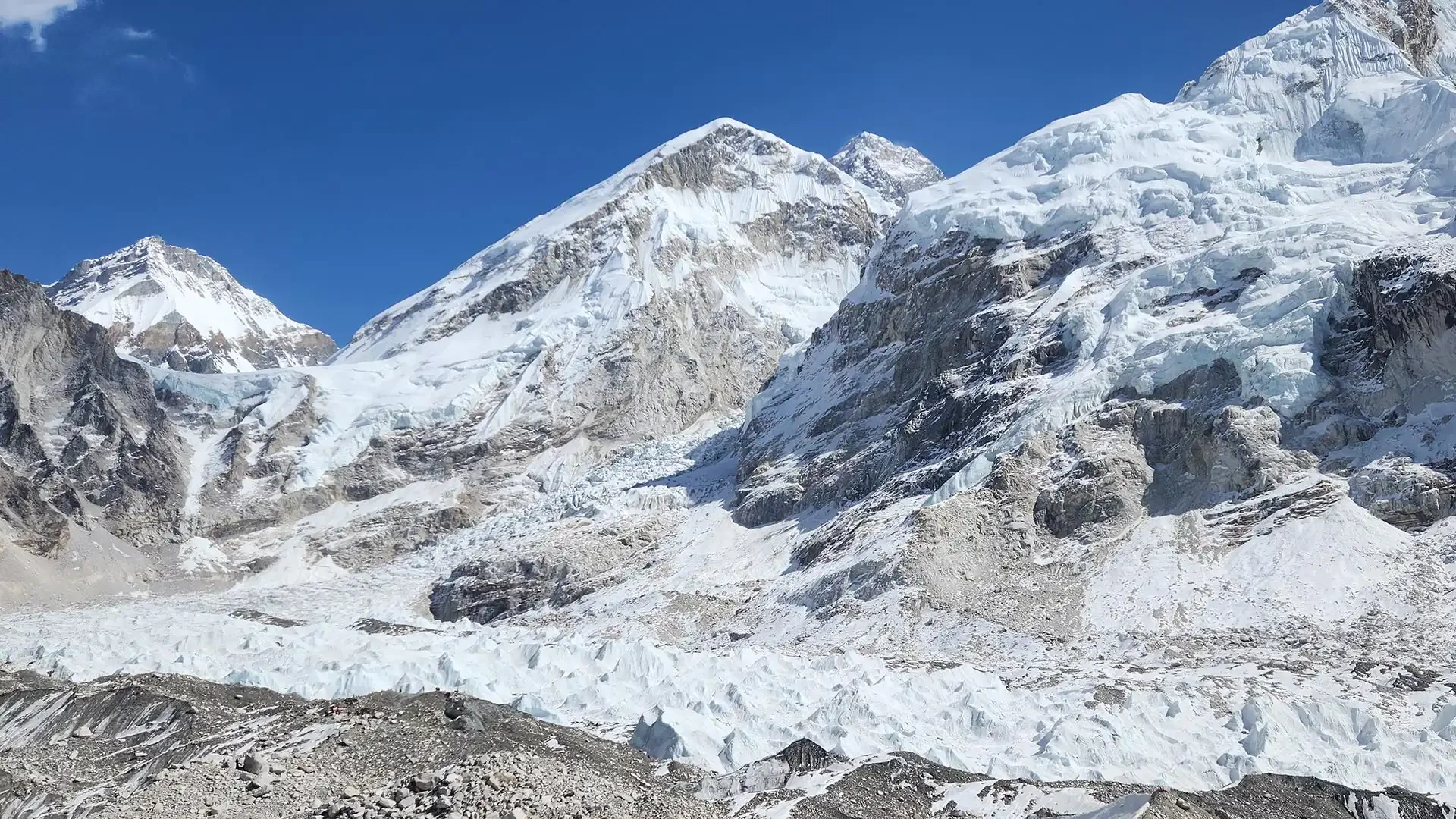
In this Everest Base Camp Trek FAQs guide, we answer everything from where Everest Base Camp is located and EBC altitude, to how challenging the trek is; along with practical insights like trek cost, total distance, and the best time to go.
On this page(10)
Every year, thousands of trekkers ask the same questions before heading to the Khumbu. How hard is it really? What does it cost? Do I need a guide? What if I get sick up there?
This guide answers all of it, clearly and directly, so you can plan your Everest Base Camp Trek with confidence. These FAQs cover everything from permits and packing to altitude, accommodation, and what's changed for 2026.
The Basics
Where is Everest Base Camp located?
Everest Base Camp is located in the Khumbu region of northeastern Nepal, inside Sagarmatha National Park, a UNESCO World Heritage Site.
It sits at 5,364 meters (17,598 feet) above sea level, at the foot of Mount Everest.
The trek begins with a short flight from Kathmandu to Lukla and passes through iconic Sherpa villages including Namche Bazaar, Tengboche, Dingboche, and Gorak Shep before reaching Base Camp.
What is the total distance of the EBC Trek?
The Everest Base Camp Trek covers approximately 130 kilometers (81 miles) round trip, starting and ending in Lukla.
That works out to roughly 65 kilometers each way, spread across 12 to 14 days of trekking.
The daily walking distance averages between 10 and 16 kilometers, with rest days built in for acclimatization.
What is the highest point on the EBC Trek?
The highest point on the standard EBC Trek is Kala Patthar, at 5,545 meters (18,192 feet).
Everest Base Camp itself sits at 5,364 meters, which is slightly lower.
Most trekkers visit both on the same itinerary, with Kala Patthar offering the best panoramic views of Mount Everest at sunrise.
How long does the EBC Trek take?
The standard Everest Base Camp Trek takes 12 to 14 days, including essential acclimatization days.
Most itineraries spend 8 to 9 days reaching Base Camp and 3 to 4 days returning to Lukla.
Some trekkers add extra days to explore side routes like the Gokyo Lakes or to extend their time at higher elevations.
What is the standard EBC Trek itinerary for 2026?
A typical 14-day itinerary looks like this:
Day 1: Fly Kathmandu to Lukla (2,840 m), trek to Phakding (2,610 m)
Day 2: Trek to Namche Bazaar (3,440 m)
Day 3: Acclimatization day in Namche, short hike to Everest View Hotel or Khumjung
Day 4: Trek to Tengboche (3,860 m)
Day 5: Trek to Dingboche (4,410 m)
Day 6: Acclimatization day in Dingboche, hike toward Chhukung or Nagarjun Hill
Day 7: Trek to Lobuche (4,910 m)
Day 8: Trek to Gorak Shep (5,164 m), visit Everest Base Camp (5,364 m)
Day 9: Hike Kala Patthar (5,545 m) at sunrise, descend to Pheriche (4,240 m)
Day 10: Trek to Namche Bazaar
Day 11: Trek to Lukla
Day 12: Fly back to Kathmandu
Extra days can be added for acclimatization, bad weather, or side excursions.
Difficulty and Fitness
How difficult is the Everest Base Camp Trek?
The EBC Trek is rated moderate to challenging, but it does not require any technical climbing skills.
The difficulty comes from the sustained high altitude, long daily walking hours (5 to 8 hours), and steep ascents and descents on rocky terrain.
Most reasonably fit people who prepare adequately can complete the trek successfully with proper acclimatization.
Do I need prior trekking experience for EBC?
Prior trekking experience is not strictly required, but it is strongly recommended.
If you have never done a multi-day hike with a loaded pack, it is a good idea to complete a few training hikes of 4 to 6 hours before the trip.
Experience at moderate altitude, even on shorter treks, will help your body respond better once you are above 4,000 meters.
How should I train for the Everest Base Camp Trek?
Start training at least three to four months before your departure date.
Focus on long-distance hiking with a loaded daypack, stair climbing, cycling, and leg and core strength training.
Cardiovascular endurance is the single most important physical attribute for the EBC Trek, so prioritize activities that raise your heart rate over extended periods.
Can older trekkers do the EBC Trek?
Yes, many trekkers in their 50s, 60s, and even 70s complete the EBC Trek every year.
Age is not a barrier as long as you are in good general health, have no serious cardiovascular conditions, and have prepared your body with consistent training.
Consult your doctor before departing, especially if you have any pre-existing medical conditions.
Can children trek to Everest Base Camp?
Children aged 12 and above can attempt the EBC Trek, but it requires careful planning and medical clearance.
Younger children are generally not recommended for treks above 4,000 meters due to the difficulty of monitoring altitude sickness symptoms in smaller bodies.
If you are trekking with a teenager, build in extra acclimatization days and watch closely for any signs of AMS.
Cost and Budget
How much does the EBC Trek cost in 2026?
A standard 12 to 14-day guided EBC Trek costs approximately $1,300 to $2,000 USD per person.
This typically includes guide and porter fees, teahouse accommodation, meals, domestic flights, and permits.
Luxury EBC packages with premium lodges or helicopter return can cost $3,500 or more.
What are the main costs broken down?
Here is a rough breakdown of typical EBC Trek costs in 2026:
Sagarmatha National Park Permit: approximately $30 USD
Khumbu Pasang Lhamu Rural Municipality Permit: approximately $25 USD
Kathmandu to Lukla round trip flights: $400 to $500 USD
Licensed guide (per day): $30 to $40 USD
Porter (per day): $20 to $28 USD
Teahouse accommodation: $5 to $15 per night
Meals on the trail: $20 to $35 per day
Gear rental or purchase: $100 to $300 USD
Travel insurance with helicopter evacuation: $100 to $200 USD
Are there hidden costs I should budget for?
Yes, several additional costs catch first-time trekkers off guard.
Wi-Fi access cards, hot showers, device charging, and bottled or boiled water all carry extra fees that increase with altitude.
Budget an additional $200 to $400 for these incidentals, tips for your guide and porter, and any emergency expenses.
Is it cheaper to book in Nepal or from home?
Booking through a reputable local trekking agency in Kathmandu is almost always more affordable than booking through a foreign operator.
Local agencies offer better rates on guides, porters, permits, and logistics, and they have on-the-ground knowledge that international operators cannot match.
Research agencies thoroughly, read recent reviews, and confirm that all staff hold valid government-issued licenses.
Permits and Regulations in 2026
What permits do I need for the EBC Trek in 2026?
You need two permits to trek to Everest Base Camp in 2026.
The first is the Sagarmatha National Park Entry Permit, obtainable at the Nepal Tourism Board in Kathmandu or at the park entry in Monjo.
The second is the Khumbu Pasang Lhamu Rural Municipality Permit, which replaced the old TIMS card for the Everest region and can be obtained in Lukla or Kathmandu.
Is the TIMS card still required in 2026?
No, the TIMS card is no longer required for trekking in the Everest region.
It has been replaced by the Khumbu Pasang Lhamu Rural Municipality Permit specifically for this area.
Carry multiple passport photocopies and passport-sized photos, as checkpoints along the trail will verify your permits at several points.
Is it now mandatory to hire a guide for the EBC Trek?
Yes. As of April 2023, the Nepal government made it compulsory to hire a licensed guide for all trekking routes, including the EBC Trek.
Independent trekking without a guide is no longer permitted under current regulations.
This rule was introduced to improve trekker safety and support local employment in mountain communities.
Has the EBC Trek permit price changed for 2026?
Permit fees are subject to periodic revision by the Nepal government, so it is always wise to confirm current prices directly with your agency or the Nepal Tourism Board before departure.
As of early 2026, the Sagarmatha National Park Permit costs approximately NPR 3,000 (around $25 USD) for foreign nationals.
Check the official Nepal Tourism Board website for the most current figures before you travel.
Altitude and Health
Is altitude sickness a serious risk on the EBC Trek?
Yes, altitude sickness is one of the most significant risks on the Everest Base Camp Trek.
Once you ascend above 3,000 meters, oxygen levels drop noticeably and your body requires time to adjust.
Acute Mountain Sickness (AMS) can develop quickly and, if ignored, can progress to more dangerous conditions like HAPE (High Altitude Pulmonary Edema) or HACE (High Altitude Cerebral Edema), both of which are life-threatening.
What are the symptoms of altitude sickness?
The most common early symptoms of AMS are headache, nausea, dizziness, fatigue, and difficulty sleeping.
Loss of appetite, shortness of breath at rest, and a feeling of general unwellness are also common early warning signs.
If symptoms worsen or you develop confusion, loss of coordination, or a persistent cough with pink frothy sputum, descend immediately and seek emergency medical assistance.
What is the golden rule for altitude on the EBC Trek?
The golden rule is: never ascend with symptoms.
If you feel unwell at any point, rest at your current altitude until symptoms fully resolve before continuing upward.
Do not push through headaches, nausea, or dizziness in hopes they will improve with altitude gain, as they almost never do.
Should I take Diamox for the EBC Trek?
Diamox (acetazolamide) is a prescription medication commonly used to prevent and treat altitude sickness.
Many trekkers take it prophylactically starting one to two days before significant altitude gain.
Consult your doctor before the trek to determine if Diamox is appropriate for you, as it is not suitable for everyone and has potential side effects including increased urination and tingling in the hands and feet.
How much water should I drink on the trek?
Aim to drink at least three to four liters of water per day throughout the EBC Trek.
Staying well-hydrated is one of the most effective tools for preventing altitude sickness and maintaining energy levels.
Avoid alcohol, especially during the first few days at altitude, as it accelerates dehydration and impairs your body's acclimatization response.
Are there medical facilities along the EBC route?
Basic medical facilities exist in Namche Bazaar and Pheriche, where the Himalayan Rescue Association (HRA) operates a medical clinic staffed by experienced altitude medicine doctors during the trekking season.
These clinics can assess and treat AMS and provide advice on whether to ascend, rest, or descend.
Beyond Pheriche, medical support is extremely limited, which is why prevention and early recognition of symptoms are so critical.
Accommodation and Food
What is accommodation like on the EBC Trek?
Accommodation on the EBC Trek consists almost entirely of teahouses, which are small, family-run lodges offering basic rooms with a bed, mattress, blanket, and pillow.
Rooms are simple and often unheated, with thin wooden walls that do little to block the cold at higher elevations.
Private rooms are available at most stops on the lower trail, but shared rooms become more common as you gain altitude and lodges become smaller.
Do teahouses have hot showers and heated rooms?
Hot showers are available at most teahouses for an additional fee, typically $2 to $5 USD.
At higher altitudes, hot water is often solar-heated and may only be available for a limited window each day.
Heated common rooms exist in most teahouses, usually warmed by a yak-dung or wood stove in the evenings, but private rooms are rarely heated.
What food is available on the EBC Trek?
Teahouse menus are surprisingly varied and include dal bhat (rice and lentils), noodle soup, pasta, fried rice, eggs, porridge, pancakes, and various hot drinks.
Dal bhat is the most popular and recommended meal on the trail as it is filling, nutritious, and almost always freshly cooked.
Food prices increase steadily with altitude since all supplies above Namche Bazaar are carried up on foot or by yak. Budget accordingly.
Is the water safe to drink on the trail?
Tap water and river water along the trail are not safe to drink without treatment.
Use water purification tablets, a personal filter like a Sawyer Squeeze or SteriPen, or purchase boiled or bottled water at teahouses.
Avoid buying plastic bottled water where possible, as plastic waste is a serious environmental problem in the Khumbu region.
Can I charge my devices and access Wi-Fi on the trail?
Yes, but both come with limitations and extra costs.
Most teahouses offer solar or generator-powered charging for $2 to $5 per device, usually only available in common areas.
Wi-Fi is accessible at most lodges through the Everest Link network, purchasable as data cards (approximately $20 for 10 GB), but speeds drop significantly above Dingboche. Bring a power bank for reliability.
Safety and Emergencies
What happens if I need emergency evacuation?
Helicopter evacuation is the primary rescue method for medical emergencies on the EBC Trek and operates out of Lukla Airport.
Helicopters can reach most points along the trail, though high winds and bad weather frequently cause delays.
Emergency evacuation is extremely expensive, often costing $3,000 to $6,000 USD or more, which is why comprehensive travel insurance covering high-altitude helicopter rescue is absolutely non-negotiable.
What travel insurance do I need for the EBC Trek?
You need a policy that specifically covers high-altitude trekking up to at least 6,000 meters and helicopter evacuation.
Standard travel insurance policies almost never include high-altitude emergency coverage as a default, so read the fine print carefully.
Confirm that your policy covers helicopter rescue costs and medical repatriation before you depart from home.
What should I do if a fellow trekker shows signs of severe altitude sickness?
If someone shows signs of severe AMS, HAPE, or HACE (confusion, inability to walk straight, severe breathlessness at rest, or coughing up fluid), begin descent immediately.
Do not wait for morning or for conditions to improve. Descent is the single most effective treatment for severe altitude illness.
Notify your guide immediately so they can coordinate emergency evacuation if needed.
Are there risks other than altitude sickness on the EBC Trek?
Yes, other risks include slips and falls on rocky or icy trail sections, frostbite at higher elevations in cold conditions, and gastrointestinal illness from contaminated food or water.
Sunburn at altitude is also a serious risk as UV radiation increases significantly above 3,000 meters. Use SPF 50 sunscreen and UV-blocking sunglasses every day.
Trekking with a reputable guide, wearing appropriate footwear, and following basic hygiene practices significantly reduces these risks.
Packing and Gear
What are the most important items to pack for EBC?
The most critical items for the EBC Trek are well-broken-in waterproof trekking boots, a sleeping bag rated to at least -15 degrees C, and quality layered clothing.
Other essentials include a down jacket, waterproof shell jacket and pants, trekking poles, a headlamp, and a personal first aid kit with altitude sickness medication.
Do not underestimate the value of good wool socks, a neck gaiter, and UV-protective sunglasses.
Should I rent or buy gear for the EBC Trek?
If you already own most of the essential gear, bring it. If not, Kathmandu's Thamel district has an enormous range of gear available for both rental and purchase at reasonable prices.
Gear rental is a practical option for expensive items like down sleeping bags and down jackets that you may not use again.
Buy or rent boots well in advance and break them in thoroughly before the trek, as new boots are one of the most common causes of blisters and foot problems on the trail.
How heavy should my pack be on the EBC Trek?
Your daypack (carried by you each day) should weigh no more than 8 to 10 kilograms.
Your main duffel bag, which your porter will carry, can hold up to 15 kilograms.
Overpacking is a very common mistake. Pack light, layer up, and resist the temptation to bring items you won't use above 4,000 meters.
How much cash should I bring?
Bring enough Nepali rupees to cover all trail expenses, as there are no reliable ATMs above Namche Bazaar.
Budget approximately $30 to $50 USD per day in cash for meals, accommodation extras, charging, water, and tips.
Withdraw cash in Kathmandu or Namche before heading higher, and always keep a small emergency reserve separate from your main funds.
Frequently Asked Questions Specific to 2026
Has anything changed about the EBC Trek for 2026?
Several practical changes affect trekkers in 2026.
The mandatory guide rule introduced in 2023 remains fully enforced, and permit fees have seen minor adjustments. It is important to verify current figures with your agency before booking.
The Nepal government continues to expand digital systems for permit verification at checkpoints, so having digital copies of your documents stored on your phone is increasingly useful alongside physical copies.
Are flight delays to Lukla still common in 2026?
Yes, flight delays and cancellations on the Kathmandu to Lukla route remain one of the most common logistical challenges for EBC trekkers.
Lukla Airport operates under strict visual flight rules, meaning even mild cloud cover can ground all flights for hours or days.
Always build at least one to two buffer days into your Kathmandu schedule at the beginning and end of your trip to absorb potential flight disruptions.
Is the helicopter option from Lukla worth considering in 2026?
Many trekkers in 2026 choose to return from Lukla to Kathmandu (or directly from higher on the trail) via helicopter for speed and comfort.
Helicopter returns have become significantly more accessible and are offered as optional add-ons by most trekking agencies.
They cost approximately $300 to $500 per person for the Lukla to Kathmandu leg and can be worth it if your time is limited or if you simply want to avoid the return trek.
How crowded is the EBC Trek in 2026?
Spring remains the busiest season, with trail crowding most noticeable between Namche Bazaar and Tengboche during peak weeks in April and May.
Teahouses fill up quickly during these weeks, particularly in Dingboche, Lobuche, and Gorak Shep.
Book accommodation in advance if you are trekking during peak season, or ask your agency to secure reservations ahead of your arrival at each stop.
Is the Lukla flight route the only way to start the EBC Trek?
No, it is the most popular starting point but not the only one.
Some trekkers choose to fly or drive to Salleri or Phaplu and trek to Lukla from there, adding several extra days to the overall journey and providing a more gradual altitude gain.
This option is increasingly popular among trekkers who want to avoid flight delays entirely and experience a quieter, less-trafficked portion of the trail.
Are there eco-friendly or sustainable trekking options available for EBC in 2026?
Yes, sustainable trekking practices and operators are increasingly available and important in 2026.
Look for agencies certified by the Nepal Tourism Board that actively promote Leave No Trace principles, employ local guides and porters at fair wages, and contribute to trail maintenance and waste management programs.
Small choices like using a reusable water bottle with a filter, avoiding single-use plastics, and staying in locally owned teahouses make a meaningful difference to the Khumbu environment.
What is the best way to give back to the local community during the EBC Trek?
Hire local guides and porters rather than relying on foreign-operated tours that send profits abroad.
Buy snacks, handmade goods, and supplies from local vendors along the trail rather than stocking up entirely in Kathmandu.
Tip your guide and porter generously. A standard tip is approximately 10 to 15 percent of the total trek cost, and it makes a significant difference to people whose livelihoods depend entirely on the trekking season.
Keep planning your EBC trek
For the full picture, read our complete Everest Base Camp trek guide, the Everest Base Camp packing list and how to train for Everest Base Camp. When you are ready, compare the 14-day Everest Base Camp trek with the helicopter-return option.
Sharing route guides and trail experience from the high trails of Nepal.