 Nepal Visuals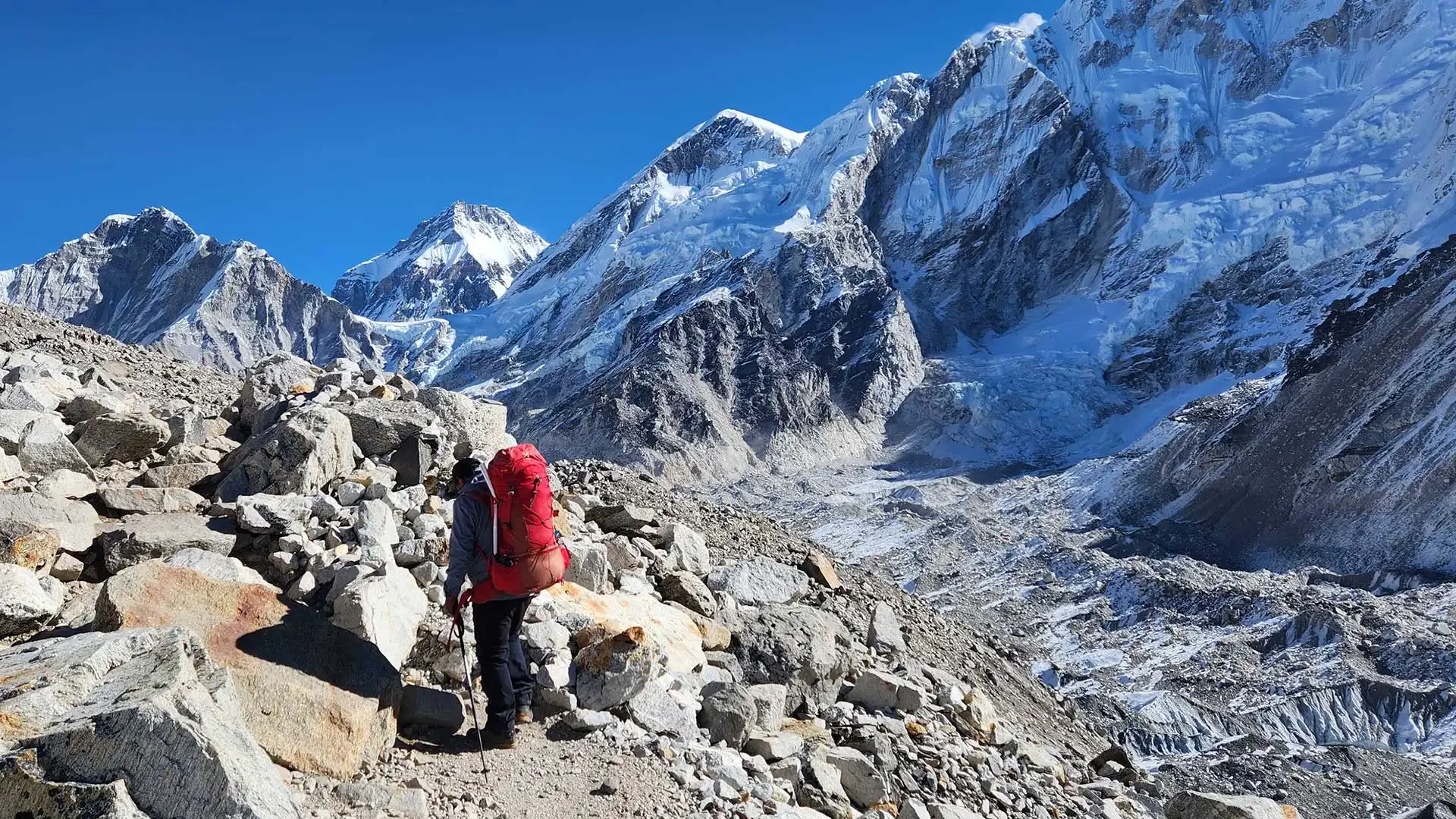
Everest Region · Challenging grade
Everest Base Camp Trek with Heli Return
The route
What the walk is.
The Everest Base Camp Trek with Heli Return combines the classic Himalayan trekking experience with a spectacular helicopter return, allowing travelers to reach Everest Base Camp and avoid the long descent on foot.
Beginning from Lukla (2,860m), this 12-day adventure takes you deep into the Khumbu region, passing through traditional Sherpa villages, suspension bridges, and beautiful mountain landscapes. Along the way you will visit important landmarks such as Tengboche Monastery, one of the most spiritual locations in the Everest region.
The journey leads you to the legendary Everest Base Camp (5,364m), where climbers prepare their expeditions to the highest mountain on Earth. You will also hike to Kala Patthar (5,644m), the most famous viewpoint in the region, where trekkers witness one of the most breathtaking sunrise views over Mount Everest, along with the surrounding Himalayan giants.
After reaching your goal, the adventure continues with a thrilling helicopter flight from Gorakshep to Lukla, saving 3 to 4 days of walking on the descent. This scenic flight offers incredible aerial views of Mount Everest, Lhotse, Ama Dablam, and the entire Khumbu region, giving you a unique perspective of the mountains you have just explored on foot.
This trek is ideal for travelers who want the complete Everest Base Camp experience but have limited time, prefer to avoid the physical strain of the return trek, or simply wish to end their journey with an unforgettable luxury finale. The best seasons for this adventure are spring (March to May) and autumn (September to November), when the weather is stable and mountain views are at their best.
General Information
Detail | Information |
Region | Everest (Khumbu), Nepal |
Start Point | Lukla |
End Point | Helicopter from Gorakshep to Lukla |
Special Feature | Helicopter returns from high altitude |
The Everest Base Camp Trek with Heli Return offers a unique approach to the classic Everest adventure. You'll experience all the highlights of the traditional trek while enjoying the comfort and excitement of a helicopter return.
The Perfect Balance
This itinerary strikes the ideal balance between an authentic trekking experience and modern convenience. You'll walk every step to Everest Base Camp, earning your achievement through days of trekking, gradual acclimatization, and cultural immersion. The helicopter return simply replaces 3-4 days of retracing your steps, giving you more time without diminishing the accomplishment.
The Trekking Experience
Your journey follows the classic EBC route from Lukla. Trek through pine forests decorated with prayer flags, cross dramatic suspension bridges over the Dudh Koshi River, pass through Namche Bazaar (the vibrant Sherpa capital), visit Tengboche Monastery with its stunning mountain backdrop, acclimatize properly in Dingboche, push to Lobuche and Gorakshep at extreme altitude, reach Everest Base Camp (5,364m), and summit Kala Patthar (5,644m) for the ultimate sunrise view.
Each day brings new landscapes: from lush rhododendron forests at lower elevations to barren high-altitude terrain near base camp. You'll sleep in traditional teahouses, eat dal bhat with Sherpa families, and experience authentic mountain life.
The Helicopter Return
After summiting Kala Patthar and achieving your Everest Base Camp goal, the adventure takes a luxurious turn. Instead of trekking 3-4 days back to Lukla, you'll board a helicopter at Gorakshep (5,140m) for a spectacular flight.
The helicopter journey offers:
Aerial perspectives of Mount Everest, Lhotse, Nuptse, and Ama Dablam
Bird's-eye views of the Khumbu Icefall and glacier
Unique perspective of the trail you trekked
15-20 minute flight versus 3-4 days walking
Time saved for Kathmandu exploration or other adventures
Rest for tired legs after days at altitude
Thrilling conclusion to your Everest experience
Who Is This Trek For?
This unique combination suits time-conscious professionals with only 12 days available, trekkers wanting the full EBC experience without long descent, those with knee concerns about downhill trekking, adventurers seeking a luxury element, people who want aerial Himalayan photography, anyone wanting to maximize Kathmandu exploration time, and couples celebrating special occasions with a memorable finale.
Physical Requirements
Despite the helicopter return, the trek up requires the same fitness as the standard EBC trek. You'll still trek 8-9 days to reach Kala Patthar and Base Camp, spending multiple days above 4,000m. Good cardiovascular fitness, previous multi-day trekking experience (recommended), comfortable walking 5-7 hours daily, ability to handle altitude up to 5,644m, and mental preparation for high-altitude challenges are essential.
Value Proposition
While the helicopter adds cost, consider what you gain: 3-4 extra days available for other activities, reduced physical strain on descent, spectacular aerial views (a separate heli tour would cost $1,000-1,500), unique perspective few trekkers experience, arrival in Lukla/Kathmandu refreshed rather than exhausted, and once-in-a-lifetime conclusion to your adventure.
Why Nepal Visuals is the Right Choice for EBC with Helicopter Return
Your Safety Comes First: Our certified local guides are experts in high-altitude logistics and first aid. They monitor your health daily and coordinate seamlessly with helicopter pilots to ensure a safe, swift transition from the trail to the sky.
Clarity Over Confusion: We provide a detailed online briefing specifically for the helicopter return trek. From luggage weight limits for the flight to the specific landing zones, you’ll know exactly how your journey transitions from trekking to flying.
No Hidden Costs: Our pricing is fully transparent and inclusive of the helicopter charter fees. We clearly outline permits, transport, and mountain accommodations so you won't face any unexpected surcharges for your luxury flight back.
Stress-Free Logistics: We handle the complex coordination of flight manifests and mountain weather windows. While we manage the permits, teahouse bookings, and helicopter scheduling, you can focus entirely on the trek and the stunning aerial views.
Travel Light, Store Safe: Since helicopters have strict weight limits, you can leave your non-trekking luggage with us in Kathmandu at no extra cost.
Day by day
Where you sleep, night by night.
Kathmandu → Kathmandu · highest point 5,545 m
- Day 01Kathmandu 3 Star hotel · Food; Welcome Dinner1,400 m
Welcome to Nepal! A representative from Nepal Visuals greets you at Tribhuvan International Airport and escorts you to your hotel in Thamel — a colourful maze of gear shops, trekking cafes, and cultural curiosities. Welcome briefing with your guide over a traditional dinner this evening.
- Day 02Kathmandu 3 Star hotel · Breakfast, Dinner1,400 m
A day to explore Kathmandu Valley before heading into the mountains. Visit Pashupatinath Temple, Boudhanath Stupa, and Swayambhunath (the Monkey Temple). Afternoon gear check with your guide — poles, layers, boots. Evening briefing on the trek ahead.
- Day 03sleep 2,610 m · Lodge / Tea House (Twin Sharing) · Breakfast, Lunch, Dinner2,860 m
Early morning flight from Kathmandu (or Ramechhap during peak season) to Lukla. Trek immediately through pine forest and suspension bridges to Phakding along the Dudh Kosi River. The mountain atmosphere begins the moment you land.
- Day 04Lodge / Tea House (Twin Sharing) · Breakfast, Lunch, Dinner3,440 m
Cross the iconic Hillary Suspension Bridge and climb the steep switchbacks into Namche Bazaar. Pass through Sagarmatha National Park entrance where permits are checked. On a clear morning, Everest appears for the first time through a gap in the ridge.
- Day 05sleep 3,440 m · Lodge / Tea House (Twin Sharing) · Breakfast, Lunch, Dinner3,860 m
Your journey continues as you trek to Tengboche, a beautiful village known for its iconic monastery. This 5-6 hour hike takes you through pine forests with views of Ama Dablam, Everest, and Lhotse. Upon arrival, the serene Tengboche Monastery offers a peaceful sanctuary for reflection. A day where physical challenge meets spiritual reward.
- Day 06sleep 3,860 m · Lodge / Tea House (Twin Sharing) · Breakfast, Lunch, Dinner4,410 m
On this day, you make your way to Dingboche, a 4-5 hour trek deeper into the Khumbu region. Pass through Pangboche village and experience the simplicity and warmth of Sherpa life. As you approach Dingboche the landscape becomes more rugged with snow-capped peaks rising in the distance — a perfect spot to rest and acclimatise.
- Day 07Rest day · Lodge / Tea House (Twin Sharing) · Breakfast, Lunch, Dinner5,083 m
A critical rest day. Hike steeply to Nangkartshang Peak for views of Makalu, Cho Oyu, Island Peak, and the Lhotse face. Your body is building red blood cells invisibly. Return to Dingboche for afternoon rest. Pace yourself — the summit push begins tomorrow.
- Day 08Lodge / Tea House (Twin Sharing) · Breakfast, Lunch, Dinner4,940 m
Trek through the Khumbu glacier lateral moraine, pausing at the Thukla Pass memorials — stone cairns for climbers lost on Everest. The air thins perceptibly. Lobuche sits at the edge of the glacier, small and spare, with enormous mountains all around.
- Day 09sleep 5,140 m · Lodge / Tea House (Twin Sharing) · Breakfast, Lunch, Dinner5,364 m
This is the pinnacle of your trek. Set off from Lobuche and make your way to Everest Base Camp, a 5-6 hour trek through rocky terrain with unparalleled views of the Khumbu Icefall and surrounding peaks. Reaching EBC is a moment of triumph — stand in awe of the world highest mountain. Return to Gorak Shep for dinner.
- Day 10Highest point · Hotel (Twin Sharing) · Breakfast, Lunch, Dinner5,545 m
Wake at 4 AM. Headtorch on. Climb Kala Patthar in the dark for the finest Everest sunrise view on Earth — the South Face lit gold, Lhotse and Nuptse flanking it like sentries. After soaking in the panorama, descend to Gorak Shep where your helicopter awaits. A breathtaking flight over the Khumbu Glacier back to Kathmandu — touch down in the city by midday. The contrast is surreal.
- Day 11Hotel (Twin Sharing) · Breakfast, Dinner1,400 m
A free day to explore Kathmandu at your own pace. Recommended: Pashupatinath Temple, Boudhanath Stupa, Swayambhunath, and the vibrant Thamel district. Celebrate your EBC achievement over a farewell dinner with your guide this evening.
- Day 12Breakfast1,400 m
Our representative transfers you to Tribhuvan International Airport in time for your onward flight. You flew in — and flew out over Everest. Carry those mountains with you always.
Fixed departures
12 group dates open.
144 places across them. Or start on any flexible date in the calendar below.
| Departure | Booked | Filling | Left | Status | Book |
|---|---|---|---|---|---|
| Sat, Mar 6, 2027 | 0/12 | 12 | Available | ||
| Sat, Mar 20, 2027 | 0/12 | 12 | Available | ||
| Sat, Apr 3, 2027 | 0/12 | 12 | Available | ||
| Sat, Apr 17, 2027 | 0/12 | 12 | Available | ||
| Sat, May 1, 2027 | 0/12 | 12 | Available | ||
| Sat, May 15, 2027 | 0/12 | 12 | Available | ||
| Sat, Sep 4, 2027 | 0/12 | 12 | Available | ||
| Sat, Sep 18, 2027 | 0/12 | 12 | Available | ||
| Sat, Oct 2, 2027 | 0/12 | 12 | Available | ||
| Sat, Oct 16, 2027 | 0/12 | 12 | Available | ||
| Sat, Nov 6, 2027 | 0/12 | 12 | Available | ||
| Sat, Nov 20, 2027 | 0/12 | 12 | Available |
Prices are per person, twin share, in USD. Book with a 20 % deposit — the balance is due 7 days before departure. Scheduled departures show places left; flexible departures can be booked on any listed start date. Booking terms
| Su | Mo | Tu | We | Th | Fr | Sa |
|---|---|---|---|---|---|---|
| 1 | 2 | 3 | ||||
| 4 | 5 | 6 | 7 | 8 | 9 | 10 |
| 11 | 12 | 13 | 14 | 15 | 16 | 17 |
| 18 | 19 | 20 | 21 | 22 | 24 | |
| 25 | 26 | 28 | 29 | 30 |
- Selected trip dates
- Available
- Filling fast
- Almost sold out
- Sold out
Fri, Oct 23Tue, Nov 3, 2026
12 days · flexible departure
- StartsFri, Oct 23, 2026 · Kathmandu
- EndsTue, Nov 3, 2026 · Kathmandu
USD $2,400 per person, twin share · Deposit today USD $480 (20 %)
On the trail
Photographs from the route.
The whole number
What the price covers.
18 things are in the price and 12 more are named as excluded.
In the price
Flights and Transportation
- ✓Tourist vehicle transport for all international and domestic airport transfers.
- ✓Kathmandu/Manthali to Lukla round trip air tickets.
- ✓Shared Tourist Bus/Jeep transport for the Kathmandu - Manthali - Kathmandu route.
- ✓Gorakshep to Lukla Helicopter flight.
Meals & Accommodations
- ✓A full-service welcome dinner at a traditional Nepali restaurant to start your journey.
- ✓3-star hotel in Kathmandu (Days 1 and 11, twin-sharing)
- ✓All trek meals (B/L/D)
- ✓Best available teahouses (twin-sharing)
Porters & Guides
- ✓Government-certified English-speaking guide
- ✓Porters (1 for 2 trekkers, 10kg limit per person)
- ✓All guide and porter wages, meals, accommodation, and insurance
First-aid & Emergency
- ✓First aid kit and oximeter (twice daily monitoring)
- ✓Emergency helicopter evacuation arrangement
Gears, Permits, & Certificates
- ✓Duffel bag and trekking poles
- ✓Free luggage storage in Kathmandu
- ✓Sagarmatha National Park permit
- ✓Khumbu Rural Municipality permit
- ✓Trek completion certificate
Not included
Travel, Insurance, & Emergencies
- ×Nepal Entry Visa and Visa extension fees (USD 50 for 30 days visa and USD 125 for 90 days visa, you can get visa upon your arrival at Tribhuvan International Airport, Kathmandu).
- ×Travel and Medical Insurance of up to 6,000m (Compulsory).
- ×Charges for emergency rescue or evacuation by helicopter, if needed.
- ×International flight fare and airport departure tax.
Meals & Accommodations
- ×Main meals (lunch and dinner) in Kathmandu.
- ×Other charges at lodges/tea houses such as showers, internet access, battery re-charging, hot water and extra hot drink.
- ×Alcoholic and non-alcoholic drinks.
- ×Any additional night’s accommodation in Kathmandu owing to early arrivals, late departures, or early returns from the trek (for any reason) than the scheduled itinerary.
- ×Extra baggage charges.
Personal & Extra Charges
- ×Alcoholic and non-alcoholic drinks.
- ×Tips for the guides and porters.
- ×Any expenses other than the Price Inclusion Section.
Challenging grade
Is this trek right for you?
You can do this if…
- ✓Walk 6–8 hours a day comfortably
- ✓Carry an 8–10 kg daypack
- ✓Manage long ascents and nights above 4,000 m
Recommended preparation
- ✓3+ months of cardio and leg-strength training
- ✓Back-to-back day hikes with a loaded pack
- ✓Check the itinerary for high passes or glacier days
Experience & support
- ✓Previous multi-day trekking recommended
- ✓Guided throughout — a licensed guide is required on Nepal treks
- ✓Unsure about age, health or fitness? Ask us — we tailor the pace
About three months out? Follow our free 12-week trek fitness plan.
Good to know
Additional information.
Accommodation and Meals
Kathmandu (Days 1, 11)
3-star hotel with private bathroom, hot shower, WiFi, breakfast included. Comfortable modern amenities after/before trek.
Trekking Route (Days 2-10)
Phakding to Namche: Good teahouses, Western toilets available, hot showers ($3-5), WiFi in most lodges
Namche Bazaar: Best facilities on route, some attached bathrooms, reliable hot water, bakeries, restaurants, WiFi, ATM (last until Kathmandu)
Tengboche to Dingboche: Standard mountain lodges, shared bathrooms, basic but clean, dining rooms with stoves
Lobuche to Gorakshep: Very basic, extremely cold, minimal facilities, shared toilets, heating limited to dining areas
Meals
Menu Variety: Dal bhat (unlimited refills, most nutritious), noodles, fried rice, pasta, momos, eggs, pancakes, porridge, soups (garlic soup helps altitude)
Food Quality: Fresh and safe at lower elevations, more limited at higher altitudes. Stick to cooked hot food.
Prices: Increase with altitude. Dal bhat NPR 400-600 at Phakding, NPR 1,000-1,200 at Gorakshep.
Special Note: Helicopter day breakfast at Gorakshep before flight. Early departure (5 AM for Kala Patthar), breakfast around 8-9 AM, flight typically 10 AM-12 PM depending on weather.
Trek Difficulty
Rating: Challenging
Trekking Demands:
The trek to Base Camp and Kala Patthar requires the same fitness and preparation as the standard EBC trek. You'll trek 8-9 days, spend multiple nights above 4,000m, reach maximum altitude of 5,644m, and walk 5-7 hours daily.
Physical Requirements:
Good cardiovascular fitness, strong legs for uphill (descent is eliminated), previous multi-day trekking helpful, comfortable carrying 5-7kg daypack, ability to handle altitude.
Altitude Considerations:
Two acclimatization days built in (Namche, Dingboche). Proper pacing essential. Days 8-10 all above 4,900m. Kala Patthar at 5,644m is extreme altitude.
The Helicopter Advantage:
The heli return eliminates 3-4 days of knee-straining descent, reduces cumulative fatigue, prevents overuse injuries common on long descents, and arrives in Lukla/Kathmandu less exhausted.
Preparation:
Start training 2-3 months before. Focus on cardio (running, cycling, swimming 3-4x weekly), long hikes building to 6-7 hours, leg strengthening (squats, lunges, stairs), altitude training if possible (not essential).
Success Rate: 90%+ for properly acclimatized trekkers. Helicopter return doesn't affect success rate (you still need to reach Gorakshep/Kala Patthar).
Altitude Sickness
Risk Level: Same as standard EBC trek for ascent. Helicopter return doesn't increase risk.
Prevention:
Two acclimatization days (Namche, Dingboche) are built in. Additional strategies: hydrate 3-4 liters daily, gradual ascent following itinerary, "climb high, sleep low" principle, proper rest, Diamox medication (consult doctor), listen to your body.
Symptoms:
Mild (Common): Headache, slight nausea, fatigue, difficulty sleeping
Moderate: Persistent headache, vomiting, marked fatigue
Severe (Rare): Confusion, loss of coordination, breathlessness at rest
Management:
Guides monitor twice daily with oximeters. If symptoms worsen: rest at current altitude, do not ascend, consider descent if moderate, immediate descent if severe.
Helicopter Advantage:
If severe altitude sickness occurs at Gorakshep or higher, the scheduled helicopter provides immediate descent option. This is a significant safety advantage over standard trek where descent takes 2-3 days.
Before you book
Questions we get most.
Difficulty & Physical Prep
Do I need previous high-altitude trekking experience?
Not necessarily, but it helps. If you are a beginner, you should be able to walk 5–7 hours a day with a light daypack. Cardiovascular training (running or stair climbing),2–3 months prior is highly recommended.
What is the "Khumbu Cough" and how do I avoid it?
It is a dry, persistent cough caused by breathing freezing, thin, and dry mountain air. To prevent it, wear a buff or neck gaiter over your mouth and nose to warm the air before it hits your lungs.
How difficult is the EBC trek if I’m flying back by helicopter?
The "up" part is still a moderate-to-strenuous challenge. You’ll be trekking for 8-9 days straight, gaining significant altitude. The helicopter return only removes the descent; it doesn’t make the climb to 5,364m any less real.
Accommodation & Hygiene
What are the teahouses like?
Teahouses are basic mountain lodges. Expect twin-sharing rooms with two single beds. While the common dining area is usually heated by a central stove, the bedrooms are unheated and can get very cold at night.
What about the toilet and shower situation?
Lower down (Namche Bazaar), you’ll find Western-style toilets. Higher up (Gorak Shep), toilets are often shared "squat" styles. Hot showers are available for a fee ($3–$7), but many trekkers use wet wipes at high altitudes to avoid catching a cold.
Do I need to bring my own toilet paper and soap?
Yes. Teahouses do not provide toiletries. Pack 2–3 rolls of biodegradable toilet paper and hand sanitizer. You can buy paper on the trail, but the price doubles with every 500m of elevation gain.
Food & Water
What kind of food will I eat?
The staple is Dal Bhat (lentils and rice). It is nutritious and comes with free refills. You’ll also find pasta, pancakes, and "Sherpa Stew."
Is it safe to eat meat on the trail?
The rule of thumb: Avoid meat above Namche Bazaar. Since meat is carried up by porters or yaks without refrigeration, the risk of food poisoning is high. Stick to vegetarian options.
Can I get caffeine or alcohol on the trek?
Tea and coffee are everywhere, but avoid alcohol entirely until your trek is over. Alcohol dehydrates you and can mask symptoms of altitude sickness. Save the "Everest Beer" for the final night!
Clothing & Gear
What is the most essential piece of gear?
A well-broken-in pair of trekking boots. Never show up with brand-new boots, or blisters will likely end your trek by Day 3.
Do I need a sleeping bag if I’m staying in lodges?
Yes. While lodges provide blankets, they aren't enough for $-10$°C to $-15$°C nights. A 4-season sleeping bag is essential (most agencies allow you to rent these in Kathmandu for $1–$3/day).
Can I rent all my gear in Kathmandu?
You can rent down jackets, sleeping bags, and poles in Thamel very cheaply. However, you should always bring your own boots and thermal base layers for hygiene and fit.
Electronics & Connectivity
Is there Wi-Fi and electricity to charge my devices?
Yes, for a fee. Most teahouses charge $2–$5 to charge a phone. For Wi-Fi, you can buy "Everest Link" prepaid cards (around $20 for 10GB–20GB), though the signal is inconsistent at higher altitudes.
Will my power bank work in the extreme cold?
Batteries drain significantly faster in sub-zero temps. Keep your phone and power bank inside your sleeping bag at night and in an inner jacket pocket during the day to keep them warm.
Guides & Support Staff
Is a guide mandatory for this trek?
As of 2023, the Nepal government strongly recommends and in some cases requires trekkers in most regions to hire a licensed guide. For EBC, it is not absolutely compulsory, but having a guide is not just about the law; it is about safety, navigation, and bridge-building with local teahouses.
How much should I tip my guide and porter?
Tipping is standard. For a 12-day trek, a common tip is roughly $150–$200 for the guide and $80–$120 for the porter. Since you fly back by heli, settle these tips before boarding, as your porter will walk back down.
The Helicopter Experience
Where does the helicopter pick me up?
Usually from Gorak Shep (5,164m) or Pheriche, right after you visit Base Camp and Kala Patthar. This saves you from the grueling 3-4 day walk back to Lukla.
What is the weight limit for the helicopter?
Most shared helicopters have a strict weight limit of 10–15 kg (22–33 lbs) for your trekking duffel. Weight management is crucial at high altitudes where lift is limited.
Health, Safety & Logistics
How do you handle Altitude Sickness (AMS)?
The 12-day itinerary includes "acclimatization days" in Namche and Dingboche. Walk slow (Bistarai, Bistarai), stay hydrated, and alert your guide immediately if you have a persistent headache.
Is travel insurance mandatory?
Absolutely. Ensure your policy specifically covers "High Altitude Trekking up to 6,000m" and "Emergency Helicopter Evacuation." Without this, a rescue can cost upwards of $5,000.
What permits do I need in 2026?
You need the Khumbu Pasang Lhamu Rural Municipality Permit (NPR 3,000) and the Sagarmatha National Park Entry Permit (NPR 3,000). Total permit costs are roughly $45–$50 USD.
Views & Photography
Where is the best spot for the "Ultimate Everest Photo"?
The best view is from the top of Kala Patthar (5,545m). You’ll usually hike this at sunrise on the morning of your helicopter return for a panoramic 360-degree view of Everest and the Khumbu Icefall.
Why do photographers prefer sunset at Kala Patthar over sunrise?
Since the sun rises behind Everest, the mountain is often in shadow during the early morning. At sunset, the "Alpenglow" hits Everest directly, turning the peak a brilliant gold and orange. If you want the best lighting for the peak itself, go at sunset.
Is it possible to see the Milky Way from the trail?
Yes! Because of the lack of light pollution, places like Gorak Shep and Lobuche offer incredible astrophotography opportunities. Just remember to bring a lightweight tripod and keep your batteries warm in your pocket until the moment you shoot.
Can I use a drone to capture the mountains?
Drones are strictly regulated in the Sagarmatha National Park. You need specific permits from the Civil Aviation Authority of Nepal (CAAN) and the Department of National Parks. Most recreational trekkers find the paperwork too difficult and fly without them to avoid heavy fines or equipment confiscation.
Still have a question? WhatsApp us →