 Nepal Visuals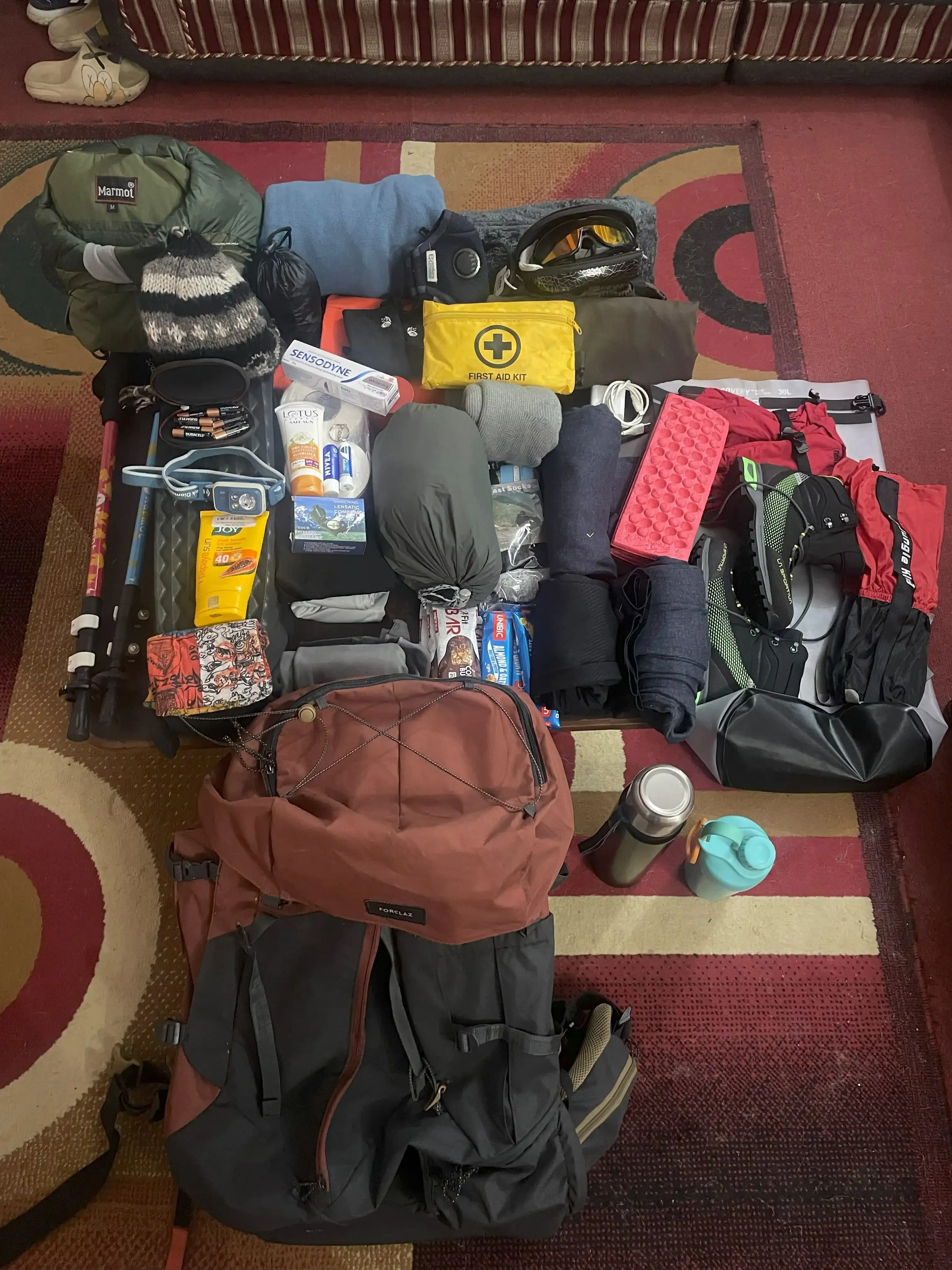
Conquering Everest Base Camp requires more than just grit; it requires the right gear. From moisture-wicking layers to broken-in boots, our definitive checklist ensures you’re prepared for every high-altitude challenge ahead.
On this page(9)
There is a version of the EBC Trek where your pack is too heavy, your boots give you blisters on day two, and you spend every cold night wishing you had brought a better sleeping bag.
There is another version where your pack sits comfortably on your shoulders, your feet feel good after eight hours of walking, and you sleep warm at Gorak Shep while the temperature outside drops to minus fifteen.
The difference between those two experiences often comes down to one thing: how well you packed before you left home.
The Everest Base Camp Trek covers 130 kilometers of high-altitude terrain across 12 to 14 days. Temperatures range from a pleasant 15 degrees Celsius on a sunny afternoon below Namche to minus 20 degrees Celsius before dawn on Kala Patthar. The altitude climbs from 2,845 meters at Lukla to 5,545 meters at the summit of Kala Patthar.
No single packing decision matters more than having the right gear for that range of conditions.
This guide gives you the complete, honest, experience-based packing list for the EBC Trek, with clear explanations for why each item matters and practical advice on exactly what to look for.
Before You Start Packing: The Core Principles
Pack Light, But Pack Right
Every extra kilogram in your pack is felt acutely above 4,000 meters.
At sea level, an extra two kilograms in your bag is an inconvenience. At 5,000 meters, where your body is already working significantly harder to extract oxygen from thin air, that same two kilograms becomes a genuine physical burden.
The goal is not to pack as little as possible. It is to pack exactly what you need and nothing more.
Every item on this list earns its place. Everything else stays home.
The Lukla Flight Weight Limit
There is a practical reason to pack light beyond comfort.
The Kathmandu to Lukla flight operates on small aircraft with strict luggage limits. Most airlines on this route allow 15 kilograms of checked luggage and 5 kilograms of carry-on per person.
Your porter will carry a duffel bag of up to 10 to 15 kilograms (as regulated by Nepal's porter welfare guidelines). Your daypack, carried by you, should stay under 8 to 10 kilograms.
Plan your packing around these numbers from the start.
The Layering Principle
The most important concept in high-altitude dressing is layering.
You will experience a 3,000-meter altitude variation between Lukla and Kala Patthar. A warm teahouse meal in Namche at midday can be followed by a freezing wind on an exposed ridge two hours later.
The layering system, three distinct layers working together, is what allows you to manage this range efficiently.
Each layer has a specific function. Understood and used correctly, they cover virtually every condition you will encounter on the trail.
Clothing: The Complete EBC Layering System
Base Layer: Your Foundation
The base layer is the clothing that sits directly against your skin. Its job is to manage moisture by pulling sweat away from your body and allowing it to evaporate.
This matters enormously on the EBC Trek. If your base layer holds moisture against your skin, you will feel cold, uncomfortable, and smelly within hours of starting to walk.
Fabric matters more than anything else at this layer.
Merino wool is the gold standard for base layer fabric on high-altitude treks. It wicks moisture efficiently, regulates temperature remarkably well in both warm and cold conditions, resists odor far better than synthetic fabrics, and remains comfortable against the skin even after multiple days of use.
Polyester is a good and more affordable alternative. It wicks moisture well and dries quickly, though it does not manage odor as effectively as merino wool.
Avoid cotton at every layer, but especially the base layer. Cotton absorbs moisture, holds it against your skin, dries extremely slowly, and will leave you cold and uncomfortable on any day that involves significant exertion or changing weather.
What to pack:
2 to 3 moisture-wicking trekking t-shirts (merino wool or polyester)
1 long-sleeve moisture-wicking base layer top for cooler days and evenings
1 pair of thermal base layer bottoms for cold nights and the early morning Kala Patthar ascent
The thermal base layers are most needed for the upper section of the trek from Dingboche upward and for the pre-dawn climb to Kala Patthar, which is done in darkness at approximately 5,000 meters before the sun rises.
Mid Layer: Your Insulation
The mid layer sits over your base layer and provides thermal insulation. Its job is to trap warm air close to your body and keep the cold out.
Fleece jacket: A good-quality fleece jacket is one of the most versatile items in your pack for the EBC Trek. It provides warmth for cool evenings and cold mornings at lower elevations, layers effectively under your outer shell in mixed conditions, and is light enough to carry without significant pack weight.
Choose a polyester fleece with a full-length zip so you can regulate temperature easily while walking. A half-zip works but gives you less ventilation control.
Down jacket: A high-quality down jacket is essential from Dingboche upward and critical at Lobuche, Gorak Shep, and on the Kala Patthar ascent.
Down provides the best warmth-to-weight ratio of any insulation material available and packs down small for easy storage in your daypack when the temperature rises.
Look for a jacket with a minimum fill power of 600 (700 or 800 fill power is better) and a water-resistant outer shell. Wet down loses its insulating properties rapidly, and the Khumbu weather can bring unexpected rain or snow at any time.
At Gorak Shep and on Kala Patthar before dawn, you will be very grateful for a good down jacket.
What to pack:
1 fleece jacket (full-zip, polyester)
1 high-quality down jacket (600 fill power minimum, water-resistant shell)
Outer Layer: Your Shield
The outer layer is your protection against wind, rain, and snow. Its job is to block external weather without trapping moisture generated by your body heat.
This is the layer that separates comfortable trekking from genuinely miserable trekking on a wet, windy day on an exposed ridge.
The single most important quality in an outer layer is breathability. A jacket that keeps rain out but traps your body heat and sweat inside will leave you just as wet and cold as one that lets the rain in.
Gore-Tex is the most widely trusted waterproof breathable fabric technology available and the one most experienced guides and trekkers recommend for the EBC Trek. It provides excellent waterproofing, wind resistance, and breathability in a single layer.
Invest in a quality Gore-Tex or equivalent waterproof-breathable jacket. This is not the place to cut costs.
What to pack:
1 waterproof and windproof shell jacket (Gore-Tex or equivalent strongly recommended)
1 pair of waterproof trekking pants (Gore-Tex or equivalent)
The waterproof pants are used less frequently than the jacket but are invaluable on wet descent days and in snowy conditions above 4,000 meters.
Trekking Pants and Shorts
Your main trekking pants should be lightweight, durable, and quick-drying.
Softshell trekking pants are a popular choice because they provide some wind and light weather resistance while remaining comfortable and breathable during active walking.
Zip-off convertible pants that convert to shorts are a practical option for the lower sections of the trail where temperatures are warmer.
What to pack:
2 pairs of trekking pants (one can be zip-off convertible for versatility)
1 pair of lightweight trekking shorts (optional, useful at lower elevations in warm weather)
Underwear
Do not underestimate the importance of good underwear on a 12-day trek.
Moisture-wicking sports underwear in merino wool or polyester is essential. Cheap cotton underwear will cause chafing and discomfort within the first two days.
Choose underwear you have worn before and know to be comfortable for extended periods. New underwear can cause irritation on long days of walking that becomes progressively worse.
What to pack:
5 pairs of moisture-wicking sports underwear (merino wool or polyester)
2 sports bras for women (moisture-wicking, non-underwire for comfort during active walking)
Headwear
Sun hat or cap: UV radiation increases by approximately 10 percent for every 1,000 meters of elevation gain. At 5,000 meters you are receiving roughly twice the UV exposure you would at sea level. A wide-brim hat or a good baseball cap with neck coverage is essential for daytime walking at all elevations.
Warm beanie: A good beanie that covers your ears is essential for cold mornings, cool evenings, and the pre-dawn Kala Patthar ascent. Choose one made from fleece or merino wool that fits snugly without being uncomfortably tight.
Neck gaiter or buff: This is one of the most underrated items on the entire packing list. A neck gaiter or buff protects your face and neck from cold wind, dusty trail sections, and the Khumbu cough, a dry, persistent cough caused by breathing cold dry air at altitude that affects many trekkers. It weighs almost nothing and takes up virtually no space.
What to pack:
1 wide-brim sun hat or baseball cap
1 warm beanie (fleece or merino wool)
1 neck gaiter or buff
Gloves
Your hands are exposed and vulnerable on the EBC Trek, particularly on early morning walking days and on the pre-dawn Kala Patthar ascent.
A two-glove system gives you the flexibility to manage a wide range of temperatures.
Inner gloves: Thin liner gloves in merino wool or synthetic fabric. These are worn during moderate cold conditions and can be used while operating trekking poles, taking photos, or using your phone. They weigh almost nothing and add significant warmth.
Insulated outer gloves: A warm, waterproof, insulated pair of gloves for cold mornings, high altitude, and the Kala Patthar ascent. These should be genuinely warm, not just wind-resistant. Mittens are warmer than gloves and are a good option for the coldest conditions, though they reduce dexterity.
What to pack:
1 pair of thin merino wool or synthetic liner gloves
1 pair of warm waterproof insulated gloves or mittens
Footwear: The Most Important Gear Decision You Will Make
Trekking Boots
There is no single piece of gear more important to your EBC Trek experience than your boots.
Your feet will carry you across approximately 130 kilometers of rocky, uneven, often steep trail over 12 to 14 days. The right boots make that possible. The wrong boots make every day more difficult than it needs to be.
Waterproofing is essential. The trail crosses rivers and stream crossings, passes through sections of snow above 4,500 meters, and encounters rain at lower elevations. Boots that soak through leave you walking in wet, cold socks for hours.
Ankle support is important on the rocky moraine sections of the upper trail, particularly between Lobuche and Gorak Shep and on the approach to Everest Base Camp. A mid-height or high-cut boot provides the lateral support that prevents ankle sprains on uneven terrain.
Sole grip matters on the descent sections, which are often more demanding on your feet and joints than the ascents. A boot with a good Vibram or equivalent rubber sole provides the traction needed on rocky and occasionally icy trail sections.
The most important rule: break your boots in before you arrive.
New boots cause blisters. Blisters at altitude are painful, slow you down, and can turn a great trek into a miserable one. Wear your boots on multiple long walks in the weeks before departure. Walk on trails, on hills, with a loaded pack. Get them properly fitted to your feet before you ever set foot in Nepal.
The fit check: when properly laced, you should be able to fit one finger behind your heel with your foot pushed forward. This prevents your toes from hitting the front of the boot on long descents.
What to pack:
1 pair of waterproof mid-height or high-cut trekking boots, properly broken in
Camp Shoes or Sandals
Your feet need relief from your trekking boots at the end of each day.
After seven hours of walking in boots, stepping into a pair of lightweight sandals or Crocs at the teahouse is one of the simplest pleasures of the entire trek.
Camp shoes also allow your boots to air out overnight, which reduces moisture buildup and the development of odor.
What to pack:
1 pair of lightweight sandals or camp shoes (Crocs, trekking sandals, or similar)
Hiking Socks
Good socks are the most underappreciated item on the entire packing list.
Merino wool hiking socks are the standard recommendation and for very good reason. They provide cushioning and support, wick moisture efficiently, insulate even when slightly damp, and resist odor far better than synthetic alternatives.
Bring enough pairs to change into fresh socks every day. Wet socks cause blisters. Wearing socks for multiple consecutive days without washing causes both odor and skin problems.
What to pack:
5 to 6 pairs of merino wool hiking socks in medium or heavy weight
1 to 2 pairs of warm thermal socks for cold nights at Lobuche and Gorak Shep
Trekking Gear: Equipment That Makes the Difference
Backpack (Daypack)
Your daypack is the bag you carry yourself every day while your porter carries your main duffel.
A 30 to 40-liter pack is the right size for the EBC Trek. Large enough to carry your daily essentials comfortably, small enough to stay manageable at altitude.
Key features to look for: a comfortable back panel with good lumbar support, padded and adjustable shoulder straps, a hip belt to distribute weight off your shoulders and onto your hips, a hydration sleeve or side pockets for water bottle access, and a rain cover.
The hip belt is especially important. Transferring pack weight to your hips rather than your shoulders significantly reduces upper body fatigue on long days.
What to pack:
1 daypack of 30 to 40 liters with hip belt and rain cover
Main Duffel Bag
Your main duffel bag is carried by your porter throughout the trek.
It should be a sturdy, cylindrical duffel of approximately 80 to 100 liters with lockable zippers.
Most reputable trekking agencies including Nepal Visuals provide a porter duffel bag as part of the service, so confirm with your agency whether you need to bring your own.
The government-regulated maximum weight for a porter's load is 25 to 30 kilograms (including the bag itself), but most responsible agencies set a lower limit of 10 to 15 kilograms to protect their porters' health. Respect this limit.
Trekking Poles
Trekking poles are one of the most genuinely useful pieces of gear on the EBC Trek.
On ascents, they provide extra points of contact with the ground and help drive you upward on steep sections.
On descents, they are invaluable. The steep rocky descents between Kala Patthar and Pheriche and on the return from Lobuche are significantly harder on your knees without poles. Studies consistently show that trekking poles reduce compressive force on the knee joints by 25 percent or more during downhill walking.
Adjustable telescoping poles that collapse for storage are practical for the Lukla flight and for sections where the trail is wide and flat enough to walk without poles.
Carbide tips provide the best grip on rocky terrain.
What to pack:
1 pair of adjustable trekking poles with carbide tips and wrist straps
Sleeping Bag
Your sleeping bag is the single most important factor in the quality of your sleep from Dingboche upward.
Teahouse blankets exist at every stop, but they are not reliable above 4,000 meters, where nighttime temperatures regularly drop below freezing. At Lobuche and Gorak Shep, temperatures inside rooms can drop well below zero.
A sleeping bag rated to -15 degrees Celsius comfort rating is the appropriate choice for the upper EBC route.
If you are trekking in winter or shoulder season, or if you run cold naturally, consider a bag rated to -20 degrees Celsius.
Down sleeping bags provide the best warmth-to-weight and warmth-to-pack-size ratio. A synthetic fill bag is a good alternative for trekkers who expect wet conditions, as synthetic insulation retains some warmth even when damp.
Sleeping bag liners add 3 to 5 degrees Celsius of warmth for very little additional weight and are worth considering as a supplemental option.
What to pack:
1 sleeping bag rated to -15 degrees Celsius comfort (down or synthetic)
1 lightweight sleeping bag liner (optional but recommended)
Headlamp
A headlamp is not optional on the EBC Trek.
The pre-dawn ascent of Kala Patthar begins well before sunrise, typically around 4 to 5 AM, when it is completely dark. Walking rocky mountain terrain in darkness without a headlamp is dangerous.
Headlamps are also useful for navigating teahouse corridors at night, reading in your room, and managing early morning departures.
Choose a headlamp with at least 200 lumens output, a red light mode to preserve night vision, and a reliable battery life.
Bring spare batteries or a USB-rechargeable model. Battery performance drops significantly in cold temperatures at altitude, and the last thing you want on the Kala Patthar ascent is a headlamp that dies halfway up.
What to pack:
1 headlamp (200 lumens minimum) with spare batteries or USB charging cable
Hydration System
Staying hydrated at altitude is one of the most important and most overlooked aspects of acclimatization.
You should be drinking three to four liters of water per day throughout the trek. At altitude, your body loses moisture through increased breathing rate alone, even before you factor in the physical exertion of walking.
Two 1-liter Nalgene water bottles are the most practical hydration solution for the EBC Trek. They are indestructible, work well in cold temperatures, and can hold boiled or purified water from teahouses.
Hydration bladders are popular but less practical at altitude because the drinking tube can freeze in cold conditions, particularly on the Kala Patthar ascent and on early morning walking days above 4,500 meters.
Water purification is essential. Tap water and stream water along the trail are not safe to drink untreated.
A SteriPen or Sawyer Squeeze filter is the most effective and environmentally responsible purification solution. Both eliminate bacteria, protozoa, and viruses from water in seconds without the waste of plastic bottles. Water purification tablets work as a reliable backup option.
Buying plastic water bottles at every teahouse is both expensive and environmentally damaging. The plastic waste problem in the Khumbu is serious. Use purification equipment.
What to pack:
2 x 1-liter Nalgene water bottles
1 SteriPen or Sawyer Squeeze filter (water purification tablets as backup)
Power Bank
Charging at teahouses costs $2 to $5 per device and is not always available above Dingboche.
A high-capacity power bank (20,000 mAh or more) can charge your phone four to six times and keep your camera battery topped up throughout the trek.
Cold temperatures reduce battery performance. Keep your power bank in an inner jacket pocket close to your body on cold mornings to maintain its efficiency.
What to pack:
1 high-capacity power bank (20,000 mAh recommended)
Charging cables for all your devices
Camera
The Khumbu region is one of the most photographed places on Earth, and for very good reason.
Use whatever camera you are comfortable with and know how to operate quickly. Fumbling with unfamiliar camera settings at minus fifteen degrees Celsius on Kala Patthar before sunrise is not the ideal photography experience.
A mirrorless or DSLR camera produces significantly better image quality than a smartphone at extreme conditions, particularly in the low pre-dawn light of the Kala Patthar sunrise.
A smartphone is perfectly capable of producing beautiful images and is far more convenient to carry and operate.
Bring at least one extra battery for your camera. Cold temperatures drain camera batteries faster than normal use, and the moments on Kala Patthar and at Base Camp are the ones you will most want to capture.
What to pack:
Camera of your choice with extra batteries and memory cards
Waterproof camera bag or dry bag for rain protection
Health, Safety, and Personal Items
First Aid Kit
Your first aid kit should be compact but complete.
What to include:
Blister treatment kit (Compeed blister plasters are the gold standard, pack at least ten)
Pain relief medication (ibuprofen and paracetamol)
Antiseptic wipes and small wound dressings
Bandages and medical tape
Rehydration salts (ORS sachets)
Anti-diarrheal medication (loperamide)
Antihistamine tablets
Personal prescription medications
Altitude sickness medication (Diamox / acetazolamide, prescribed by your doctor before departure)
A small pair of scissors and safety pins
Sunscreen and Lip Balm
UV radiation is significantly more intense at altitude than at sea level, increasing by approximately 10 percent per 1,000 meters.
At 5,000 meters, you are receiving roughly twice the UV exposure of sea level, and sunburn happens much faster than most people expect, even on overcast days.
Use SPF 50 or higher sunscreen on all exposed skin every day from Lukla onward. Reapply every two hours on long walking days.
Lips are particularly vulnerable at altitude. A lip balm with SPF protection prevents the painful cracking and peeling that affects many trekkers who neglect lip protection.
What to pack:
SPF 50 sunscreen (two tubes for a 14-day trek)
SPF lip balm (two sticks)
Sunglasses
UV-protective sunglasses are not optional on the EBC Trek. Snow blindness is a real and painful condition caused by UV damage to the cornea and is entirely preventable with proper eye protection.
Choose sunglasses with Category 3 or Category 4 UV protection and full coverage lenses that wrap around the side of the eyes. Category 4 is recommended for the upper sections of the route where snow and ice increase UV reflection.
Glacier glasses with side shields provide the maximum protection available and are recommended for the high sections above 4,500 meters.
What to pack:
1 pair of Category 3 or 4 UV-protective sunglasses with side coverage
Toiletries and Hygiene
Pack a minimal toiletries kit. Every gram counts.
What to include:
Biodegradable soap and shampoo (important for environmental reasons near water sources)
Quick-dry microfiber travel towel (small size, for use at teahouses where towels are not provided)
Toothbrush and toothpaste
Hand sanitizer (use before every meal and after every bathroom visit)
Wet wipes (invaluable for freshening up on days without shower access)
Toilet paper (not always reliably stocked at all teahouses)
Small personal hand sanitizer bottle for trail use
Female hygiene products as needed
Cash
There are no reliable ATMs above Namche Bazaar, and card payments are not accepted at most teahouses on the upper trail.
Withdraw sufficient Nepali rupees in Kathmandu or Namche before heading higher.
Budget approximately $40 to $60 USD per day equivalent in rupees for meals, accommodation extras, hot showers, device charging, water, Wi-Fi cards, and incidentals.
Carry a small emergency reserve of US dollars separately from your main cash, as USD is accepted at some establishments in Namche and occasionally higher on the trail.
Documents and Extras
Keep all documents in a waterproof document holder or dry bag.
What to carry:
Passport (original plus at least three photocopies)
Trek permits (Sagarmatha National Park and Khumbu Pasang Lhamu permits)
Travel insurance documents with emergency hotline number
Emergency contact information (written separately from your phone)
Several passport-sized photographs (for permit checkpoints and unexpected requirements)
High-energy snacks are worth packing even though food is available at every teahouse. Protein bars, dried fruit, nuts, and chocolate provide an accessible energy source on long exposed sections between teahouses and on the early morning Kala Patthar ascent when teahouses are not yet open.
Gear You Can Rent in Kathmandu
Several items on the EBC packing list are available for rental in Kathmandu's Thamel district at reasonable prices.
Sleeping bags, down jackets, trekking poles, and duffel bags are all commonly rented.
The important caveat is quality control. Rental gear in Thamel varies enormously in quality and condition, and it is not always possible to verify the fill power of a rental down jacket or the temperature rating of a rental sleeping bag.
For items where performance matters most (sleeping bag, boots, base layers), bring your own or purchase from a reputable supplier.
For items where quality is easier to verify in person (trekking poles, duffel bag), rental can be a practical and cost-effective option.
Do not rent boots. The importance of properly broken-in, well-fitting boots that you know and trust cannot be overstated. Rental boots are the single most common cause of blister problems on the EBC Trek.
The Complete EBC Packing Checklist
Clothing: 2 to 3 moisture-wicking trekking t-shirts 1 long-sleeve moisture-wicking base layer top 1 pair of thermal base layer bottoms 1 fleece jacket 1 high-quality down jacket 1 waterproof windproof shell jacket (Gore-Tex recommended) 1 pair of waterproof trekking pants 2 pairs of trekking pants 5 pairs of moisture-wicking sports underwear 2 sports bras (women) 1 wide-brim sun hat or cap 1 warm beanie 1 neck gaiter or buff 1 pair of thin liner gloves 1 pair of warm insulated waterproof gloves
Footwear: 1 pair of waterproof trekking boots (broken in) 1 pair of camp sandals or Crocs 5 to 6 pairs of merino wool hiking socks 1 to 2 pairs of warm thermal socks
Gear: 1 daypack of 30 to 40 liters with hip belt and rain cover 1 duffel bag (often provided by agency) 1 pair of adjustable trekking poles 1 sleeping bag rated to -15 degrees Celsius 1 sleeping bag liner 1 headlamp with spare batteries 2 x 1-liter Nalgene water bottles 1 SteriPen or Sawyer filter plus purification tablets 1 high-capacity power bank (20,000 mAh) Camera with extra batteries and memory cards
Health and Personal: First aid kit (blister treatment, pain relief, antiseptic, rehydration salts, anti-diarrheal, Diamox) SPF 50 sunscreen (two tubes) SPF lip balm (two sticks) Category 3 or 4 UV-protective sunglasses Biodegradable soap and shampoo Quick-dry microfiber travel towel Hand sanitizer Wet wipes Toilet paper Personal toiletries High-energy snacks
Documents: Passport plus photocopies Trek permits Travel insurance documents Emergency contacts (written) Passport photos Cash in Nepali rupees plus emergency USD reserve
Final Packing Advice
Pack your bag at least a week before departure and wear it on a long walk.
If it feels too heavy or the fit is wrong, you still have time to adjust. A bag that causes shoulder or back discomfort after two hours of walking at sea level will be significantly more uncomfortable after seven hours at 4,500 meters.
Your porter is there to carry your main bag. Let them. The purpose of the porter system is not a luxury but a practical arrangement that protects your energy for the walking itself and supports the local economy meaningfully.
Pack smart. Test your gear before you go. Break in your boots properly. And trust the list.
Ready to Trek to Everest Base Camp with Nepal Visuals?
Packing right is the foundation of a successful EBC Trek. Everything else builds from there.
At Nepal Visuals, we have guided hundreds of trekkers to Everest Base Camp across every season and every experience level. Our licensed local guides know this trail intimately and can advise you on gear, conditions, and preparation specific to your departure date and route.
We organize every detail: permits, domestic flights, licensed guides, experienced porters, teahouse reservations, and emergency protocols, so that all you have to focus on is the walking and the views.
Every year we take a limited number of groups to maintain the quality and personal attention our trekkers deserve. Spots for spring and autumn fill quickly.
Contact Nepal Visuals today to start planning your Everest Base Camp Trek.
Reach us at info@nepalvisuals.com or visit nepalvisuals.com for our full range of EBC Trek packages and pricing.
The mountain is ready. Are you?
Sharing route guides and trail experience from the high trails of Nepal.