 Nepal Visuals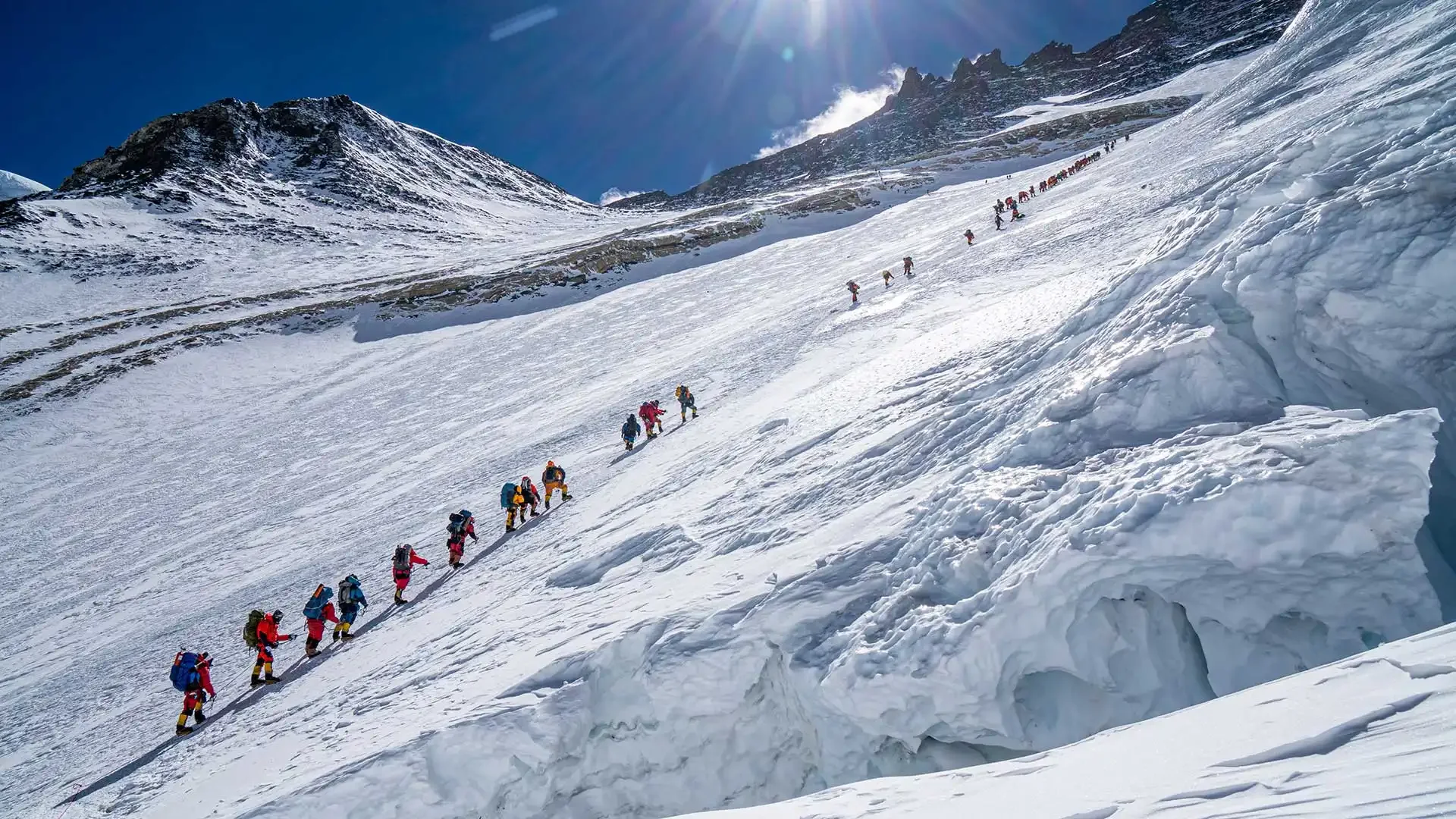
Some most asked questions about Everest and their detailed answers.
On this page(12)
Whether you've typed "Where is Mount Everest located?" into Google at 2 AM or wondered what it actually feels like to stand at 8,848 meters, you're in the right place. This guide covers everything: geography, climbing costs, records, deaths, culture, gear, and more. No jargon. No gatekeeping. Just clear, honest answers for curious minds.
General Questions About Mount Everest
What is Mount Everest?
Mount Everest is the highest mountain on Earth, standing at 8,848.86 meters (29,031.7 feet) above sea level.
It sits on the border between Nepal and Tibet and is part of the Mahalangur Himal sub-range of the Himalayas.
Known as Sagarmatha in Nepal and Chomolungma in Tibet, the mountain is both a geographical landmark and a deeply sacred site.
Where is Mount Everest located?
Mount Everest is located in the Himalayas, on the border between Nepal and the Tibet Autonomous Region of China.
The southern side sits in Nepal's Solukhumbu District. The northern side belongs to Tibet.
The exact coordinates are 27.9881 degrees N and 86.9250 degrees E, northeast of Kathmandu.
What country is Mount Everest in?
Mount Everest belongs to two countries: Nepal and China (Tibet Autonomous Region).
The summit itself straddles the border. Most climbers and trekkers approach from the Nepal side, which is better developed for tourism and expeditions.
How tall is Mount Everest?
Mount Everest stands at 8,848.86 meters, or 29,031.7 feet above sea level.
This figure was officially confirmed in 2020 after a joint survey conducted by Nepal and China.
In kilometers, that's approximately 8.85 km from sea level to summit, roughly the cruising altitude of a commercial airplane.
How was Mount Everest formed?
Mount Everest was formed by the collision of the Indian tectonic plate and the Eurasian plate, which began around 50 million years ago.
That slow-motion crash pushed the land upward, gradually forming the Himalayan range.
Even today, the mountain continues to rise by a few millimeters each year due to ongoing tectonic activity.
How did Mount Everest get its name?
Mount Everest was named in 1865 after Sir George Everest, a British surveyor-general of India.
The irony is that Sir George Everest never actually saw the mountain himself.
The mountain already had meaningful local names, Sagarmatha and Chomolungma, both rooted in Tibetan Buddhist tradition and centuries of local culture.
What does Sagarmatha mean?
Sagarmatha is the Nepali name for Mount Everest and means "Forehead of the Sky" or "Goddess of the Sky."
It is also the name of the national park that surrounds the Everest region, the Sagarmatha National Park, a UNESCO World Heritage Site.
What does Chomolungma mean?
Chomolungma is the Tibetan name for Mount Everest and translates to "Goddess Mother of the World."
This name reflects the deep spiritual significance the mountain holds for Tibetan Buddhist communities who have revered it for centuries.
Why is Mount Everest so famous?
Mount Everest is famous primarily because it is the highest point on Earth, making it the ultimate goal for mountaineers worldwide.
Its combination of extreme altitude, dramatic landscape, unpredictable weather, and legendary stories of triumph and tragedy has made it iconic.
Beyond climbing, the name "Everest" has become a global symbol of ambition, endurance, and reaching the top.
Location and Geography
Which side of Everest is more popular, Nepal or Tibet?
The Nepal side is significantly more popular, accounting for around 90 percent of all summit attempts.
It offers better infrastructure, more scenic trekking routes, and richer cultural experiences through Sherpa villages and monasteries.
The Tibet side is more remote, less commercialized, and involves stricter Chinese permit regulations.
Where is Mount Everest on a map?
On a map, Mount Everest appears along the Nepal-Tibet border in the Mahalangur section of the Himalayas.
It sits within Sagarmatha National Park on the Nepali side.
On Google Maps, simply search "Mount Everest" and zoom into the Khumbu Region of northeastern Nepal to find it clearly marked.
Can Everest be seen from Kathmandu?
No, Mount Everest cannot be seen from Kathmandu with the naked eye.
It is hidden behind other towering Himalayan peaks from that vantage point.
However, a scenic mountain flight or helicopter tour from Kathmandu will give you stunning close-up views of Everest and its neighboring giants.
What is the closest airport to Mount Everest?
The closest airport to Mount Everest is Tenzing-Hillary Airport in Lukla, situated at an altitude of 2,860 meters.
The flight from Kathmandu to Lukla takes only about 35 minutes but is widely considered one of the most thrilling mountain landings in the world.
What is the closest town to Mount Everest?
Namche Bazaar, sitting at 3,440 meters, is the closest proper town to Everest and serves as the main gateway for all trekking and climbing in the Khumbu region.
It has teahouses, bakeries, gear shops, a Saturday market, and even a museum dedicated to Sherpa culture.
What mountain range is Everest part of?
Mount Everest is part of the Himalayas, specifically the Mahalangur Himal sub-range.
The Himalayan range itself stretches across five countries: Nepal, India, China, Bhutan, and Pakistan.
It is the highest mountain range on Earth and home to all fourteen of the world's 8,000-meter peaks.
Which is the longest mountain range in the world?
The longest mountain range in the world is the Andes in South America, stretching approximately 7,000 kilometers.
The Himalayas, while not the longest, are the highest range and home to the greatest concentration of towering peaks on the planet.
Everest Base Camp
What is Everest Base Camp and where is it?
Everest Base Camp (EBC) is the staging point for all summit expeditions on the Nepal side of Everest, located at 5,364 meters (17,598 feet).
It sits at the foot of the Khumbu Icefall in the Khumbu region of northeastern Nepal.
For trekkers, reaching Base Camp is a bucket-list achievement in itself, complete with prayer flags, glacier views, and the electric atmosphere of active expeditions.
How long does it take to trek to Everest Base Camp?
The standard Everest Base Camp Trek takes 12 to 14 days round trip from Lukla.
This includes trekking days, essential acclimatization rest days, and the return journey.
Most itineraries begin and end in Lukla, with the full journey starting from Kathmandu.
What is the best time to do the EBC Trek?
The best times to trek to Everest Base Camp are spring (March to May) and autumn (September to November).
Spring offers rhododendron forests in bloom and stable weather windows.
Autumn brings exceptional clarity after the monsoon season cleans the air, with crisp skies and spectacular mountain views.
What is the success rate for reaching Everest Base Camp?
Over 90 percent of trekkers who attempt the Everest Base Camp Trek successfully reach their destination.
Good preparation, proper acclimatization, experienced guides, and a gradual ascent are the main reasons most trekkers complete the journey without serious difficulty.
What permits are needed for the EBC Trek?
Trekkers need two main permits: a TIMS Card (Trekkers' Information Management System) and a Sagarmatha National Park Entry Permit.
Both are obtainable in Kathmandu or at the national park entry point in Monjo.
Your trekking agency will typically arrange these on your behalf if you are booking a guided trek.
Climbing Mount Everest
How long does it take to climb Mount Everest?
Climbing Mount Everest takes approximately two months from start to finish.
This includes trekking to Base Camp (8 to 12 days), multiple acclimatization rotations between camps (2 to 3 weeks), waiting for a suitable weather window (1 to 2 weeks), and the summit push itself (5 to 7 days).
Why does it take two months to climb Everest?
It takes two months primarily because of acclimatization.
The human body needs time to adjust to extreme altitude before it can safely push toward the summit.
Climbers make multiple rotations up and down the mountain, sleeping at progressively higher camps to trigger the physiological changes needed for survival above 8,000 meters.
How much does it cost to climb Mount Everest?
Climbing Mount Everest costs between $40,000 and $85,000 USD depending on the operator and services included.
The Nepal government climbing permit alone costs approximately $15,000.
Additional costs include guide fees, Sherpa support, oxygen systems, gear, flights, insurance, food, and accommodation across the full two-month expedition.
Why does it cost so much to climb Everest?
The cost reflects the enormous logistical operation required to support a safe summit attempt.
Oxygen bottles, high-altitude Sherpa teams, base camp infrastructure, medical support, and government permit fees all add up quickly.
Budget expeditions that cut corners on safety tend to carry significantly higher risk.
Do I need a guide or Sherpa to climb Everest?
Yes, it is now a legal requirement under Nepal government regulations to climb Everest with a licensed guide.
Beyond legality, Sherpas are essential to the operation: they fix ropes, carry equipment, set up high camps, and navigate some of the most dangerous terrain on the mountain.
Without them, a successful summit would be impossible for the vast majority of climbers.
Is Everest technically difficult to climb?
Everest is not considered the most technically challenging mountain in the world, but it is extremely dangerous.
The primary dangers are extreme altitude, sudden weather changes, the treacherous Khumbu Icefall, the steep Lhotse Face, and the thin oxygen above 8,000 meters.
Climbers do not need elite technical rock-climbing skills, but they must have crampon training, rope skills, and previous high-altitude experience.
Can beginners climb Mount Everest?
No, Everest is not suitable for beginners and is now officially off-limits to inexperienced climbers.
Nepal's government now requires all Everest permit applicants to have previously summited a peak of at least 7,000 meters.
Most reputable expedition operators also require prior ascents of mountains such as Denali, Aconcagua, or Island Peak before accepting new clients.
Can Everest be climbed without supplemental oxygen?
Yes, but it is extremely rare and carries enormous risk.
Only around 200 climbers in history have successfully summited Everest without supplemental oxygen.
Reinhold Messner and Peter Habeler made the first oxygenless ascent in 1978, shocking the mountaineering world and proving it was physiologically possible.
Which route is easier, the Nepal side or the Tibet side?
The Nepal (South Col) route is considered the easier of the two and is where roughly 90 percent of summits take place.
It has better logistics, more experienced Sherpa support, and easier access to rescue services.
The Tibet (North Col) route is longer, more technically demanding, and involves stricter permit processes through Chinese authorities.
Can you climb from Everest to Lhotse in the same expedition?
Yes, it is possible to summit both Everest and Lhotse (8,516 m) during a single expedition, as the two routes share much of the same path up to Camp 3.
This is known as a "double-header" and has been completed by several elite climbers, sometimes within 24 hours of each other.
It requires exceptional fitness, thorough acclimatization, sufficient oxygen supplies, and ideal weather windows for both summits.
The Death Zone
What is the Death Zone on Mount Everest?
The Death Zone refers to the altitude above 8,000 meters (26,247 feet) where oxygen levels are so low that the human body begins to deteriorate even at rest.
In the Death Zone, your body cannot recover, digest food properly, or think clearly.
Every minute spent there without supplemental oxygen accelerates physical breakdown.
How long can you survive in the Death Zone without oxygen?
Without supplemental oxygen, most people would lose consciousness within hours above 8,000 meters.
Even with oxygen, climbers try to limit time in the Death Zone to 12 to 16 hours maximum.
The body's deterioration is rapid and irreversible the longer a climber stays at that altitude.
What is the 2PM rule on Everest?
The 2PM rule is a widely followed safety guideline that states: if you have not reached the summit by 2 PM, you must turn back immediately.
This exists because descending in darkness significantly increases the risk of falls, exposure, and death.
Many of the fatalities on Everest have occurred because climbers pushed past this turnaround time.
Dangers and Deaths on Everest
How many people have died on Mount Everest?
More than 330 people have died attempting to climb Mount Everest since records began in 1922.
Most deaths occur in the Death Zone, between Camp 4 and the summit, due to altitude sickness, falls, avalanches, and exhaustion.
The actual number may be higher, as some deaths in early decades went undocumented.
Are there still bodies on Mount Everest?
Yes, many bodies remain on the mountain, preserved by the extreme cold.
It is often too dangerous and logistically impossible to recover bodies from above 8,000 meters.
Some have become grim landmarks, such as "Green Boots," believed to be Indian climber Tsewang Paljor, who died in the 1996 storm.
Who is "Sleeping Beauty" on Mount Everest?
"Sleeping Beauty" is the nickname given to the body of Francys Arsentiev, the first American woman to summit Everest without supplemental oxygen, who died during her descent in 1998.
Her body remained visible on the mountain for years, a haunting reminder of the risks above 8,000 meters.
What is Rainbow Valley on Everest?
Rainbow Valley is a section just below the summit on the North Face of Everest where the bodies of many fallen climbers remain.
The name comes from the brightly colored down suits (red, yellow, blue) of deceased climbers visible against the snow.
It is one of the most sobering places on the entire mountain.
What are the most common causes of death on Everest?
The most common causes of death on Everest are altitude sickness (including HACE and HAPE), falls, avalanches, frostbite, hypothermia, and exhaustion.
Poor decision-making due to altitude-induced cognitive impairment is also a significant contributing factor.
Many deaths happen during the descent, not the ascent, when energy is depleted and focus drops.
Records and Firsts
Who climbed Everest first?
Mount Everest was first summited on May 29, 1953 by Sir Edmund Hillary of New Zealand and Tenzing Norgay Sherpa of Nepal.
They reached the top via the South Col Route, becoming the first confirmed humans to stand on the highest point on Earth.
Who was the first woman to climb Everest?
Junko Tabei of Japan became the first woman to summit Mount Everest on May 16, 1975.
She was not only a pioneering mountaineer but also a lifelong advocate for women in outdoor adventure sports.
Who is the youngest person to summit Everest?
Jordan Romero of the USA summited Everest at just 13 years old in 2010, climbing via the north side from Tibet.
The youngest girl to summit is Malavath Purna of India, who reached the top in 2014 at 13 years and 11 months old.
Who has climbed Everest the most times?
Kami Rita Sherpa of Nepal holds the record for the most Everest summits, with 31 ascents as of 2025.
He is widely regarded as a living legend in the mountaineering world and continues to set new records.
What is the fastest ascent of Everest?
The fastest recorded ascent from Base Camp to the summit was completed by Lhakpa Gelu Sherpa in just 10 hours and 56 minutes in 2003.
By comparison, most commercial climbers take 4 to 5 days for the same push from Base Camp to the summit.
Who was the first to climb Everest without oxygen?
Reinhold Messner and Peter Habeler made the first oxygenless summit of Everest in 1978, a feat many experts previously believed was physiologically impossible.
Messner returned in 1980 and became the first person to solo climb Everest without supplemental oxygen.
Faces and Features of Everest
What are the faces of Mount Everest?
Everest has two primary faces: the South Face in Nepal and the North Face in Tibet.
The South Face is the more frequently climbed side and the one visible during the EBC Trek.
The North Face is steeper, more remote, and involves a longer and more technical summit ridge.
What is the Khumbu Icefall?
The Khumbu Icefall is one of the most dangerous sections of the Everest climb, located just above Base Camp on the South Face.
It is a constantly shifting maze of massive ice towers called seracs, deep crevasses, and unstable ice bridges.
Climbers cross it using aluminum ladders and fixed ropes, often in the early morning hours to minimize the risk of collapse.
What is the Hillary Step?
The Hillary Step was a near-vertical rock face close to the summit of Everest, named after Sir Edmund Hillary who first climbed it in 1953.
It was one of the most technically demanding sections of the South Col Route.
After the 2015 earthquake, the step reportedly changed in structure, and many climbers now describe it as more of a steep snow slope than a defined rock feature.
What is the elevation of Camp 4 on Everest?
Camp 4, also known as the South Col, sits at 7,900 meters (25,918 feet), deep inside the Death Zone.
It is the final camp before the summit push and the highest camp on the Nepal side of Everest.
Climbers spend as little time as possible here, typically departing for the summit push around midnight.
Temperature and Conditions
How cold is it at the summit of Everest?
At the Everest summit, average temperatures range from -20 degrees C to -30 degrees C in the warmer months.
In winter, temperatures can plunge below -40 degrees C, and wind chill can make it feel even colder.
Frostbite can occur within minutes of exposed skin at these temperatures.
What does it look like from the top of Everest?
From the summit, you can see an endless panorama of Himalayan peaks stretching across Nepal and Tibet.
Clouds sit far below you. Neighboring giants like Lhotse, Makalu, and Nuptse appear at eye level or lower.
Most climbers spend only 15 to 20 minutes at the top due to the extreme risk of prolonged exposure at that altitude.
Culture and Environment
What does Everest mean to the Sherpa people?
To the Sherpa people, Everest is not simply a mountain. It is a sacred goddess called Chomolungma.
Prayer flags, mani stones, and Buddhist shrines along the trails are not tourist decorations. They are offerings of respect, protection, and devotion to the spirits of the mountains.
Is Everest suffering from overtourism?
Yes, overtourism on Everest is a serious and growing concern among conservationists, local communities, and mountaineers.
Crowded summit routes, increased waste on the mountain, environmental stress on glaciers, and disruption to local ecosystems are all worsening each year.
The Nepal government has been exploring permit restrictions and stricter regulations to manage the pressure.
How can I be a responsible trekker on the EBC route?
Pack out everything you bring in, hire local guides and porters, stay in locally owned teahouses, and respect all sacred sites along the trail.
Avoid single-use plastics, support clean-up initiatives, and follow Leave No Trace principles throughout the trek.
Organizations like the Sagarmatha Pollution Control Committee (SPCC) do vital work on the mountain and welcome support.
Planning and Preparation
How do I train for the Everest Base Camp Trek?
Train with long hikes carrying a loaded pack, stair climbing, hill walking, and core and leg strength exercises.
Cardiovascular endurance is the most important physical attribute for the EBC Trek.
Begin training at least three to four months before your trek and gradually increase distance and elevation gain each week.
What gear do I need for the EBC Trek?
Essential gear includes layered clothing, a down jacket, a sleeping bag rated for at least -15 degrees C, sturdy trekking boots, trekking poles, a headlamp, sunglasses, and a quality daypack.
Water purification tablets or a filter bottle are important, as is a good first aid kit with altitude sickness medication like Diamox.
Cash is essential past Namche Bazaar, as there are no ATMs further up the trail.
What apps and documents should I bring?
Useful apps include Maps.me or Gaia GPS for offline navigation, and Windy or Mountain Forecast for weather updates.
Carry physical copies of your passport, trek permits, insurance documents, and an emergency contact list.
A portable power bank is essential, as charging options become limited at higher elevations.
Is travel insurance necessary for the EBC Trek?
Yes, travel insurance is absolutely essential and should specifically cover high-altitude helicopter rescue up to at least 6,000 meters.
Standard travel insurance often does not cover high-altitude emergencies, so read your policy carefully before departing.
Medical evacuation from the Khumbu region is expensive and only possible by helicopter, making proper insurance non-negotiable.
Quick Everest facts people search for
How high is Everest in feet? The official height is 8,848.86 m, which is about 29,032 ft.
What is the Hillary Step? It is the short, near-vertical rock and snow section on the southeast ridge at roughly 8,790 m, just below the summit. It has long been the last serious obstacle on the Nepal side and its appearance has changed since the 2015 earthquake.
Why are there queues on Everest? Summit windows are narrow, so large numbers of climbers push for the top on the same few days, which creates the bottlenecks seen in widely shared photographs near the ridge.
How dangerous is it? Expedition climbing above 8,000 m carries a real fatality risk from altitude illness, weather, avalanche and icefall. Trekking to Base Camp is a very different activity with a far lower risk profile - see our Everest Base Camp Trek.
How many 8,000 m peaks are there? Fourteen, eight of which lie wholly or partly in Nepal. Everest is the highest and Dhaulagiri I, at 8,167 m, is the seventh highest mountain in the world.
Sharing route guides and trail experience from the high trails of Nepal.