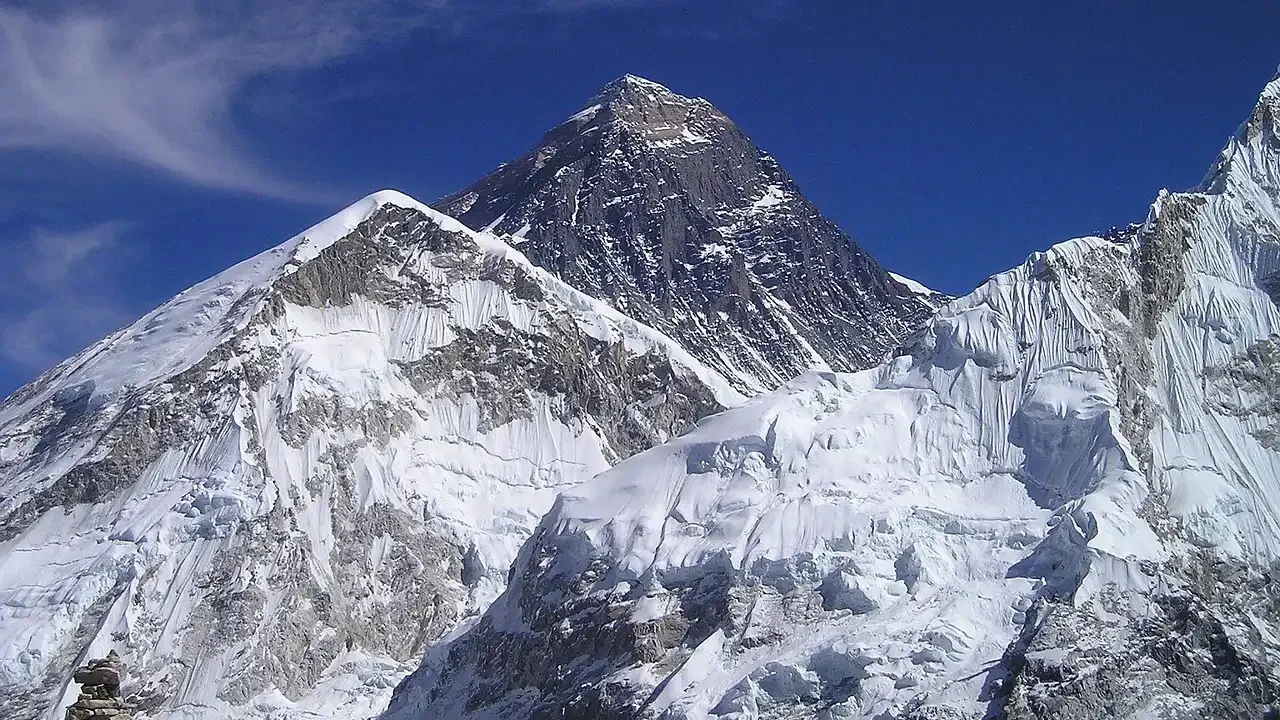
Discover the majesty of the world’s highest peak, revered as the "Goddess of the Sky." This guide explores the awe-inspiring geography, spiritual heritage, and legendary allure of the mountain that defines the Himalayan landscape.
On this page(11)
There is a question that comes up constantly in travel forums, geography classrooms, and casual conversations around the world. People want to know where Mount Everest is, how high it actually stands, what it costs to climb, how many people have died on its slopes, and whether that story about the woman frozen in place near the summit is real.
This article answers all of it, in one place, without the filler.
Start with the basics. Mount Everest, known in Nepal as Sagarmatha mountain and in Tibet as Chomolungma, is the highest point on earth. The official Mount Everest height is 8,848.86 meters above sea level, or 29,032 feet.
That figure was confirmed by a joint Chinese-Nepalese survey in 2020 and replaced the previous measurement of 8,848 meters that had stood since 1954. The difference is small. The significance is not. Every measurement of Everest is a statement about how seriously the world takes this mountain.
Where Is Mount Everest?
Mount Everest is located in the Mahalangur Himal sub-range of the Himalayas, sitting directly on the border between Nepal and the Tibet Autonomous Region of China. The south face and the approach most trekkers and climbers use lies in Nepal, in the Solukhumbu District of the Khumbu region. The north face belongs to Tibet.
People phrase the question in different ways. Mount Everest is where, exactly? The coordinates place the summit at roughly 27.9881 degrees north, 86.9250 degrees east. On a Mount Everest map, it sits in the northeastern corner of Nepal, surrounded by other giants including Lhotse, Nuptse, and Changtse.
It is part of the Great Himalayan Range, which stretches over 2,400 kilometers across five countries: Nepal, China, India, Bhutan, and Pakistan.
The Khumbu Glacier flows from the mountain's western flank down toward Base Camp and eventually feeds the Dudh Koshi River. This glacier forms the approach corridor for the classic South Col route. The Khumbu Icefall, where the glacier spills over a rocky cliff in a chaotic jumble of ice blocks and crevasses, is one of the most dangerous sections of the entire climb.
The Mount Everest Peak Height in Context
The Mount Everest peak height of 8,848.86 meters makes it the highest mountain above sea level on earth, but it is worth understanding what that number actually means in physical terms.
At the summit, atmospheric pressure is roughly one third of what it is at sea level. There is enough oxygen to sustain life, but only barely, and only briefly. The human body at that altitude is deteriorating faster than it can recover.
Every minute above 8,000 meters, the zone climbers call the death zone, is a minute your body cannot fully compensate for. The height is not just a number. It is a physiological reality that shapes every decision made on the mountain.
For comparison, commercial aircraft cruise at between 9,000 and 12,000 meters. The Mount Everest summit sits just below cruising altitude. The people standing on top of the world are essentially outside the envelope of human habitability, kept alive by their fitness, their acclimatization, and often by supplemental oxygen.
The Geography Around the Summit
The Mount Everest mountain does not stand alone. It is flanked by Lhotse at 8,516 meters on the southeast and Nuptse at 7,861 meters to the southwest, forming a horseshoe of extreme altitude that defines the upper Khumbu. Changtse, on the Tibetan side, rises to 7,583 meters.
These are not minor supporting peaks. Any one of them would be among the most famous mountains on earth if Everest did not exist.
The south side of Everest, the Nepalese side, is what most people picture when they think of the mountain. The approach from Lukla through Namche Bazaar, Tengboche, Dingboche, and Lobuche to Base Camp at 5,364 meters is one of the most traveled trekking routes in the world.
The Mount Everest top, when seen from Kala Patthar at 5,643 meters, appears as a dark pyramid above the surrounding ridges, often trailing a plume of wind-driven snow from the summit that is visible from 50 kilometers away.
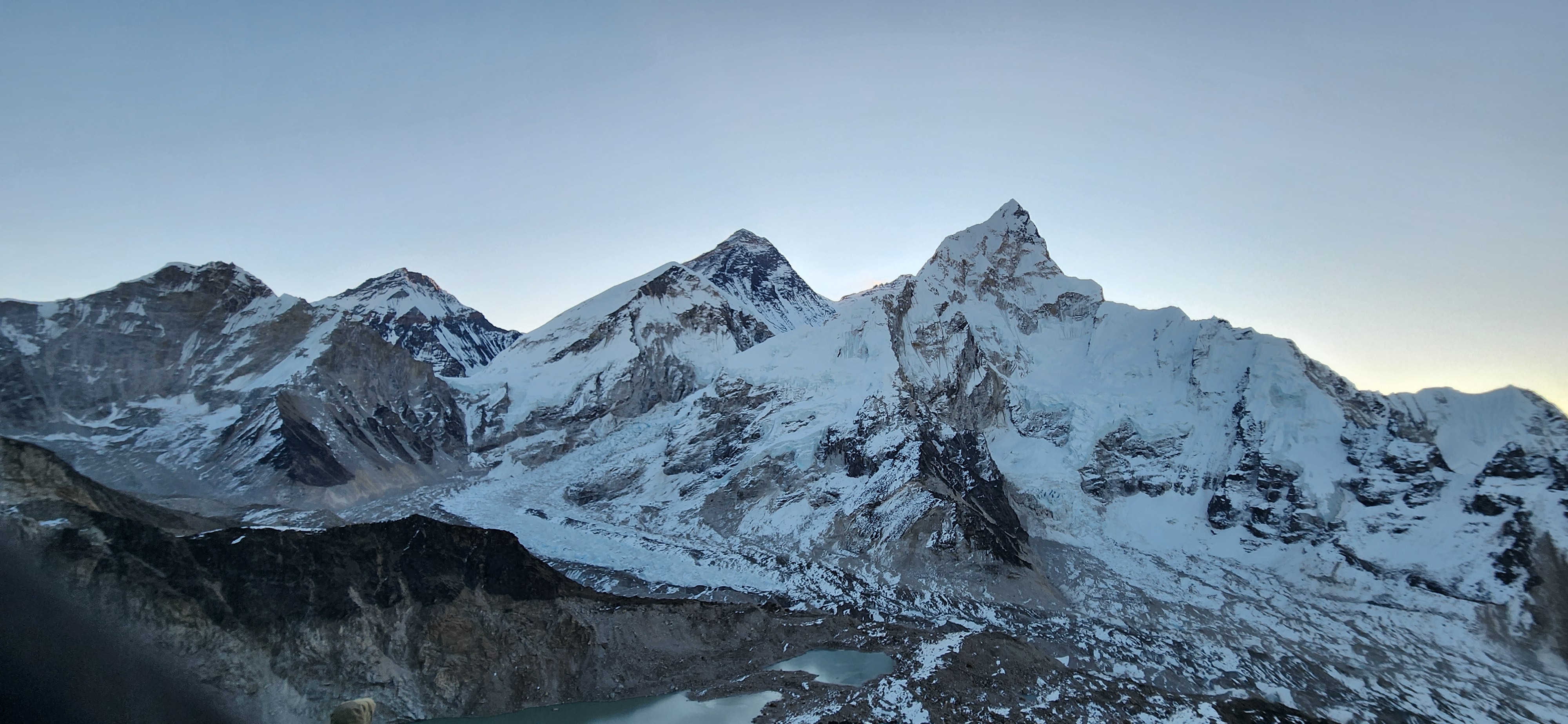 Mount Everest (in the middle) as seen from Kala Patthar during early morning sunrise
The History of Attempts on the Summit
The story of Everest expeditions is as much about failure as it is about success. British mountaineers began making serious attempts in the early 1920s, driven partly by national pride and partly by the simple fact that the mountain had never been climbed.
The 1921 British Reconnaissance Expedition was primarily a mapping and scouting mission. The 1922 expedition pushed above 8,000 meters for the first time in history, though it also recorded the mountain's first deaths when an avalanche killed seven Sherpa climbers.
The most famous early chapter came in 1924, when George Mallory and Andrew Irvine disappeared high on the Northeast Ridge during a summit attempt. Mallory had been asked why he wanted to climb Everest and gave the answer that has been repeated ever since: because it is there.
His body was discovered in 1999 at around 8,155 meters, remarkably preserved by the cold. Whether he and Irvine reached the summit before they died remains one of mountaineering's enduring mysteries.
It was not until May 29, 1953, that the Mount Everest summit was first definitively reached. Sir Edmund Hillary of New Zealand and Tenzing Norgay, a Sherpa from the Khumbu region, stood on top together at 11:30 in the morning.
They had left their high camp at 27,900 feet in the pre-dawn darkness and navigated the South Col, the Southeast Ridge, and the near-vertical rock step just below the summit that is now called the Hillary Step. Their achievement changed everything. It opened the door for the thousands of expeditions that followed, transformed the Sherpa community's global profile, and turned Mount Everest from a geographical fact into a cultural symbol.
Mount Everest Bodies: The Dead Who Remain
This is the part of the Everest story that people ask about in hushed voices, and it deserves a straight answer. As of 2024, over 330 people have died on Mount Everest. Many of those bodies have never been brought down.
At extreme altitude, in terrain that is genuinely dangerous to navigate even under good conditions, recovering a body is sometimes impossible and always enormously risky to the people attempting the recovery. The result is that Mount Everest bodies remain on the mountain in various states of preservation.
The cold and dry conditions at extreme altitude prevent normal decomposition, which means that some bodies are remarkably intact after years or even decades on the slope. Several have become unofficial landmarks, known to climbers passing through specific sections of the route.
The most discussed of these is a woman climbers have referred to as Sleeping Beauty, formally identified as Francys Arsentiev, an American climber who died on the descent from the summit in 1998 after becoming separated from her husband Sergei. She was found in a position that gave her the name, lying on the slope in what looked like peaceful sleep.
Her husband Sergei died separately while trying to rescue her. For years her body was visible on the route. In 2007, a team made a deliberate effort to move and cover her remains out of respect.
The existence of Mount Everest bodies on the mountain is a sobering counterweight to the achievement narratives. For every triumph at the top, there is a cost, and sometimes that cost is permanent and visible.
Mount Everest Eruption: A Question Worth Addressing
One question that surfaces with surprising regularity is whether Mount Everest has a volcano or whether a Mount Everest eruption is possible. The short answer is no.
Everest is not a volcano and has never erupted. It is a fold mountain, formed over tens of millions of years by the collision of the Indian and Eurasian tectonic plates, which pushed the seabed upward into the Himalayan range. The rocks near the summit of Everest were once ocean floor, and marine fossils have been found at high elevation on the mountain.
The region is seismically active, and Nepal has experienced devastating earthquakes, most recently in 2015 when a 7.8 magnitude earthquake triggered avalanches on Everest that killed 22 people at Base Camp, the deadliest single day in the mountain's history.
But seismic activity is not the same as volcanic activity. There is no magma chamber, no volcanic cone, and no eruption risk associated with Everest. The mountain is growing, very slowly, as the tectonic collision continues, but it is doing so silently.
How Long Does It Take to Climb
The full process of climbing Mount Everest, from arriving at Base Camp to summiting and returning, takes approximately 60 to 70 days. That number surprises most people who assume it is a matter of a few weeks of hard climbing.
The reason for the timeline is acclimatization. You cannot simply fly to Kathmandu and start climbing. Your body needs weeks to adjust to progressively higher altitudes, and the standard approach involves repeated cycles of climbing to a higher camp, returning to a lower one to rest, and then climbing higher again on the next rotation.
This is called the climb high, sleep low method, and it is not optional. Skipping acclimatization is how people die.
The process typically starts with several days at Base Camp at 5,364 meters. Then comes a rotation up through the Khumbu Icefall to Camp 1 and Camp 2, followed by a return to Base Camp to rest. Then a longer rotation up to Camp 3 on the Lhotse Face, back down again, before the final summit push.
The summit push goes through Camp 4 on the South Col at 8,000 meters. The window for the actual summit attempt is narrow, usually a few days in May when the jet stream shifts and wind speeds drop enough to make the upper mountain survivable.
What It Costs
The cost of climbing Mount Everest is significant by any measure. A full expedition package from a reputable operator runs between $40,000 and $100,000 per person, depending on the level of support, the experience of the guides, and whether the package includes personal Sherpa support, supplemental oxygen, satellite communication, and high-end food at Base Camp.
Included in that figure, or billed separately, is the Nepal government climbing permit, which currently stands at $15,000 per person for the south side route. That permit fee alone makes Everest inaccessible for most aspiring mountaineers, which is part of why the mountain sees roughly 300 to 500 climbers per season rather than the tens of thousands who trek to Base Camp annually.
Local Nepali operators generally charge less than international outfitters, sometimes significantly less, bringing the overall cost closer to $30,000 to $40,000 on the lower end. The difference in price reflects differences in guide-to-client ratio, equipment quality, and the level of logistical support rather than anything fundamental about the mountain itself.
Records Worth Knowing
The record books around Everest tell their own story.
Junko Tabei of Japan became the first woman to reach the Mount Everest summit on May 16, 1975. Jordan Romero, an American, summited at the age of 13 in 2010, making him the youngest person to stand on top. Yuichiro Miura of Japan reached the summit at 80, the oldest.
Kami Rita Sherpa holds the record for most ascents with 31 successful summits as of 2024, a number that reflects both extraordinary physical ability and the central role Sherpas play in every expedition that passes through this mountain.
Reinhold Messner and Peter Habeler made the first ascent without supplemental oxygen in 1978, a feat many thought physiologically impossible at the time. Lhakpa Gelu Sherpa holds the record for the fastest ascent from Base Camp to summit at 10 hours and 56 minutes, set in 2003.
The Environmental Reality
The increasing number of expeditions and trekkers has created a visible environmental toll on the mountain and the surrounding Sagarmatha National Park. Base Camp during the climbing season is a small city of tents, equipment, and people, generating waste at a rate the high-altitude environment struggles to process.
Human waste, discarded oxygen canisters, food packaging, and old fixed ropes accumulate on the upper mountain and at camps along the route.
The Sagarmatha Pollution Control Committee manages much of the waste removal effort in the lower sections, and climbers are required to carry their waste back to Base Camp. Some expeditions conduct dedicated clean-up operations, removing garbage brought down from altitude at significant effort.
The 2015 earthquake and subsequent shifts in the Khumbu Glacier have also changed parts of the climbing route, and the glacier's retreat is measurable and ongoing.
Climate change is reshaping the mountain in ways that go beyond aesthetics. The glaciers feeding the Dudh Koshi River are retreating, with downstream implications for water availability across Nepal and northern India. The permafrost that holds certain sections of fixed ropes and anchors in place is softening.
The window of safe climbing conditions may be shifting. Everest in 2026 is not the same physical entity as Everest in 1953, and the pace of change is accelerating.
What the Mountain Means
Mount Everest is not just the world's highest mountain. It is a mirror. It reflects back whatever people bring to it: ambition, grief, wonder, hubris, camaraderie, and occasionally something that cannot easily be named.
For the Sherpa community, it is sacred ground, the home of Miyolangsangma, a goddess of inexhaustible giving. Every expedition begins with a puja ceremony seeking her blessing and permission before a single crampon touches the ice above Base Camp.
For the government of Nepal, it is an economic engine and a source of national identity. For the climbers who attempt the Mount Everest summit each spring, it is the answer to a question they have been asking themselves for most of their lives.
For the hundreds of thousands who trek to Base Camp without any intention of climbing higher, it is enough simply to stand in its presence.
The mountain does not care about any of this. It was here before anyone gave it a name, and it will be here long after the last fixed rope has rotted away. That indifference is part of what draws people to it.
There is something clarifying about a thing that large, that old, and that completely unmoved by human opinion.
Sharing route guides and trail experience from the high trails of Nepal.