 Nepal Visuals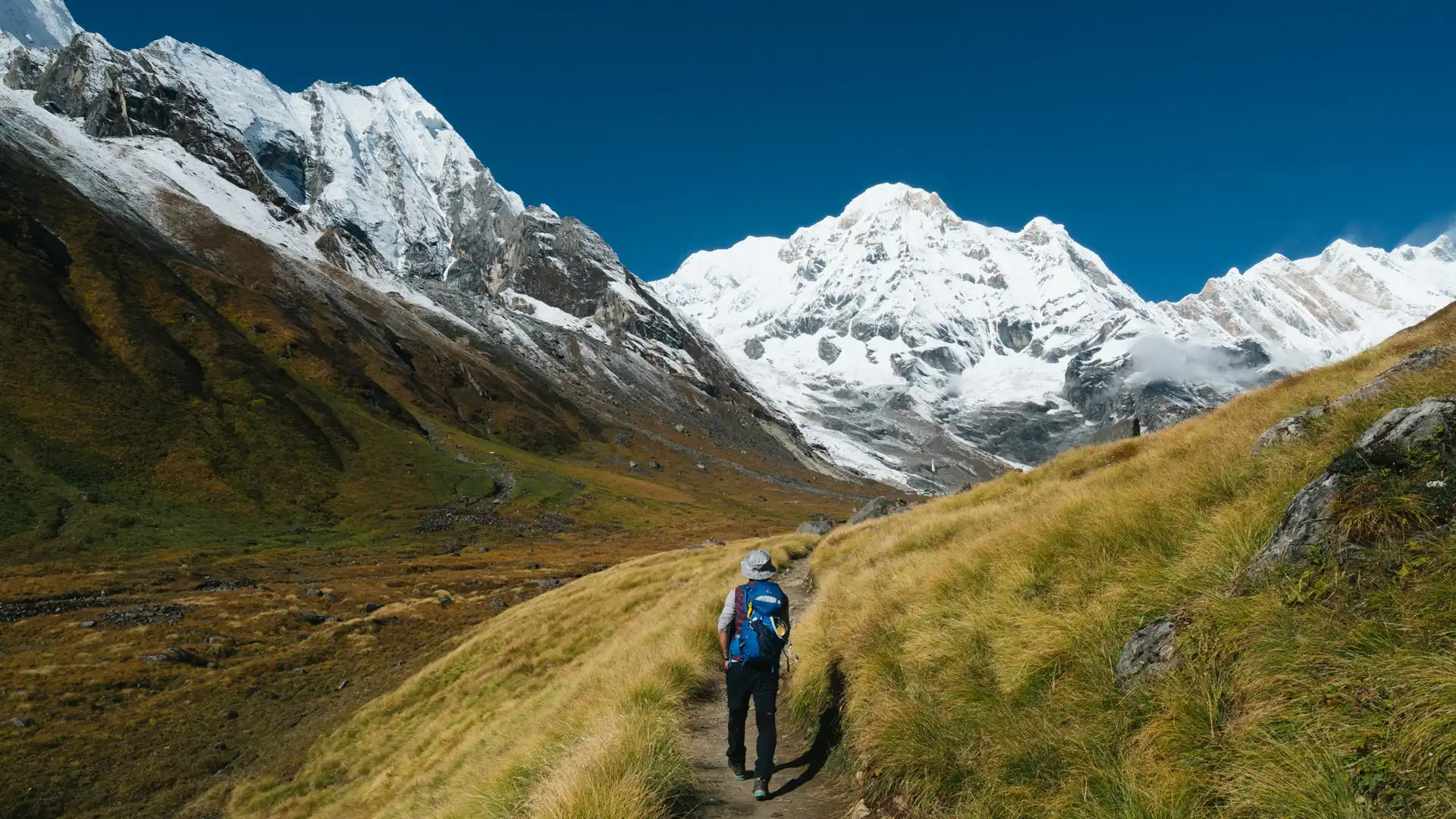
Annapurna Region · Moderate grade
Annapurna Base Camp Trek
The route
What the walk is.
The Annapurna Base Camp Trek (11 Days) is one of Nepal’s most rewarding moderate treks, taking you deep into the heart of the Annapurna Sanctuary. This journey offers an unforgettable combination of diverse landscapes, cultural encounters, and the thrill of reaching a true Himalayan base camp surrounded by towering peaks.
Starting from Pokhara, the trail leads through terraced farmland, lush rhododendron forests, and traditional Gurung villages such as Ghandruk and Chhomrong. The gradual ascent allows proper acclimatization while offering constantly changing scenery that keeps each day engaging.
A memorable highlight is the optional sunrise hike to Poonhill (3,210 m), where golden light reveals sweeping views of the Annapurna and Dhaulagiri ranges. This viewpoint adds a classic Himalayan panorama to an already scenic trek.
As the journey continues along the Modi Khola valley, the landscape becomes more rugged and dramatic. Waterfalls, bamboo forests, and alpine terrain eventually lead into the Annapurna Sanctuary, a high glacial basin surrounded by massive peaks.
The main highlight is reaching Annapurna Base Camp (4,130 m), where trekkers experience a breathtaking 360 degree mountain amphitheater. Annapurna I, Machapuchare, and several other Himalayan giants rise dramatically above, creating a powerful and emotional mountain experience.
The descent offers a different perspective as you pass back through forested trails and welcoming mountain communities. A stop at Jhinu Danda gives trekkers the chance to relax in natural hot springs before completing the journey.
With moderate difficulty and no technical climbing required, this trek is achievable for fit beginners with good preparation. It is an excellent choice for those seeking a complete Himalayan base camp experience with manageable altitude and comfortable trekking conditions.
Overall, the Annapurna Base Camp Trek in 11 days is ideal for trekkers wanting a balanced adventure that combines mountain beauty, cultural richness, and a well-paced itinerary
General Information
Detail | Information |
Destination | Annapurna Region |
Start Point | Tikhedhunga (via Nayapul from Pokhara) |
End Point | Syauli (return to Pokhara) |
Daily Walking | 4-7 hours |
Permits Required | ACAP, TIMS |
Ideal For | Moderate trekkers, base camp seekers, families |
What makes This ABC Trek extraordinary:
The Annapurna Sanctuary: Base camp sits at 4,130m on the floor of a dramatic natural amphitheater completely encircled by some of the world's highest mountains: Annapurna I (8,091m, tenth highest) rises directly south, sacred Machapuchare (Fishtail, 6,993m) towers north creating distinctive double-summit profile, Annapurna South (7,219m) southeast, Hiunchuli (6,441m) west, Gangapurna northeast, and countless other 6,000-7,000m peaks surrounding.
The sanctuary's unique bowl shape creates intimate scale. Peaks loom so close they feel within touching distance, their massive faces rising vertically thousands of meters above. Sunrise and sunset transform the amphitheater as golden light progressively illuminates peaks creating spectacular alpenglow.
Moderate Accessibility: Unlike high-altitude treks requiring weeks and extreme effort (EBC, Manaslu, Circuit with high passes), ABC reaches spectacular base camp at moderate 4,130m through comfortable pacing over 7 days ascent.
This lower maximum altitude significantly reduces serious altitude sickness risk while still delivering genuine high-altitude experience and views.
The well-maintained trail requires no technical skills, just sustained walking on established paths. Fit beginners can successfully complete this with proper preparation.
Diverse Landscapes: The route showcases extraordinary variety: terraced farmlands and villages (lowlands), dense rhododendron and oak forests blooming spectacularly spring (mid-elevations), bamboo groves and alpine meadows (approaching sanctuary), glacial moraine and barren terrain (base camp area). Each day brings completely different scenery preventing monotony.
The Modi Khola gorge ascent into sanctuary creates dramatic transition from forest to alpine zone compressed into steep climb.
Cultural Richness: Pass through beautiful Gurung villages (Ghandruk, Chhomrong, Sinuwa) where traditional mountain culture thrives: slate-roofed stone houses, terraced agriculture, warm hospitality, and genuine interactions with families running teahouses for generations. Combine mountain adventure with authentic cultural immersion.
This 11-day comprehensive package includes: scenic drive from Pokhara to trek start, spectacular Poonhill sunrise detour (optional Day 4 early morning), gradual ascent allowing natural acclimatization, comfortable teahouse accommodation throughout, all meals during trek, experienced guide and porter service, relaxing Jhinu Danda hot springs soak on descent, and return to beautiful lakeside Pokhara.
Focus on the adventure while we handle logistics.
Why choose Nepal Visuals for your 11 Day Annapurna Base Camp Trek?
Certified, Experienced Guides: Skilled in high-altitude trekking, culture, and terrain for a richer, safer journey.
Complimentary Airport Transfers: Free airport pickup and drop-off in a private vehicle for added convenience.
Pre-Trek Online Briefing: Comprehensive online trip briefing provided upon booking confirmation.
Flexible Itineraries: Tailored options to suit your fitness level and preferences.
Seamless Logistics: Coordinated permits, accommodations, and transport for a stress-free experience.
Secured Luggage Storage: Free storage for extra luggage at Contour Expeditions store.
Dedicated 24/7 Support: Multi-channel communication (Email, WhatsApp, Facebook, Insta, Viber, Skype, Zoom)
Easy Booking & Payment Options: Smooth reservation and payment process for your convenience.
Day by day
Where you sleep, night by night.
Kathmandu → Kathmandu · highest point 4,130 m
- Day 01Hotel (Twin Sharing) · Welcome Dinner1,400 m
Nepal Visuals representative meets you at the airport and transfers you to your hotel in Thamel. Welcome briefing and dinner.
- Day 02Tea House (Twin Sharing) · Breakfast, Lunch, Dinner1,495 m
Drive to Nayapul (6-7 hours). Begin trekking through terraced farmland toward Tikhedhunga, starting the Annapurna trail.
- Day 03Tea House (Twin Sharing) · Breakfast, Lunch, Dinner2,874 m
Climb the famous stone staircase through Ulleri into beautiful rhododendron and oak forest. Arrive at Ghorepani ridge. Early dinner for tomorrow pre-dawn Poonhill climb.
- Day 04Tea House (Twin Sharing) · Breakfast, Lunch, Dinner2,630 m
Pre-dawn climb to Poon Hill (3,210m) for the celebrated Dhaulagiri-Annapurna sunrise panorama. After breakfast trek through lush rhododendron forests to Tadapani with excellent Annapurna South and Machhapuchhre views.
- Day 05Tea House (Twin Sharing) · Breakfast, Lunch, Dinner2,170 m
Descend through forest toward the Modi Khola river valley. Climb to Chhomrong, a large Gurung village with spectacular Annapurna South and Machhapuchhre views. Cross the Chhomrong Khola suspension bridge.
- Day 06Tea House (Twin Sharing) · Breakfast, Lunch, Dinner2,310 m
Descend from Chhomrong, cross Chhomrong Khola, and climb into the bamboo and rhododendron gorge of the Modi Khola. Pass Sinuwa and continue deeper into the sanctuary as vegetation thickens around you.
- Day 07Tea House (Twin Sharing) · Breakfast, Lunch, Dinner3,230 m
Ascend through bamboo groves and rhododendron forests, passing Doban. Reach Deurali where the tree line transitions to alpine terrain. Tomorrow you enter the Annapurna Sanctuary.
- Day 08Highest point · Tea House, ABC · Breakfast, Lunch, Dinner4,130 m
The big day. Gradual climb through barren alpine terrain to Machapuchare Base Camp (3,700m) then the final push to Annapurna Base Camp (4,130m). The full 360-degree amphitheater reveals Annapurna I, Annapurna South, Hiunchuli, Gangapurna, and Machhapuchhre surrounding you. Watch sunset alpenglow on the peaks.
- Day 09Tea House (Twin Sharing) · Breakfast, Lunch, Dinner1,780 m
Early sunrise at the Sanctuary. Begin descent retracing through MBC, Deurali, Bamboo, and on to Jhinu Danda. Optional hot springs 20 minutes below the village. Perfect for sore muscles.
- Day 10Hotel (Twin Sharing) · Breakfast, Lunch, Dinner1,780 m
Final trekking day. Descend through forest and terraced farmland to Nayapul. Drive back to Pokhara (1 hour). Celebrate with a lakeside dinner at Phewa Lake.
- Day 11Breakfast1,400 m
Fly or drive back to Kathmandu. Transfer to the airport for your onward flight home. Carry the Annapurna Sanctuary with you always.
Fixed departures
12 group dates open.
144 places across them. Or start on any flexible date in the calendar below.
| Departure | Booked | Filling | Left | Status | Book |
|---|---|---|---|---|---|
| Sat, Mar 6, 2027 | 0/12 | 12 | Available | ||
| Sat, Mar 20, 2027 | 0/12 | 12 | Available | ||
| Sat, Apr 3, 2027 | 0/12 | 12 | Available | ||
| Sat, Apr 17, 2027 | 0/12 | 12 | Available | ||
| Sat, May 1, 2027 | 0/12 | 12 | Available | ||
| Sat, May 15, 2027 | 0/12 | 12 | Available | ||
| Sat, Sep 4, 2027 | 0/12 | 12 | Available | ||
| Sat, Sep 18, 2027 | 0/12 | 12 | Available | ||
| Sat, Oct 2, 2027 | 0/12 | 12 | Available | ||
| Sat, Oct 16, 2027 | 0/12 | 12 | Available | ||
| Sat, Nov 6, 2027 | 0/12 | 12 | Available | ||
| Sat, Nov 20, 2027 | 0/12 | 12 | Available |
Prices are per person, twin share, in USD. Book with a 20 % deposit — the balance is due 7 days before departure. Scheduled departures show places left; flexible departures can be booked on any listed start date. Booking terms
| Su | Mo | Tu | We | Th | Fr | Sa |
|---|---|---|---|---|---|---|
| 1 | 2 | 3 | ||||
| 4 | 5 | 6 | 7 | 8 | 9 | 10 |
| 11 | 12 | 13 | 14 | 15 | 16 | 17 |
| 18 | 19 | 20 | 21 | 22 | 24 | |
| 25 | 26 | 28 | 29 | 30 |
- Selected trip dates
- Available
- Filling fast
- Almost sold out
- Sold out
Fri, Oct 23Mon, Nov 2, 2026
11 days · flexible departure
- StartsFri, Oct 23, 2026 · Kathmandu
- EndsMon, Nov 2, 2026 · Kathmandu
USD $830 per person, twin share · Deposit today USD $166 (20 %)
On the trail
Photographs from the route.
The whole number
What the price covers.
12 things are in the price and 9 more are named as excluded.
In the price
Transportation & Logistics
- ✓Local Transfers · All necessary round-trip transportation between Pokhara and the trekking starting/ending points.
- ✓Official Permits · All required trekking permits, including the Annapurna Conservation Area Project (ACAP) fee and TIMS (Trekkers' Information Management Systems) card.
Professional Support & Safety
- ✓Expert Leadership · A government-certified trekking guide to lead your journey.
- ✓Porter Service · Professional porter support (1 porter per 2 trekkers, with a 10 kg limit per person).
- ✓Staff Welfare · Full coverage of wages, meals, insurance, and lodging for your entire guide and porter team.
- ✓Health & Safety · Provision of a comprehensive first aid kit and an oximeter for regular altitude and health monitoring.
- ✓Emergency Support · Full coordination for emergency services or evacuations if required.
Accommodation & Meals
- ✓City Stay · 2 nights of 2-star hotel accommodation in Pokhara on a twin-sharing basis, including breakfast.
- ✓Trek Nutrition · Full board meals (Breakfast, Lunch, and Dinner) for the duration of the 9-day trek.
- ✓Trail Lodging · Comfortable teahouse/lodge accommodation throughout the trek on a twin-sharing basis.
Gear & Recognition
- ✓Trekking Essentials · Complimentary use of durable duffel bags and trekking poles for the duration of the trip.
- ✓Official Achievement · A formal Trek Completion Certificate to commemorate your ABC adventure.
Not included
Flights, Visas, and Logistics
- ×International Travel · International airfare to and from Nepal.
- ×Entry Requirements · Nepal Entry Visa fees and any necessary extensions.
- ×Kathmandu Stays · Any accommodation or expenses incurred in Kathmandu (this package begins/ends in Pokhara).
Personal Protection & Equipment
- ×Mandatory Insurance · Comprehensive Travel and Medical Insurance (Compulsory), specifically covering high-altitude trekking and evacuation.
- ×Individual Gear · All personal trekking clothing, footwear, and specialized equipment.
Trail & City Expenses
- ×Pokhara Dining · Main meals (lunch and dinner) while staying in Pokhara, except for breakfast.
- ×Teahouse Amenities · Personal expenses at lodges, such as hot showers, Wi-Fi/internet, battery charging, and laundry.
- ×General Extras · Any alcoholic or non-alcoholic beverages, snacks, and expenses not listed in the inclusions.
Professional Tips and Gratuity
- ×Staff Appreciation · Customary tips for your trekking team. Suggested total rates are approximately $55–$65 for your guide and $40–$50 per porter.
Moderate grade
Is this trek right for you?
You can do this if…
- ✓Walk 5–6 hours a day, some of it steep
- ✓Carry a 5–8 kg daypack
- ✓Comfortable with several days in a row on foot
Recommended preparation
- ✓2–3 months of regular cardio (walking, running, cycling)
- ✓Weekend hikes with a loaded pack
- ✓Read the altitude notes below — you will sleep above 3,000 m
Experience & support
- ✓A good first Himalayan trek
- ✓Guided throughout — a licensed guide is required on Nepal treks
- ✓Unsure about age, health or fitness? Ask us — we tailor the pace
About three months out? Follow our free 12-week trek fitness plan.
Good to know
Additional information.
Journey to the Sanctuary
Phase 1 - Poonhill & Gurung Villages (Days 1-5): Drive Pokhara to Nayapul then Tikhedhunga. Begin trekking through terraced hillsides to Ulleri (steep famous stone staircase, good introduction to sustained climbing), continue through rhododendron forests to Ghorepani (2,874m). Optional pre-dawn Poonhill (3,210m) climb for spectacular sunrise over Annapurna and Dhaulagiri ranges—classic Nepal viewpoint. Descend to Tadapani through forests, reach beautiful Chhomrong village (2,340m), gateway to sanctuary.
Phase 2 - Modi Khola Gorge Ascent (Days 5-7): From Chhomrong, descend to cross Chhomrong Khola river then climb opposite side (knees tested!) reaching Sinuwa. Continue ascending Modi Khola gorge through bamboo forests and rhododendron groves to Deurali (3,230m). Landscape progressively transitions from forest to alpine zone. Reach Machapuchare Base Camp (3,700m) with stunning Fishtail proximity.
Phase 3 - Sanctuary & Base Camp (Day 7): Final push from Machapuchare Base Camp to Annapurna Base Camp (4,130m). Trail climbs gradually through glacial moraine, vegetation disappears completely, peaks loom larger with every step. Reach base camp mid-afternoon: dramatic amphitheater revelation, 360-degree mountain panoramas, profound sense of accomplishment and awe. Spend afternoon absorbing incredible setting. Watch sunset alpenglow transform peaks. Overnight at base camp (cold but unforgettable).
Phase 4 - Descent & Hot Springs (Days 8-10): Retrace route descending from base camp through sanctuary to Bamboo. Continue to Jhinu Danda (1,780m) with natural hot springs—perfect for relaxing tired muscles after sustained trekking. Final descent to Syauli, drive back to Pokhara.
The Base Camp Experience
Reaching Annapurna Base Camp at 4,130m creates moments transcending typical trekking experiences. As you round final corner and the full amphitheater reveals itself—massive peaks rising vertically on all sides, glaciers hanging from mountainsides, complete silence except wind and occasional avalanche rumble in distance—most trekkers report overwhelming emotions: tears, laughter, profound awe at nature's scale and their own accomplishment.
Morning at Base Camp: Wake early (4-5 AM) for sunrise (or previous evening sunset equally spectacular). Watch magical transformation as first light touches highest peaks (Annapurna I, Annapurna South), progressively descending mountain faces as sun rises, colors shifting from dark purple to pink to gold to brilliant white. Cold (typically -5 to -10°C at dawn) but absolutely worth it. The combination of dramatic light, towering scale, and being physically present in this sacred amphitheater creates powerful memories lasting lifetime.
Mountain Proximity: Unlike distant viewpoint treks where mountains appear on horizon, ABC's amphitheater position places you at base of massive faces rising 3,000-4,000m vertically above. Annapurna South's face looms just 3 km away creating overwhelming scale. Machapuchare's distinctive Fishtail summit dominates northern horizon. This intimate proximity makes photographs struggle to capture true scale—your eyes constantly sweep upward trying to take in vertical extent.
Machapuchare: The Sacred Fishtail
Machapuchare (6,993m) dominates ABC views, its distinctive double-summit profile creating iconic "fishtail" shape visible throughout Nepal. What makes this mountain extraordinary extends beyond beauty:
Sacred Status: Nepali government permanently banned climbing out of respect for local religious beliefs (mountain considered sacred to Hindu god Shiva). Never summited, never will be, preserving mysterious unclimbed character. This protected status adds spiritual dimension to viewing.
Visual Drama: The Fishtail's distinctive shape and position directly north of ABC creates stunning compositions. Watch light play across its faces throughout day: dawn pink, midday brilliant white, sunset gold. The mountain's beauty and proximity make it ABC's most photographed peak alongside Annapurna I.
Poonhill Sunrise Detour
Day 4 includes optional pre-dawn climb from Ghorepani to Poonhill (3,210m, 45 minutes) for spectacular sunrise panorama over Annapurna and Dhaulagiri ranges. While crowded (200-500 people at peak season), the view justifies fame: watch first light progressively illuminate dozens of peaks from 6,000-8,000m. After sunrise, return to Ghorepani for breakfast then continue to Tadapani. This adds moderate effort but provides classic Nepal viewpoint experience before sanctuary immersion.
Who Should Trek to ABC
Ideal for:
Moderate trekkers seeking accessible base camp experience
First Himalayan base camp attempts (easier than EBC)
Photographers wanting intimate mountain compositions
Families with active teens (14+) in good fitness
Those drawn to Machapuchare's sacred beauty
Trekkers seeking spectacular rewards without extreme difficulty
Spring visitors specifically wanting rhododendron blooms
Anyone with 11-12 days total including Pokhara
Not ideal for:
Those specifically seeking extreme altitude challenge (max 4,130m moderate)
Complete beginners without any hiking experience
Anyone uncomfortable with sustained multi-day effort
Those requiring luxury facilities (teahouses basic but adequate)
Accommodation and Meals
Pokhara (Days 1, 11): 2-star hotel, comfortable, hot showers, WiFi, lakeside
Lower Trail (Ulleri-Ghorepani-Tadapani): Good teahouses (popular Poonhill route infrastructure), hot showers available (fee), varied menus
Chhomrong-Sinuwa-Bamboo: Comfortable lodges, decent facilities
High Sanctuary (Deurali-MBC-ABC): Basic teahouses, shared bathrooms, limited hot water, simple facilities, cold at base camp
Jhinu Danda: Simple lodges near hot springs
Meals: Dal bhat (unlimited refills), fried rice, chowmein, momos, soups, eggs, pancakes. Variety decreases with altitude.
Before you book
Questions we get most.
Highlights & Scenery
How is this 11-day trek different from the 9-day version?
The 11-day trek is the "Complete Classic." Unlike the 9-day direct route, this version includes the sunrise hike to Poon Hill, providing two major Himalayan highlights instead of just one.
What can I see from the Poon Hill viewpoint?
From the 3,210m summit of Poon Hill, you get a 360-degree panorama of the Dhaulagiri and Annapurna ranges. Seeing two 8,000m peaks (Dhaulagiri and Annapurna I) glowing at sunrise is a life-changing experience.
Is the forest scenery different on this route?
Yes, because you start lower, you walk through world-famous rhododendron forests. In the spring (March-April), these forests bloom in vibrant reds and pinks, a sight you miss if you drive further in like the 9-day trek.
Difficulty & Terrain
How difficult is the "Ulleri Staircase"?
This is a famous challenge on the 11-day route involving over 3,000 stone steps. It is a test of leg strength and patience, but the views of the valley from the top are a massive reward.
What is the daily walking distance?
You will cover roughly 10–12 kilometers per day. The pace is more balanced than the 9-day trek, usually averaging 5–6 hours of walking, which allows for more photo breaks and rest.
Are trekking poles necessary for the 11-day route?
They are essentially mandatory. With thousands of stone steps going both up and down, poles reduce the impact on your knee joints by roughly 25%, preventing long-term pain during the descent.
Life on the Trail
Are there hot showers available every night?
In lower villages like Ghorepani and Chhomrong, hot gas showers are common. As you get higher toward the base camp, showers become "bucket showers" with solar-heated water, often costing a few extra dollars.
What kind of food is served in the teahouses?
The menu is surprisingly diverse, ranging from traditional Nepali Dal Bhat to pasta, pancakes, and even pizza. We recommend the Dal Bhat as it is the most nutritious and provides lasting energy for trekking.
Is Wi-Fi reliable on the 11-day route?
In villages like Ghorepani and Ghandruk, Wi-Fi is decent. However, inside the deep gorge leading to the base camp, signals are often blocked by the massive mountain walls, so expect to be offline for 2–3 days.
Preparation & Health
How does the 11-day itinerary help with altitude?
By visiting Poon Hill first, you spend a night at 2,800m before heading toward 4,130m. This "staged" ascent is much safer for your body’s acclimatization than the direct 9-day route.
What is the "Khumbu Cough" and will I get it?
While more common in the Everest region, the dry, cold air at ABC can cause a persistent dry cough. Wearing a "Buff" or neck gaiter to warm the air before you breathe it is the best prevention.
Can I do this trek in the winter?
Yes, but you must be prepared for deep snow near the base camp. December and January offer the clearest skies, but the temperature at ABC can drop to -15°C, requiring professional-grade cold-weather gear.
Logistics & Permits
What permits are required for the 11-day journey?
You need the Annapurna Conservation Area Project (ACAP) permit and a TIMS card. Your agency handles these, but carry copies and your original passport for checkpoints. Fees support trail maintenance and local wildlife protection within the conservation area.
Is it possible to trek without a guide or porter?
Nepal now mandates that all foreign trekkers must have a licensed guide for safety. Hiring a porter is also recommended to reduce physical strain on steep sections. This ensures safety during emergencies and provides vital employment for local mountain communities.
How do we travel from Kathmandu to Pokhara?
Packages include a 7-to-8-hour tourist bus drive, though you can upgrade to a 25-minute domestic flight. From Pokhara, a short private ride reaches the trailhead. We recommend flying to save time and avoid winding, dusty mountain roads.
Gear & Packing
What is the "Golden Rule" for packing?
Prioritize layering over one heavy coat, as temperatures fluctuate between sunny valleys and the freezing base camp. Use moisture-wicking base layers, a fleece mid-layer, and a waterproof shell. This system allows easy temperature adjustments, preventing you from getting too sweaty or cold.
Do I need a high-altitude sleeping bag?
Nights at Annapurna Base Camp are consistently below freezing. Teahouse blankets are often insufficient for thin-walled rooms, making a personal -15°C bag more hygienic. We provide professional bags, but suggest a silk liner for added personal comfort and extra warmth.
What footwear is best for the trails?
Waterproof trekking boots with ankle support are essential for the 11-day journey. Bring lightweight sandals for evenings to let your feet recover in villages like Ghandruk. Ensure your boots are thoroughly broken-in before your trip to prevent painful blisters on the long ascent.
What items should I keep in my daypack?
Keep water, high-energy snacks, sunblock, and waterproof gear in your daypack. Ensure your first-aid kit, camera batteries, and windproof jacket are easily accessible to adapt to changing weather. This ensures you stay prepared throughout the 5 to 6 hours of daily walking.
Communication & Connectivity
Is there reliable mobile coverage along the trail?
Coverage is reliable in lower villages like Ghorepani but disappears once you enter the narrow gorge toward base camp. Most teahouses offer Wi-Fi for a small fee, though weather affects the speed. Expect to be "offline" for at least 48 hours inside the sanctuary.
Is it easy to charge electronics every night?
Teahouses offer communal charging for a small fee. While some lower-altitude lodges have room outlets, they are less common higher up. A 20,000mAh power bank is a smart backup to ensure your camera is ready for spectacular views from Poon Hill and ABC.
Can I use my credit card in the villages?
While some lodges in Ghandruk accept cards, the trek is almost entirely a cash-only economy. Carry enough Nepali Rupees for snacks, drinks, and tips for the full 11 days. Withdraw all necessary cash in Kathmandu or Pokhara, as no reliable ATMs exist on the trail.
Still have a question? WhatsApp us →