 Nepal Visuals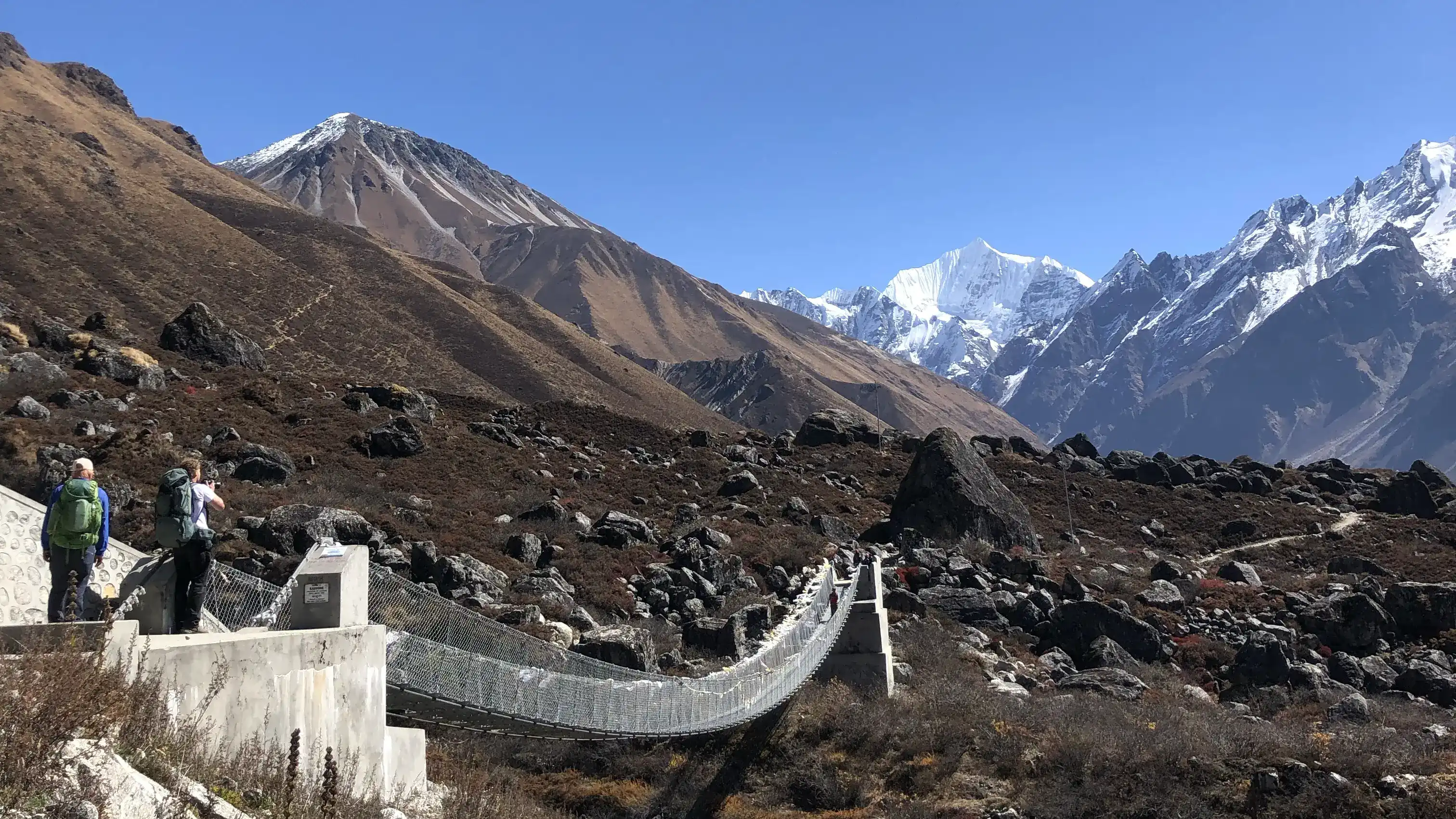
Langtang Region · Moderate grade
Langtang Valley Trek
The route
What the walk is.
The Langtang Valley Trek (8 Days) is an ideal short Himalayan adventure that delivers a complete mountain experience within a limited timeframe. Located just north of Kathmandu, this moderate trek takes you through Langtang National Park to Kyanjin Gompa (3,870 m), offering a perfect mix of nature, culture, and dramatic mountain scenery.
The trek begins with a scenic drive to Syabrubesi, followed by a gradual ascent through lush rhododendron and bamboo forests rich in wildlife. Along the way, trekkers pass traditional Tamang villages where Tibetan Buddhist culture, monasteries, and prayer flags reflect the region’s deep spiritual heritage.
A highlight of the trek is reaching Kyanjin Gompa, a peaceful mountain settlement surrounded by glaciers and high peaks. An acclimatization day here allows trekkers to explore the area and optionally hike to Kyanjin Ri (4,773 m), a spectacular viewpoint offering panoramic views of Langtang Lirung and surrounding Himalayan ranges.
The return journey follows the same scenic trail back through forests and alpine meadows to Syabrubesi. Comfortable teahouse accommodation throughout the route makes the trek accessible and enjoyable even for those new to Himalayan trekking.
With moderate difficulty, gradual altitude gain, and a maximum elevation of 4,773 meters, this trek is suitable for fit beginners and experienced trekkers alike. Overall, the Langtang Valley Trek is perfect for those seeking an authentic, less crowded Himalayan experience in just eight days.
General Information
Detail | Information |
Region | Langtang National Park |
Difficulty | Moderate |
Start/End Point | Syabrubesi |
Daily Walking | 4-7 hours |
Why choose Nepal Visuals for the 8 Day Langtang Valley Trek?
The Himalayas closer to Kathmandu than anywhere else
Langtang is the nearest high Himalayan valley to the capital, yet it remains far quieter than routes in the Annapurna or Khumbu regions. Our guides make the most of that proximity without it feeling like a compromise.
Tamang culture experienced from the inside
The Langtang valley is home to one of Nepal's most distinct Tamang communities. Our guides introduce you to local families, monasteries, and traditions that give the trek a cultural depth well beyond its eight days.
Altitude managed carefully on a steady climb
The trail rises consistently from Syabrubesi to Kyanjin Gompa at 3,870 m. Our guides monitor your health at each stage and pace the ascent so your body adjusts comfortably before reaching the higher viewpoints.
Every permit, transfer, and teahouse arranged in advance
Langtang National Park permits, the Kathmandu to Syabrubesi road transfer, and all teahouse bookings along the valley are confirmed before your trek begins so no morning is lost to logistics.
Full pricing stated clearly before you commit
The complete cost of your 8-day trek is presented at the outset with every included service itemised. No permit fees, accommodation charges, or guide costs appear as surprises once you are on the trail.
Kyanjin Ri and Tserko Ri options guided with your fitness in mind
The optional viewpoint climbs above Kyanjin Gompa offer extraordinary Langtang Lirung panoramas. Our guides assess your energy and condition before recommending which summit attempt suits you best.
A valley with a story worth understanding
Langtang village was devastated by the 2015 earthquake and has been carefully rebuilt by its community. Our guides share that history respectfully, giving the trek a human dimension that makes it quietly unforgettable.
City luggage stored safely while you walk the valley
Leave non-essential bags at our secure Kathmandu facility free of charge before heading to Syabrubesi, and collect everything on your return without any handling fees or complications.
Responsive support throughout all eight days
Our team stays reachable via WhatsApp, Email, and Zoom from your first day in Kathmandu to your last on the trail so any concern gets a fast and helpful response without delay.
Your departure is guaranteed regardless of group size
Solo travellers are welcomed and protected equally. Once your Langtang Valley Trek is confirmed, it runs as planned and your eight days in one of Nepal's most resilient and beautiful valleys are secured.
Day by day
Where you sleep, night by night.
Syabrubesi → Syabrubesi · highest point 4,773 m
- Day 01Tea House (Twin Sharing) · Breakfast, Lunch, Dinner1,450 m
Early morning departure from Kathmandu. Follow the Trishuli River through terraced countryside. Pass Dhunche permit checkpoint before the final winding descent to Syabrubesi. Check into teahouse, meet porter team, gear preparation, and early dinner.
- Day 02Lodge/Tea-House (Twin Sharing) · Breakfast, Lunch, Dinner2,500 m
Trek begins. Cross the suspension bridge into Langtang National Park and climb through dense oak and rhododendron forest. Pass through Bamboo settlement before arriving at Lama Hotel, a cosy cluster of lodges in a forest clearing.
- Day 03Lodge/Tea-House (Twin Sharing) · Breakfast, Lunch, Dinner3,440 m
Continue ascending through thinning forest into open valley with spectacular Langtang Lirung south face views. Pass through Ghoratabel and Thangsyap before arriving at Langtang Village, rebuilt after the devastating 2015 earthquake. Visit the memorial stupas.
- Day 04Lodge/Tea-House (Twin Sharing) · Breakfast, Lunch, Dinner3,870 m
Trek through yak pastures and herder settlements to Kyanjin Gompa. Afternoon visit to the Buddhist monastery and the Langtang yak cheese factory. Stunning views of Langtang Lirung and the Langtang Glacier.
- Day 05Highest point · Lodge/Tea-House (Twin Sharing) · Breakfast, Lunch, Dinner4,773 m
Climb Kyanjin Ri for a 360-degree panorama of the entire Langtang massif. Return to Kyanjin Gompa for afternoon rest.
- Day 06Lodge/Tea-House (Twin Sharing) · Breakfast, Lunch, Dinner2,500 m
Begin the descent. Pass through Langtang Village and continue down through the national park forest back to Lama Hotel for a celebratory dinner.
- Day 07Lodge/Tea-House (Twin Sharing) · Breakfast, Lunch, Dinner1,450 m
Final trekking day. Complete descent through rhododendron and bamboo forest back to Syabrubesi. Celebrate with your guide and porter team over a final dinner.
- Day 08Hotel (Twin Sharing) · Breakfast, Dinner1,450 m
After breakfast, return to Kathmandu by tourist bus. Arrive late afternoon. Transfer to hotel for rest and final dinner.
Fixed departures
12 group dates open.
144 places across them. Or start on any flexible date in the calendar below.
| Departure | Booked | Filling | Left | Status | Book |
|---|---|---|---|---|---|
| Sat, Mar 6, 2027 | 0/12 | 12 | Available | ||
| Sat, Mar 20, 2027 | 0/12 | 12 | Available | ||
| Sat, Apr 3, 2027 | 0/12 | 12 | Available | ||
| Sat, Apr 17, 2027 | 0/12 | 12 | Available | ||
| Sat, May 1, 2027 | 0/12 | 12 | Available | ||
| Sat, May 15, 2027 | 0/12 | 12 | Available | ||
| Sat, Sep 4, 2027 | 0/12 | 12 | Available | ||
| Sat, Sep 18, 2027 | 0/12 | 12 | Available | ||
| Sat, Oct 2, 2027 | 0/12 | 12 | Available | ||
| Sat, Oct 16, 2027 | 0/12 | 12 | Available | ||
| Sat, Nov 6, 2027 | 0/12 | 12 | Available | ||
| Sat, Nov 20, 2027 | 0/12 | 12 | Available |
Prices are per person, twin share, in USD. Book with a 20 % deposit — the balance is due 7 days before departure. Scheduled departures show places left; flexible departures can be booked on any listed start date. Booking terms
| Su | Mo | Tu | We | Th | Fr | Sa |
|---|---|---|---|---|---|---|
| 1 | 2 | 3 | ||||
| 4 | 5 | 6 | 7 | 8 | 9 | 10 |
| 11 | 12 | 13 | 14 | 15 | 16 | 17 |
| 18 | 19 | 20 | 21 | 22 | 24 | |
| 25 | 26 | 28 | 29 | 30 |
- Selected trip dates
- Available
- Filling fast
- Almost sold out
- Sold out
Fri, Oct 23Fri, Oct 30, 2026
8 days · flexible departure
- StartsFri, Oct 23, 2026 · Syabrubesi
- EndsFri, Oct 30, 2026 · Syabrubesi
USD $620 per person, twin share · Deposit today USD $124 (20 %)
On the trail
Photographs from the route.
The whole number
What the price covers.
12 things are in the price and 11 more are named as excluded.
In the price
Professional Support & Safety
- ✓Expert Leadership · A government-certified, highly experienced, and friendly English-speaking trekking guide.
- ✓Group Support · An assistant guide provided for larger groups (8 or more participants).
- ✓Porter Service · Professional porter support (1 porter per 2 trekkers, with a 10 kg limit per person).
- ✓Health Monitoring · Daily vitals checks using an oximeter (twice a day) and a comprehensive first aid kit.
- ✓Staff Welfare · All wages, meals, lodging, transportation, and insurance for your guide and porter team.
- ✓Emergency Coordination · Full assistance in arranging helicopter services for emergencies (costs covered by your insurance).
Permits & Logistics
- ✓Official Fees · All conservation fees (Langtang National Park), permit fees, and government taxes.
- ✓Government Liaison · Full coordination with relevant government offices for trekking formalities.
Accommodation & Meals
- ✓Trek Nutrition · Full board standard meals (breakfast, lunch, and dinner) throughout the duration of the trek.
- ✓Cultural Welcome · A celebratory welcome dinner at a typical Nepalese restaurant in Kathmandu.
Gear & Recognition
- ✓Trekking Essentials · Complimentary use of duffle bags and trekking poles for those who do not have their own.
- ✓Official Achievement · A formal Trek Completion Certificate issued by Nepal Visuals.
Not included
Flights, Visas, and Logistics
- ×International Travel · International flight fares and airport departure taxes.
- ×Entry Requirements · Nepal Entry Visa fees ($50 for 30 days or $125 for 90 days), obtainable upon arrival at the airport.
- ×Baggage Overages · Any extra baggage charges exceeding weight limits.
- ×Miscellaneous · Any expenses or services not explicitly mentioned in the "What's Included" section.
Personal Protection & Equipment
- ×Mandatory Insurance · Comprehensive Travel and Medical Insurance (Compulsory).
- ×Rescue Costs · Actual charges for emergency rescue or evacuation by helicopter (to be claimed via your insurance).
- ×Individual Gear · All personal trekking gear, clothing, and mountain equipment.
Trail & City Expenses
- ×Teahouse Amenities · Out-of-pocket costs for hot showers, internet access, battery recharging, and extra hot drinks or hot water.
- ×Beverages · All alcoholic and non-alcoholic drinks (sodas, bottled water, etc.).
- ×Extended Stays · Any additional nights of accommodation in Kathmandu due to early arrivals, late departures, or early returns from the trail.
Professional Tips and Gratuity
- ×Staff Appreciation · Tips for the guides and porters as a gesture of thanks for their service.
Moderate grade
Is this trek right for you?
You can do this if…
- ✓Walk 5–6 hours a day, some of it steep
- ✓Carry a 5–8 kg daypack
- ✓Comfortable with several days in a row on foot
Recommended preparation
- ✓2–3 months of regular cardio (walking, running, cycling)
- ✓Weekend hikes with a loaded pack
- ✓Read the altitude notes below — you will sleep above 3,000 m
Experience & support
- ✓A good first Himalayan trek
- ✓Guided throughout — a licensed guide is required on Nepal treks
- ✓Unsure about age, health or fitness? Ask us — we tailor the pace
About three months out? Follow our free 12-week trek fitness plan.
Good to know
Additional information.
Who Is This Trek For?
Working Professionals: One week of vacation (plus travel weekends) delivers a complete Himalayan adventure without extended time off work.
First-Time Himalayan Trekkers: Moderate difficulty and shorter duration build confidence without overwhelming commitment.
Time-Constrained Travelers: Touring multiple Asian countries and want to add Nepal trekking without derailing your schedule.
Weekend Warriors: Accustomed to long weekend hiking trips and ready to string together consecutive trekking days.
Budget-Conscious Adventurers: Fewer days means lower total costs while still experiencing everything Langtang offers.
Langtang Valley: Nepal's Best-Kept Secret
While Everest and Annapurna regions host thousands of trekkers daily, Langtang remains blissfully uncrowded. Located just 51 km north of Kathmandu, this narrow high valley carved by ancient glaciers offers pristine wilderness, authentic culture, and spectacular mountain scenery without the tourist masses.
The valley's accessibility makes it perfect for the 8-day format. No expensive flights to Lukla. No extended travel time to remote starting points. Just a scenic 6-7 hour drive from Kathmandu, and you're ready to trek.
The 2015 Earthquake and Recovery
The April 2015 earthquake devastated Langtang Village, killing over 300 people in a massive avalanche. The tragedy profoundly affected every family in the valley. Today, the region has rebuilt with remarkable resilience. Langtang Village now sits on safer ground. Teahouses have reopened. Life continues.
Trekking here now is both safe and meaningful. Your visit directly supports recovery by providing income to rebuilt lodge families, employment for local guides and porters, and economic motivation for communities to thrive again. Tourism validates that the valley is safe and ready to welcome visitors.
Langtang National Park
Established in 1976 as Nepal's first Himalayan national park, Langtang National Park protects 1,710 square kilometers of diverse ecosystems from subtropical forests at 1,500m to alpine terrain and glaciers above 7,000m.
The park shelters:
Over 1,000 plant species including 150 rhododendron varieties
Endangered wildlife like red pandas, snow leopards, Himalayan black bears
46 mammal species including musk deer, Himalayan tahr, langur monkeys
250+ bird species including Himalayan monals (Nepal's national bird)
Trekking through this protected wilderness means walking pristine forests where wildlife thrives, crossing glacial rivers feeding the Ganges watershed, and experiencing successful conservation in action.
Tamang Cultural Heritage
The Langtang Valley's indigenous Tamang people maintain distinct cultural traditions closely related to Tibetan heritage. As you trek, you'll pass through villages where traditional life continues:
Stone houses with intricately carved wooden windows
Buddhist prayer wheels and mani stones with sacred inscriptions
Prayer flags carrying blessings on mountain winds
Small monasteries hosting daily rituals
Traditional agriculture (potatoes, barley, yak herding)
The teahouse lodge system provides genuine cultural exchange. Sharing meals with Tamang families around wood stoves, learning words in their language, these interactions transform trekking from sightseeing into authentic cultural immersion.
The Mountain Panorama
While Langtang lacks 8,000m giants, its peaks create equally stunning scenery:
Langtang Lirung (7,227m): The highest peak in the Langtang Himal, dominating views with its massive south face and hanging glaciers. Many consider it Nepal's most beautiful 7,000m peak.
Gangchempo (6,387m): Also called Fluted Peak for its distinctive ridged profile, this elegant mountain frames the valley's western end.
Dorje Lakpa (6,966m): Visible to the south, this sacred peak appears at various points along the trail.
Langtang Ri (7,205m): Part of the northern wall forming the Tibet border.
These peaks feel intimately close as you trek directly beneath their faces, creating photography opportunities impossible from distant viewpoints.
Kyanjin Gompa and Beyond
Your destination is Kyanjin Gompa (3,870m), a small monastery settlement in a wide glacial valley surrounded by soaring peaks. This ancient Buddhist gompa serves as your base for exploration:
Visit the monastery and witness daily Buddhist ceremonies
Sample yak cheese from the local factory (established with Swiss assistance in the 1950s)
Summit Kyanjin Ri (4,773m) for sunrise panoramas
Explore glacial moraines and alpine meadows
Simply rest and absorb the profound mountain atmosphere
The acclimatization day here is crucial. Despite the tight 8-day schedule, this full rest day allows your body to adjust to altitude while you summit Langtang's premier viewpoint.
Physical Demands
Rated moderate, this trek requires:
Good general fitness (ability to walk 5-7 hours daily)
Consecutive day endurance (6 trekking days in a row)
Comfortable with sustained effort
Mental preparation for altitude up to 4,773m
No technical skills required
The 8-day format is more demanding than 10-day versions simply because there's less downtime. Every day involves trekking except Day 8 (drive back). This sustained effort requires good fitness but is achievable for active people who train properly.
Seasonal Considerations
Spring (March-May): Rhododendron forests explode in vivid blooms, comfortable temperatures, clear skies, very popular.
Autumn (September-November): Crystal-clear mountain views post-monsoon, stable weather, comfortable temps, most popular season.
Winter (December-February): Snow-covered beauty, extreme cold, some teahouses closed, only for experienced trekkers.
Monsoon (June-August): Heavy rain, leeches, landslides, limited views, not recommended.
Altitude Sickness
Risk Level: Moderate
The 8-day timeline creates slightly higher altitude risk than 10-day versions due to less rest time, though the itinerary still includes proper acclimatization.
Ascent Profile:
Day 1: Syabrubesi 1,450m
Day 2: Lama Hotel 2,500m (1,050m gain)
Day 3: Langtang Village 3,440m (940m gain)
Day 4: Kyanjin Gompa 3,870m (430m gain - ideal)
Day 5: Kyanjin Ri 4,773m (acclimatization hike, sleep 3,870m)
Days 6-7: Descend (relief)
Prevention:
Walk slowly despite tight schedule (resist rushing), hydrate constantly (3-4 liters daily), no alcohol especially Days 2-5, listen to body signals immediately, optional Diamox (consult doctor), inform guide of any symptoms.
Symptoms:
Mild: Slight headache, fatigue, breathlessness (normal above 3,500m)
Moderate: Persistent headache, nausea, significant fatigue (warning signs)
Severe: Confusion, severe breathlessness at rest, inability to walk (emergency)
Management:
Guides monitor twice daily with oximeter, immediate response if symptoms worsen, descent available if needed, helicopter evacuation coordinated if severe.
Important: The tight 8-day schedule means you must maintain pace. Serious altitude sickness requiring extra rest days could disrupt timeline. This is why proper acclimatization awareness is crucial.
Before you book
Questions we get most.
Pace & Geography
How is the 8-day itinerary structured for speed?
The 8-day version is a focused "in-and-out" trek. It skips the extra acclimatization days in Kyanjin Gompa, moving directly from the valley floor to the high-altitude settlement to maximize your limited time in the mountains.
What makes Langtang Valley unique compared to Annapurna?
Langtang is often called the "Valley of Glaciers." It is a narrow, deep U-shaped valley carved by ancient ice, offering a much more enclosed and dramatic alpine feel than the wide-open foothills of the Annapurna region.
Is the 8-day trek suitable for first-time trekkers?
Yes, it is one of the most accessible "short" high-altitude treks in Nepal. The trail follows a gradual river ascent, making it physically less punishing than the steep staircases found on the Poon Hill or ABC routes.
Route & Highlights
What is the significance of Kyanjin Gompa?
Kyanjin Gompa (3,870m) is the spiritual heart of the valley. It features an ancient Buddhist monastery and a famous government-run Yak Cheese Factory, where you can taste fresh alpine cheese produced using traditional Swiss methods.
Will I see the effects of the 2015 earthquake?
You will pass the site of the original Langtang Village, which was completely buried in 2015. Seeing the new village rebuilt nearby is a powerful testament to the resilience and strength of the local Tamang people.
What is the highest point reached on the 8-day trek?
While the village of Kyanjin Gompa is at 3,870m, most 8-day trekkers take a morning hike to Kyanjin Ri (4,773m). This viewpoint offers a stunning 360-degree panorama of Langtang Lirung and the surrounding peaks.
Culture & Comfort
What is the "Tamang" culture mentioned in the itinerary?
The Langtang region is primarily inhabited by the Tamang people, whose language, dress, and Buddhist practices are closely linked to Tibet. You will see many prayer walls (Mani walls) and colorful flags throughout the journey.
How are the teahouses in Langtang post-reconstruction?
Because the valley was largely rebuilt after 2015, many teahouses are newer and more modern than those in older trekking regions. They often feature better insulation and cleaner, more standardized room layouts for guests.
Is there electricity for charging cameras and phones?
Yes, most lodges in the Langtang Valley are powered by local micro-hydroelectricity. Charging is generally reliable, though lodges may charge a small fee of $2–$4 to support the local power grid maintenance.
Safety & Logistics
How do we get to the start of the trek?
The trek begins in Syabrubesi, which is a 7-to-8-hour drive from Kathmandu. The road is famously "adventurous" and winding, providing an authentic look at the rural middle hills of Nepal before you start walking.
Do I need a special permit for Langtang?
You need a Langtang National Park Entry Permit and a TIMS card. These are mandatory for all trekkers and help fund the conservation of the endangered Red Panda, which lives in the park’s bamboo forests.
What happens if it snows in Kyanjin Gompa?
Because the valley is narrow, snow can accumulate quickly. Our guides carry basic safety gear and monitor weather reports daily to ensure you don't get "snowed in" at the upper end of the valley.
Gear & Packing Essentials
What is the "must-have" clothing item for the Langtang ridge?
A high-quality windbreaker or "hardshell" jacket is vital. While the valley floor is warm, the wind picks up significantly as you approach Kyanjin Gompa (3,870m). Because the valley is U-shaped, it acts as a wind tunnel, and an outer shell will prevent the "mountain chill" from draining your energy during the final ascent.
Do I need a heavy sleeping bag for only 8 days?
Yes. Even though the trek is short, temperatures in Kyanjin Gompa can drop well below freezing at night. While teahouses provide blankets, they are often not enough during the 2026 spring and autumn seasons. We recommend a 3-to-4-season sleeping bag (rated to -10°C) to ensure you get the recovery sleep needed for the climb to Kyanjin Ri.
Health & Hydration
How much water should I drink in a narrow valley?
Hydration is your primary defense against altitude sickness. You should aim for 3 to 4 liters of water daily. In 2026, most Langtang teahouses offer "Safe Drinking Water" stations to reduce plastic waste; we recommend using a reusable bottle with a filtration system or purification tablets as a double layer of safety.
What is the "Lama Hotel to Langtang" challenge?
The walk from Lama Hotel (2,470m) to Langtang Village (3,430m) is the most demanding day, with a nearly 1,000m elevation gain. On the 8-day pace, it is essential to start early (by 8:00 AM) and maintain a slow, rhythmic "Sherpa step" to avoid overexertion before reaching the high-altitude zone.
Wildlife & Nature
Can I really see Red Pandas in Langtang?
Langtang National Park is one of the best places in Nepal to spot the endangered Red Panda. They live in the dense bamboo forests between Pahi and Riverside. While they are shy, trekking in 2026 with a quiet group increases your chances. Keep an eye on the moss-covered trees during the first two days of your ascent!
What other animals should I look for?
Besides the Red Panda, you are very likely to see Himalayan Tahr (wild goats) grazing on the cliffs near Kyanjin Gompa and Langur monkeys in the lower forests. For bird enthusiasts, the colorful Danphe (Nepal’s national bird) is often spotted in the alpine meadows above 3,500m.
Nutrition & Recovery
Why is "Dal Bhat" the best fuel for the 8-day pace?
Because the 8-day itinerary is compressed, your body needs consistent energy. Dal Bhat (lentils and rice) provides a perfect balance of protein and carbs. Best of all, it comes with "24-hour refills," ensuring you are fully fueled for the next day's climb without the digestive heaviness of meat-based meals.
Is it safe to eat meat at Kyanjin Gompa?
We generally recommend a vegetarian diet once you pass Lama Hotel. In these remote valleys, meat is often carried up by porters over several days without refrigeration. Sticking to fresh local veg, eggs, and the famous Kyanjin yak cheese is a much safer way to avoid stomach issues during your short trip.
Connectivity & Tech
What is the 2026 Wi-Fi situation in the valley?
While many lodges claim to have Wi-Fi, the signal is often satellite-based and can be knocked out by afternoon clouds. If you need to stay connected, an NTC (Nepal Telecom) SIM card usually has the most consistent 4G signal in Langtang Village, though connectivity disappears entirely once you move toward the glaciers.
How do I manage charging on a budget?
Most lodges in Langtang use micro-hydro power, but they charge $2–$5 for a full phone or camera battery charge. To save money over 8 days, bring a 20,000mAh power bank. Charge it fully in Syabrubesi, where it's often free or cheaper, and use it to top up your devices at the higher, more expensive altitudes.
Still have a question? WhatsApp us →