 Nepal Visuals
Beyond the trail's physical challenge lies a world of wonder. Discover nine essential stops, from the serene Tengboche Monastery to secret viewpoints, ensuring you experience the true magic of the Himalayas.
On this page(11)
Most people plan the Everest Base Camp Trek with one goal in mind: reaching the iconic rock at 5,364 meters.
What surprises almost every trekker is how much there is to see, experience, and understand before they ever get there.
The trail to Everest Base Camp is not a corridor to a single destination. It is a journey through one of the most historically significant, culturally rich, and naturally dramatic landscapes on Earth.
Every stop along the route has its own story. Every landmark carries a layer of meaning that goes beyond what it looks like on the surface.
This guide covers the nine most important landmarks and hidden gems on the EBC Trek, what they are, why they matter, and what to look for when you arrive.
1. Sagarmatha National Park: Where the Adventure Officially Begins
The moment your plane touches down at Lukla Airport, you are already inside one of the most extraordinary protected areas in the world.
Sagarmatha National Park covers approximately 1,148 square kilometers of the Khumbu region in northeastern Nepal.
It was established in 1976 and designated as a UNESCO World Heritage Site in 1979, recognized for both its exceptional natural landscape and the living cultural heritage of the Sherpa communities within its boundaries.
The park spans an extraordinary range of altitudes, from around 2,800 meters at its lowest point to 8,848.86 meters at the summit of Mount Everest.
That altitude range creates an equally dramatic range of ecosystems within a single protected area.
The lower sections of the park are covered in dense forests of rhododendron, birch, juniper, and pine.
In spring, the rhododendron forests between Lukla and Namche Bazaar bloom in deep red, pink, and white, creating one of the most visually spectacular trail environments of any trekking route in the world.
Higher up, the forests give way to alpine meadows, rocky moraines, glaciers, and eventually the permanent ice and rock of the high Himalayan terrain.
The park is home to remarkable Himalayan wildlife including snow leopards, red pandas, Himalayan tahrs, musk deer, clouded leopards, and over 150 species of birds.
Most trekkers never see a snow leopard. They are shy, solitary, and extremely well-camouflaged against the rocky terrain above the treeline. But knowing they exist in the landscape around you adds a particular quality to the upper trail.
The name "Sagarmatha" is the Nepali name for Mount Everest, translating as "Forehead of the Sky" or "Goddess of the Sky." The Tibetan name "Chomolungma" means "Goddess Mother of the World."
Both names reflect the deep spiritual significance this mountain holds for the communities that have lived in its shadow for centuries.
Entering Sagarmatha National Park requires a park entry permit, currently approximately NPR 3,000 (around $25 USD) for foreign nationals.
The permit fee directly supports the conservation and maintenance programs that protect this landscape for future generations.
2. The Sherpa Culture Museum, Namche Bazaar: A Window into the World Behind the Trek
Most trekkers pass through Namche Bazaar twice: once on the way up and once on the way down.
Very few take the time to visit the Sherpa Culture Museum, also known as the Sherwi Khangba Center, and that is a significant missed opportunity.
The museum is located in the upper section of Namche Bazaar, a short but steep walk from the main teahouse area.
It was established in 1990 through a collaboration between Lhakpa Sonam Sherpa and a group of Swiss supporters, with a clear mission: to preserve and document the rapidly changing cultural heritage of the Sherpa people.
The museum houses an impressive collection of traditional Sherpa clothing, household artifacts, agricultural tools, religious objects, and mountaineering equipment used in historic Everest expeditions.
The mountaineering collection is particularly fascinating. You can see the kinds of ropes, boots, oxygen equipment, and climbing gear used in expeditions from the 1950s onward, and the difference between that equipment and modern gear makes immediately clear how extraordinary those early ascents truly were.
The museum is managed by Lhakpa Sonam Sherpa and his family, supported by the Mountain Museum Foundation.
It is worth spending at least an hour here during your Namche acclimatization day.
Understanding the culture and history of the people whose trails you are walking makes the rest of the trek significantly more meaningful.
3. Hotel Everest View: The World's Highest Luxury Hotel
At 3,880 meters above sea level, on a ridge above the village of Syangboche near Namche Bazaar, sits one of the most unusually located hotels on Earth.
The Hotel Everest View holds the Guinness World Record as the world's highest-altitude hotel and has done so since it opened in the 1970s.
The hotel was originally conceived as a destination for visitors who wanted to see Everest without completing the full trek.
In the early years, guests were flown directly to the nearby Syangboche airstrip by helicopter, meaning some arrived at nearly 4,000 meters with almost no altitude preparation, a practice that resulted in significant altitude sickness problems and is now strongly discouraged.
Today, most people visit the Hotel Everest View during the Namche Bazaar acclimatization day as a destination hike.
The climb from Namche takes approximately 45 minutes to one hour on a clear trail through dwarf juniper and rhododendron.
The view from the hotel terrace is extraordinary.
Everest, Lhotse, Nuptse, and Ama Dablam are all visible simultaneously on a clear morning, framed by the wide panoramic windows of the terrace and the open mountain sky above.
Sitting with a cup of butter tea or Nepali masala chai on that terrace, looking at four of the world's highest peaks in a single view, is one of the quieter but genuinely memorable experiences of the entire trek.
The hotel also offers overnight accommodation for those who want a more comfortable stay than a standard teahouse, though at prices that reflect its unique status.
Even if you only stop for a drink, the acclimatization hike to the hotel serves a practical purpose: the altitude gain and return to Namche follow the "climb high, sleep low" principle that is central to healthy acclimatization on the EBC route.
4. Tengboche Monastery: The Spiritual Heart of the Khumbu
No landmark on the entire EBC Trek carries more spiritual weight than Tengboche Monastery.
It sits at 3,867 meters on a forested ridge, with a direct and unobstructed view of Ama Dablam rising dramatically to the south and Everest visible in the distance to the north.
The monastery is the largest and most important Tibetan Buddhist monastery in the entire Khumbu region.
It serves as the spiritual center for Sherpa communities throughout the Everest area, and its head lama is one of the most respected religious figures in the region.
The monastery has been destroyed twice in its history and rebuilt both times.
The first destruction came in the 1934 earthquake that caused widespread damage across Nepal.
The second came in 1989, when a fire caused by an electrical fault destroyed much of the original structure.
Both times, the local Sherpa community, supported by international donors including Sir Edmund Hillary's Himalayan Trust, raised the resources and collective effort to rebuild.
The fact that this monastery has been rebuilt twice from near-total destruction says something important about its place in Sherpa cultural and spiritual life.
The current monastery building dates primarily from the 1993 reconstruction and is a beautifully constructed example of traditional Tibetan Buddhist architecture.
The interior houses impressive thangka paintings (traditional Tibetan religious scroll paintings), statues of Buddhist deities, ritual objects, and the kind of deep, resonant atmosphere that takes time to fully absorb.
If you arrive during morning prayers, which typically begin around 6 to 7 AM, step quietly inside and sit.
The sound of monks chanting in low, overlapping voices, accompanied by drums, cymbals, and the deep drone of Tibetan horns, with juniper incense smoke rising toward the painted ceiling and Ama Dablam framed in the windows, is one of the most atmospheric experiences available on any trekking route in the world.
The annual Mani Rimdu festival, held at Tengboche in November, is one of the most celebrated cultural events in the Khumbu.
The three-day festival involves masked dances, theatrical performances depicting stories from Tibetan Buddhist tradition, and large community gatherings.
If your trek timing coincides with Mani Rimdu, it is an experience well worth building your itinerary around.
Remove your shoes before entering the monastery. Walk clockwise around the prayer wheels in the courtyard. Ask before taking photographs inside.
These are not bureaucratic rules. They are acts of respect for a living spiritual community.
5. The Everest Memorial Park, Thukla Pass: Where the Mountain's True Cost Is Remembered
The trail from Dingboche to Lobuche climbs steadily to the Thukla Pass, also known as Dughla, at approximately 4,830 meters.
At the top of that climb, where the trail flattens briefly before continuing toward Lobuche, you enter a different kind of place.
The Everest Memorial Park is a collection of stone cairns and monuments erected in memory of the climbers and Sherpa guides who have died on Everest and in the Khumbu region.
The monuments stand on the ridge in the thin, cold air, each one marking the loss of a specific person.
The names carved into the stones belong to people from across the world: American climbers, British mountaineers, Japanese trekkers, and dozens of Sherpa guides who have spent their careers on the mountain.
Some monuments are for individuals who became legendary figures in mountaineering history. Scott Fischer and Rob Hall, who both died in the catastrophic 1996 storm, are among the names commemorated here.
Others are for Sherpa guides whose names are less known outside Nepal but whose skill, courage, and contribution to Himalayan mountaineering was no less significant.
The 1996 disaster on Everest, in which eight people died in a single storm, is one of the best-documented tragedies in mountaineering history, later detailed in Jon Krakauer's book "Into Thin Air."
The 2014 avalanche in the Khumbu Icefall killed sixteen Sherpa guides in a single event, the deadliest day in the history of Everest expeditions.
Many of the memorials here reflect both of those tragedies.
Standing among the cairns with Everest visible in the distance behind them, you feel the full weight of what the mountain demands of those who attempt it.
This is not a place of discouragement. The climbers commemorated here knew the risks and chose their path with open eyes.
But it is a place of genuine humility, and it tends to change the quality of attention with which trekkers continue up the trail toward Lobuche.
Take your time here. Read the names. Let the place be what it is.
6. The Khumbu Climbing Center, Phortse: Where Sherpa Guides Are Trained
Most trekkers walk past Phortse village without stopping, and most have never heard of the Khumbu Climbing Center.
That is a shame, because the KCC is one of the most important institutions in the history of Himalayan mountaineering.
The center was co-founded with the significant involvement of American mountaineer and author Conrad Anker, one of the most respected figures in modern alpine climbing.
It is now managed by The Juniper Fund, a nonprofit organization committed to improving safety and opportunity for Sherpa climbers and high-altitude workers.
The KCC provides training in technical rock climbing, ice climbing, rope management, crevasse rescue, high-altitude first aid, and emergency response to Sherpa climbers and guides from the Khumbu region.
Before the KCC existed, Sherpa guides learned their skills primarily through direct experience on expeditions, without formal training in rescue and emergency techniques.
The center changed that fundamentally, and the improvement in safety outcomes for both Sherpa guides and the climbers they support has been measurable and significant.
The center is located in Phortse, a quiet Sherpa village above the main EBC trail between Namche Bazaar and Tengboche.
Visiting requires a short detour from the main trail but is entirely feasible during the Namche to Tengboche section of the trek.
The center welcomes visitors and donations, and spending an hour there gives you a completely different perspective on the people and systems that make Himalayan mountaineering possible.
7. Khumjung Monastery and the Yeti Scalp: The Khumbu's Most Intriguing Mystery
The village of Khumjung sits above Namche Bazaar on the ridge below the Everest View Hotel and is one of the largest and oldest Sherpa villages in the Khumbu.
The village monastery is a beautiful and well-preserved example of traditional Sherpa Buddhist architecture, worth visiting for its own sake.
But Khumjung Monastery is famous for one specific and very unusual reason.
Inside the monastery, preserved in a locked wooden box, is what the local community has maintained for generations is the scalp of a Yeti.
The Yeti, known in Western culture as the Abominable Snowman, is a deeply embedded figure in Himalayan folklore. Stories of large, bipedal, ape-like creatures living in the high snow regions of the Himalayas have been reported by Sherpa communities for centuries.
The scalp has been examined multiple times by Western scientists and researchers.
In 1960, Sir Edmund Hillary organized an expedition specifically to investigate Himalayan Yeti evidence and borrowed the Khumjung scalp for scientific analysis in Europe.
The results of that examination were inconclusive. Some scientists suggested the scalp was made from the skin of a Himalayan serow (a type of mountain goat-antelope). Others disputed that finding.
The local community has consistently maintained that the scalp is genuine and of significant spiritual importance, regardless of what scientific analysis concludes.
Whether you approach the Yeti question as a skeptic or with an open mind, the Khumjung Monastery visit is genuinely interesting.
The history of Himalayan Yeti folklore, the 1960 Hillary expedition, and the broader question of what large mammals might inhabit the remote high valleys of Nepal are all fascinating threads that the monastery visit brings into focus.
The monastery is a short walk from the main trail on the Namche acclimatization day hike route.
8. Everest Base Camp and the Iconic EBC Rock: The End of the Trekker's Trail
After all the days of walking, all the altitude and cold and early mornings, you arrive at a rocky, glacier-edged plateau at 5,364 meters and see a collection of prayer flag-draped cairns and, near the center, the rock.
The Everest Base Camp rock is perhaps the most photographed object on any trekking route in the Himalayas.
It sits on the Khumbu Glacier near the main prayer flag cairns and serves as the unofficial finishing marker for trekkers who have completed the journey to Base Camp.
The rock was originally marked with red paint to indicate the location of Base Camp for climbers and trekkers navigating the moraine terrain.
Over the years, as EBC trekking grew in popularity, the rock became progressively more significant as a personal milestone marker.
Trekkers now inscribe their names on it, photograph it, pose beside it, and share it across social media platforms as the defining proof of arrival.
The rock's appearance has changed noticeably over the years as a result of climate change.
The Khumbu Glacier, on which Base Camp sits, is retreating due to rising temperatures in the Himalayas. The ice and snow surrounding and supporting the rock have diminished, and the rock's position relative to the glacier surface has shifted.
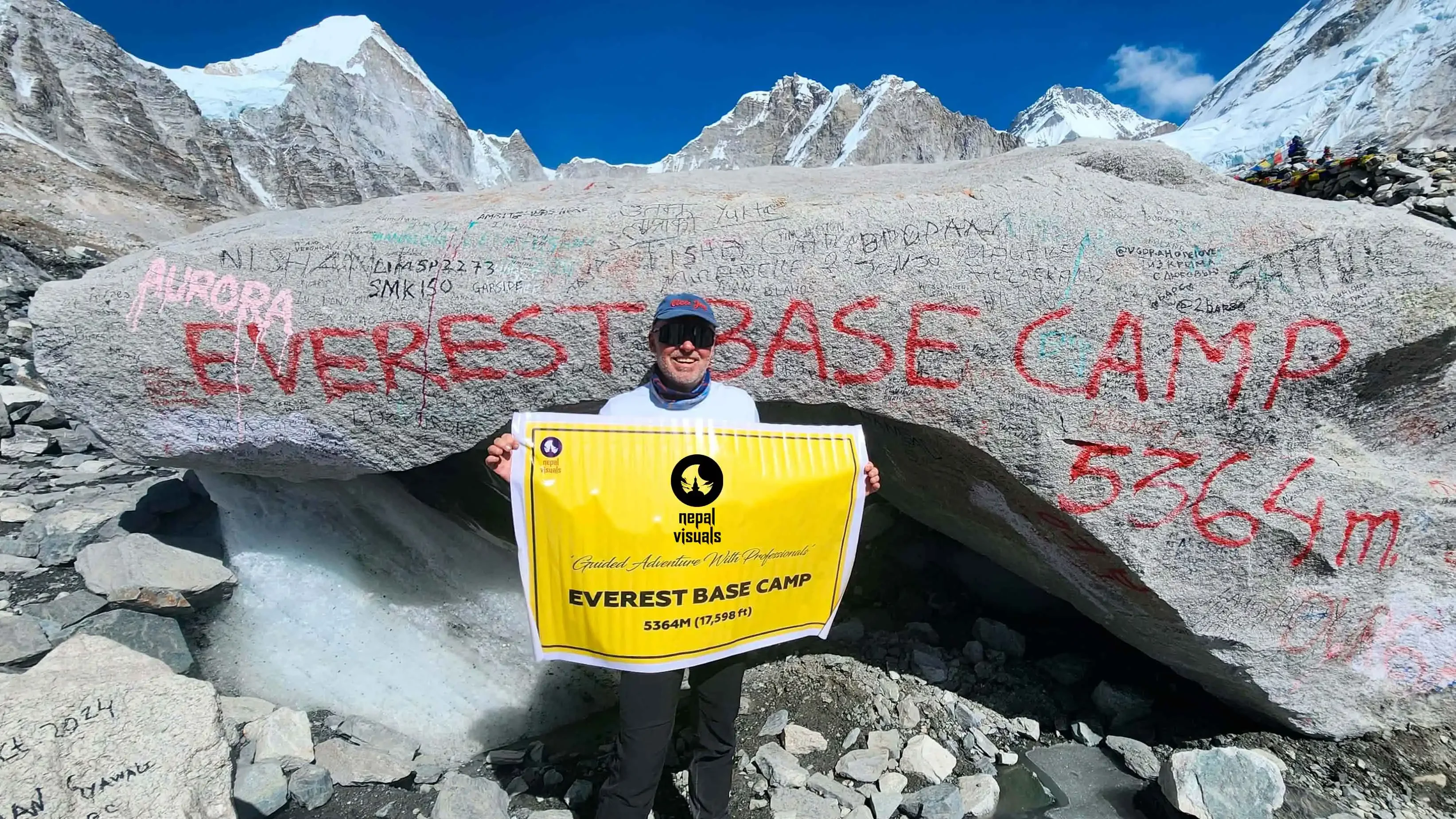 Everest Base Camp Rock
This gradual change is itself a significant data point in the ongoing documentation of climate change effects in the Khumbu.
Beyond the rock, what Base Camp actually shows you is the Khumbu Icefall, and it is extraordinary.
The icefall is one of the most dramatic natural features visible from any trekking route in the world.
It is a continuously moving, constantly shifting cascade of enormous ice towers called seracs, deep crevasses, and unstable ice bridges that forms where the Western Cwm glacier flows steeply down toward Base Camp.
The icefall groans, cracks, and shifts audibly as you stand and watch it.
During spring climbing season, the Base Camp area is transformed into a functioning high-altitude camp city, with hundreds of colorful expedition tents, communications equipment, cooking areas, medical stations, and the constant activity of mountaineers preparing for summit attempts.
Outside of climbing season, Base Camp is empty and quiet, just you, the glacier, the icefall, and the mountain.
Both versions are extraordinary in their own way.
9. The Sagarmatha Next Center: Art, Sustainability, and the Future of Everest
Most trekkers have never heard of Sagarmatha Next, which makes it one of the most genuinely surprising discoveries available on the EBC route.
Located near Namche Bazaar, Sagarmatha Next is the first project of the Himalayan Museum and Sustainability Park, a nonprofit organization working to address the environmental challenges facing the Khumbu region.
The center's mission is to change the way local communities, trekkers, and mountaineers think about waste and environmental responsibility in one of the world's most sensitive and high-profile mountain environments.
The Everest waste problem is well-documented and serious.
Decades of expeditions have left behind oxygen cylinders, tent materials, rope, human waste, food packaging, and equipment at various points on the mountain and throughout the Khumbu region.
The Everest Waste Management Project has been running cleanup expeditions for years, recovering hundreds of kilograms of waste from the upper mountain and Base Camp area each season.
What makes Sagarmatha Next distinctive is its approach to the problem.
Rather than focusing purely on cleanup operations, the center uses art and cultural programming to shift attitudes toward waste at the community level.
Their Art Residency program invites artists to create installations and sculptures using waste materials recovered from the mountain and the trekking region.
One of the most striking examples is a large-scale sculpture installation by photographer and artist Benjamin Von Wong, created entirely from waste materials recovered from the Everest region, designed to draw attention to the scale of the environmental problem in a visual and visceral way.
The center also runs educational programs for local schools, community waste management training, and research into sustainable tourism practices specifically adapted to high-altitude environments.
Visiting Sagarmatha Next takes only a short detour during your Namche Bazaar acclimatization day.
It is the kind of place that prompts genuine reflection on what responsible trekking actually looks like and what it requires from each individual who walks through the Khumbu.
How to Make the Most of These Landmarks
The temptation on the EBC Trek is to keep moving, to focus on the altitude ahead, to save energy for the big days above 4,000 meters.
That instinct is understandable, but it comes with a cost.
The landmarks on this trail are not obstacles or detours. They are the substance of the journey.
Tengboche Monastery at dawn. The memorial cairns at Thukla Pass. The quiet room at the Sherpa Culture Museum. The conversation at the Khumbu Climbing Center. The art at Sagarmatha Next.
These are the moments that separate a trek to Everest Base Camp from the simple act of walking to a rock at 5,364 meters and walking back.
The mountain will be there. The views will be there. Take the time for the rest of it too.
Trek to Everest Base Camp with Nepal Visuals
At Nepal Visuals, we design EBC Trek itineraries that give you the time and guidance to experience the full depth of the Khumbu, not just the trail from Lukla to Base Camp.
Our licensed local guides have deep knowledge of every landmark, every monastery, every cultural site, and every hidden viewpoint along the route.
We take only a limited number of groups each year to maintain the quality and personal attention that your trek deserves.
Spring and autumn slots fill quickly.
Contact Nepal Visuals today to start planning your Everest Base Camp Trek.
Reach us at info@nepalvisuals.com to explore our itineraries and trek packages.
The trail has more to offer than most people realize. Let us show you all of it.
Sharing route guides and trail experience from the high trails of Nepal.