 Nepal Visuals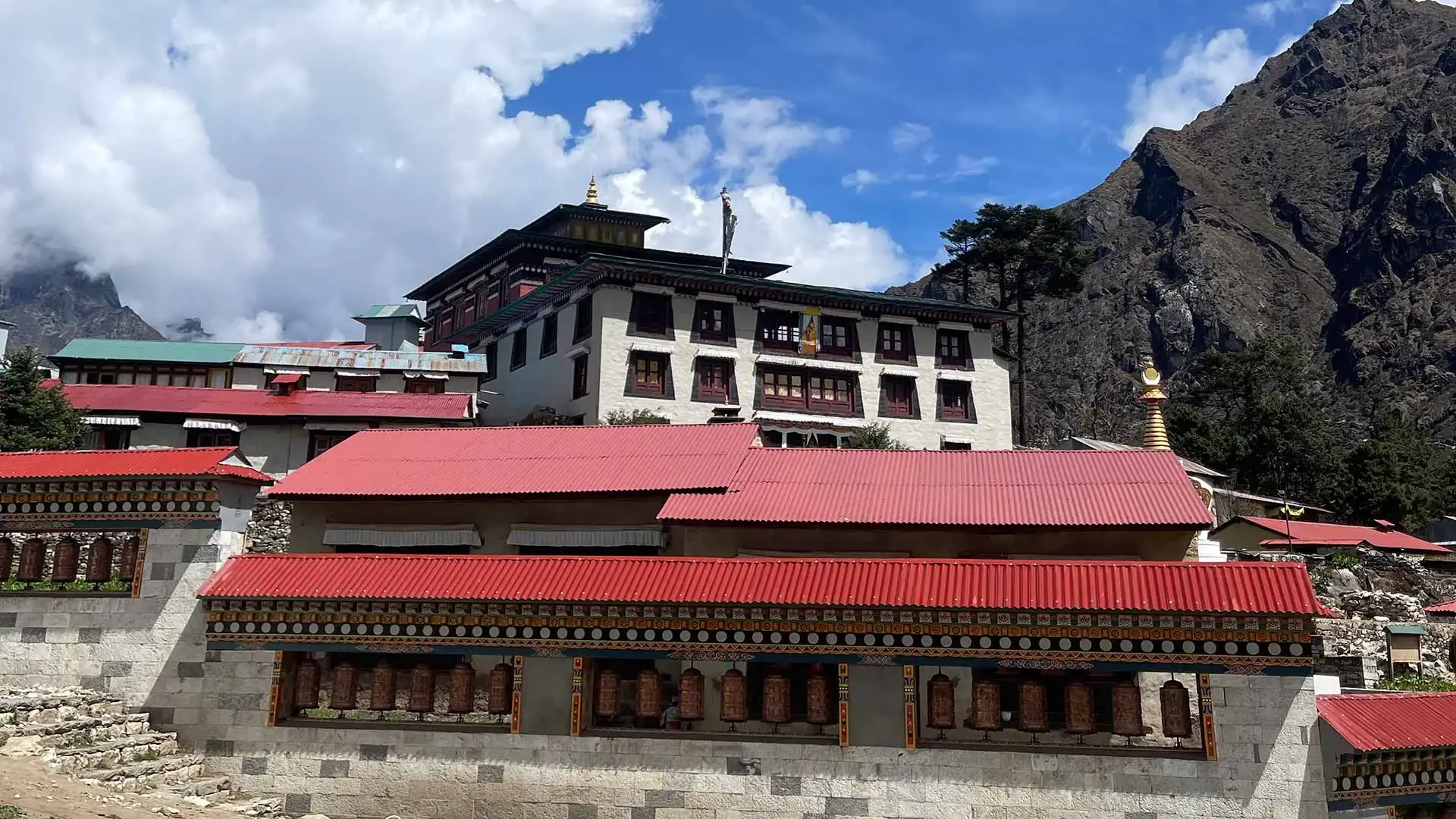
Perched at 3,867 meters against the backdrop of Ama Dablam, Tengboche Monastery serves as the spiritual heart of the Khumbu. This sacred Sherpa site offers a profound blend of vibrant Tibetan architecture, chanting monks, and unparalleled Himalayan vistas.
On this page(11)
There is a moment, somewhere between Namche Bazaar and the high pastures above it, when the trail suddenly opens up and you catch your first proper glimpse of Tengboche Monastery sitting on its ridge. It stops you cold. Not just because your lungs are working harder than usual at this altitude, but because the scene in front of you looks almost too perfect to be real.
A cluster of ochre and white buildings, prayer flags snapping in a cold breeze, and behind it all, the jagged white teeth of Ama Dablam and the distant bulk of Everest. If there is a single image that captures what the Khumbu feels like, this might be it.
This article is for anyone planning to visit Tengboche Monastery, whether you are deep in the research phase, already on the trail, or simply curious about one of Nepal's most remarkable religious sites.
We will cover the elevation, the hike, the history (including the devastating fire), the sunrise, practical tips for booking and respectful visits, how it compares to other monasteries in Nepal, and how to get there from Kathmandu. Consider this your complete Tengboche monastery guide.
Where Exactly Is Tengboche Monastery?
The Tengboche monastery location on the Everest trail puts it at roughly the halfway point between Lukla and Everest Base Camp. Administratively it sits in the Khumbu Pasang Lhamu Rural Municipality in Solukhumbu District.
On the ground, it occupies a broad forested ridge above the confluence of the Dudh Koshi and Imja Khola rivers, surrounded by rhododendron and juniper forests that blaze red and pink in spring.
So is Tengboche monastery on the EBC route? Absolutely. It is not a side trip or optional detour. Every trekker heading to Everest Base Camp passes directly through Tengboche, typically around day four or five of the classic route from Lukla. The monastery sits right on the main trail, which means you do not need to add extra days or kilometers to include it. It includes itself.
The Height of Tengboche Monastery
The elevation of Tengboche Monastery is 3,867 meters above sea level, which works out to 12,687 feet. That height matters for more than just statistics. At this elevation, the air is noticeably thinner than in Kathmandu (at roughly 1,400 meters) or even Namche Bazaar (3,440 meters), and most trekkers feel the difference. Headaches, disrupted sleep, and shortness of breath on minor exertion are all common here.
This is actually one of the reasons experienced guides recommend spending a night at Tengboche rather than pushing on. The height of Tengboche monastery places it in the sweet spot for acclimatization. You gain elevation gradually, your body gets a full night to adapt, and you wake up having earned the morning view.
The Tengboche Monastery Hike: Getting There on Foot
There are no roads to Tengboche. The only way in is by foot, and that is one of the things that makes it special.
Most trekkers arrive via the classic EBC route: fly into Lukla, hike to Phakding on day one, reach Namche Bazaar on day two, rest in Namche for acclimatization on day three, and then continue up through Kyangjuma and Phunki Thanka to Tengboche on day four.
The Tengboche monastery hike from Namche takes roughly four to five hours depending on your pace and how many times you stop to stare at the view (the answer will be many times).
The trail drops steeply from Namche down to the river crossing at Phunki Thanka before climbing hard back up through forest to the monastery ridge. That descent and re-ascent is the part nobody warns you about. Your knees will remember it. But the final stretch through the rhododendron forest, with prayer flags appearing between the trees as you get closer, is genuinely magical.
There is also a helipad near the monastery. The Tengboche monastery helipad is used primarily for emergency evacuations, VIP arrivals, and occasional supply runs. You might see a helicopter land or depart. For most visitors, though, the trail is the only way to arrive, and that feels right.
The Fire That Almost Erased It
You cannot talk about Tengboche monastery without talking about the fire.
On January 19, 1989, an electrical fault in the newly installed power system started a blaze that tore through the main building.
By the time it was over, the monastery that Lama Gulu had founded in 1916 was largely destroyed. Murals, scriptures, sacred statues, and ceremonial objects accumulated over decades were gone. It was a loss that hit the Sherpa community and the broader mountaineering world hard.
The Tengboche monastery fire became a rallying point. The international climbing community, which had long used the Khumbu as its gateway to the world's highest peaks, contributed significantly to the rebuilding effort.
The American Himalayan Foundation played a particularly important role in funding the restoration. By 1993, a new building had risen on the same site, rebuilt in the traditional Tibetan style with reinforced construction and, this time, a fire suppression system.
The rebuilt monastery is beautiful. But when you sit inside during morning prayers, it is worth knowing that you are in a place that was literally resurrected. That history gives the incense smoke and chanting an extra layer of weight.
About Tengboche Monastery: Faith, Culture, and Daily Life
About Tengboche monastery, the most important thing to understand is that it is not a museum. It is a functioning religious institution. Monks live and study here year-round. Daily rituals happen whether tourists are present or not.
The monastery is the spiritual center of the Khumbu region and the largest gompa in the area.
It belongs to the Nyingma school of Tibetan Buddhism, the oldest of the four main schools. The head lama, known as the Rinpoche of Tengboche, holds considerable spiritual authority across the region.
Morning and evening prayer sessions happen daily, and on special occasions the courtyard fills with monks in deep red robes, long horns, and ceremonial drums.
The most spectacular annual event is the Mani Rimdu festival, held in October or November at the full moon. It involves three days of masked dances, rituals, and community gathering that draw locals and trekkers alike. If your timing allows it, try to be in Tengboche during Mani Rimdu.
It is one of the most vivid cultural experiences available on any trek in Nepal.
Sunrise at Tengboche Monastery
Sunrise at Tengboche monastery deserves its own paragraph, possibly its own chapter.
Wake up early, around 5:30 a.m., and walk to the open ground in front of the monastery before the light comes. At first there is just darkness and cold and the silhouettes of the peaks. Then the light hits the summit of Ama Dablam first, turning it from grey to pink to gold. Then Thamserku catches it. Then, if the sky is clear, you see the distant pyramid of Everest beginning to glow above the nearer ridges. The monastery bell rings for morning prayers somewhere behind you.
No photograph truly does it justice, though people certainly try. The collection of Tengboche monastery photos people share online is enormous, and many of them are stunning. But the actual experience of standing there in the cold with the mountains waking up around you is something a camera sensor cannot fully capture.
Tengboche Monastery Visit: Booking and Practical Information
There is no formal Tengboche monastery visit booking system in the way you might reserve tickets for a museum. The monastery is generally open to visitors during daylight hours, and you can simply arrive and walk in. However, there are a few things worth knowing.
During morning and evening prayers, visitors are welcome to sit quietly at the back of the main hall and observe. This is a genuine privilege and should be treated as such. Photography inside the prayer hall is restricted, and you should ask before raising a camera. The monks do not perform for tourists. They are doing their actual work, and you are a guest.
Entry to the main monastery building typically involves a small fee, usually a few hundred Nepalese rupees. This goes toward the upkeep of the monastery. Pay it cheerfully.
Teahouses in Tengboche village, just below the monastery ridge, offer accommodation. Staying the night is highly recommended. It gives you the sunrise, the evening prayers, and the morning prayers, all in one stop.
Tengboche Monastery Respect: How to Visit Well
Tengboche monastery respect is something every guidebook mentions, but it is worth spelling out concretely.
Remove your shoes before entering any building. Dress conservatively. Avoid shorts and sleeveless tops. Walk clockwise around stupas and mani walls, never counterclockwise. Keep your voice low inside the monastery grounds.
Do not touch statues, thangkas, or religious objects. If monks are in prayer, do not interrupt or speak to them. Turn off your phone or put it on silent.
These are not arbitrary rules. They reflect a genuine religious practice that predates tourism in the region by centuries. The Sherpa community welcomes visitors, but they also watch how those visitors behave. Treating Tengboche with care is how you ensure it remains open and welcoming for the trekkers who come after you.
Donations are genuinely appreciated. There is usually a donation box near the entrance, and the monastery does rely on contributions from visitors to maintain the building and support the monks.
Kyanjin Gompa vs Tengboche Monastery: A Quick Comparison
A common question among trekkers planning multiple Nepal adventures is how Kyanjin Gompa compares to Tengboche. Both are high-altitude monasteries in spectacular mountain settings, but they are quite different experiences.
In the comparison of Kyanjin Gompa vs Tengboche monastery, Tengboche is the larger and more architecturally significant of the two. It sits on a more dramatic ridge with a broader panorama, hosts more monks, and has a longer and more complex history. Kyanjin Gompa, in the Langtang Valley, is smaller and more remote in character, sitting at around 3,870 meters (similar elevation) but in a valley that sees considerably fewer visitors than the Everest corridor.
Kyanjin has a more off-the-beaten-track feel. Tengboche has grander ceremony and more cultural activity. If you are specifically interested in an active monastic community with festivals and daily rituals, Tengboche is the stronger choice.
If you prefer solitude and a less-trodden trail, the Langtang Valley and Kyanjin offer something Tengboche cannot match anymore, given the heavy foot traffic on the EBC route.
Both are worth visiting. They are not in competition. But if you can only do one, and your goal is the full Himalayan monastery experience with mountain views that make you understand why people talk about the Khumbu in the way they do, Tengboche is the answer.
Kathmandu to Tengboche Monastery: How to Get Here
The journey from Kathmandu to Tengboche monastery follows a well-established route. Here is how it typically works.
You start with a flight from Kathmandu's Tribhuvan International Airport to Lukla's Tenzing-Hillary Airport. The flight takes about 35 minutes and is famous for being one of the more exciting landings in commercial aviation. Lukla sits at 2,860 meters, and the airstrip ends at a mountain wall.
From Lukla, the trek begins. Day one takes you down to Phakding (2,610 meters). Day two climbs through Monjo and up to Namche Bazaar (3,440 meters). Day three is a rest and acclimatization day in Namche, ideally with a hike to a higher viewpoint for the altitude exposure. Day four continues up through forest and meadow to Tengboche.
Total walking time from Lukla to Tengboche is roughly 16 to 20 hours spread across four days, depending on fitness and pace. The distance is not the challenge. The altitude is the challenge. Take it seriously and do not rush the acclimatization stops.
For those with more money and less time, helicopter charters from Kathmandu or Lukla to the Tengboche helipad exist, though they are expensive and remove much of the point of the journey.
Why Tengboche Stays With You
There is something about Tengboche that trekkers keep coming back to in their memories long after the trip ends. It might be the sunrise. It might be the prayers echoing off stone walls on a cold morning. It might be the specific way Ama Dablam looks from the monastery courtyard, so improbably perfect that it seems like it was placed there deliberately.
More likely, it is the combination: the altitude that slows everything down, the sense of genuine religious life continuing around you, the history of rebuilding after destruction, and the knowledge that you walked to get here, step by step, the same way everyone who ever visited this place walked to get here.
Tengboche monastery is not a backdrop for a selfie. It is a place that has been doing something important for over a century, quietly and seriously, in one of the most dramatic landscapes on earth. Arrive with that understanding, and it will give you something worth carrying home.
Sharing route guides and trail experience from the high trails of Nepal.