 Nepal Visuals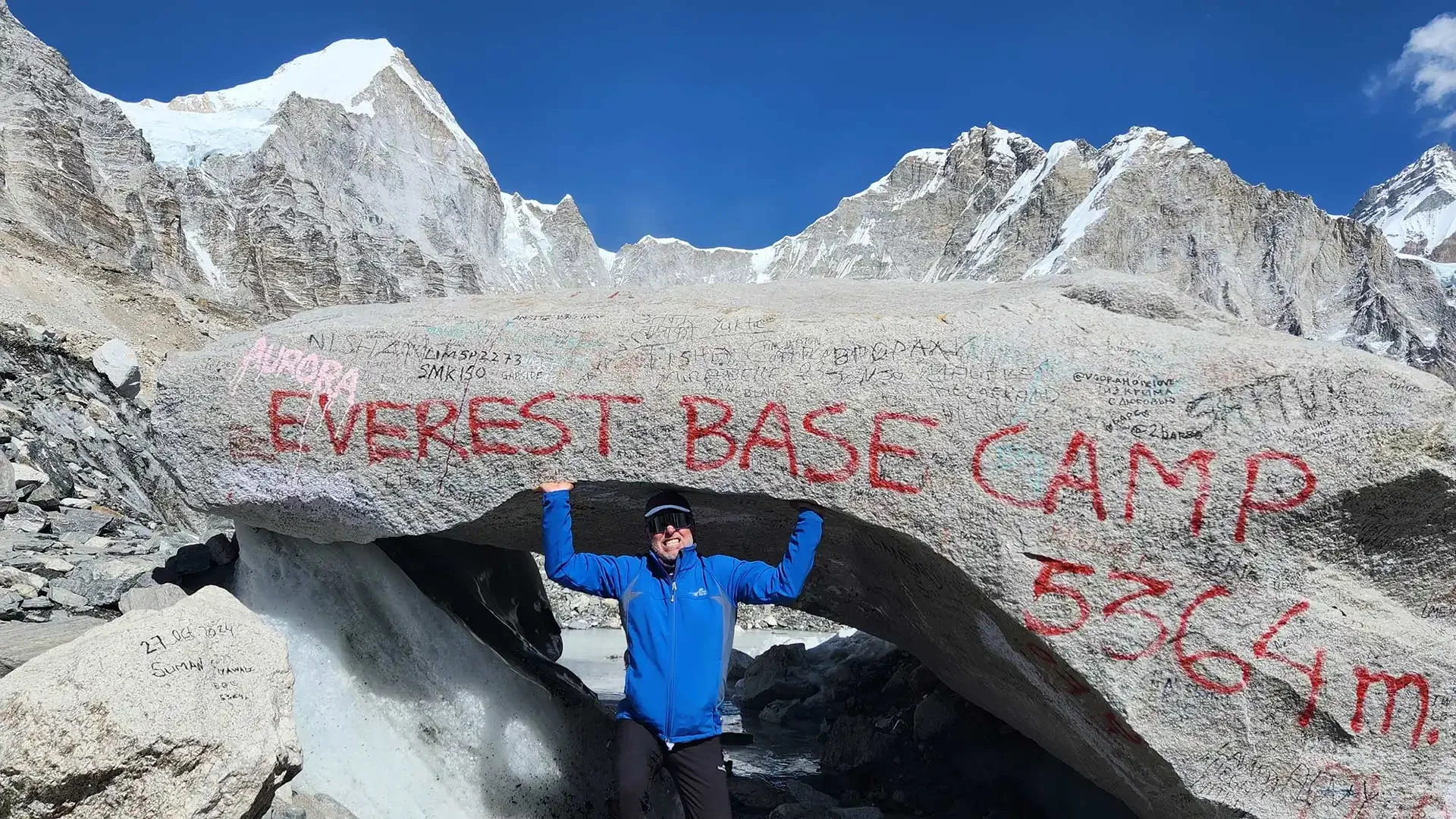
Turn your Himalayan dreams into reality with our approachable guide for first-time trekkers. From physical preparation to daily trail expectations, we simplify the journey so you can confidently conquer the path to Everest Base Camp.
On this page(14)
Most people who have stood at Everest Base Camp did not consider themselves experienced trekkers before they went.
They were teachers, accountants, nurses, engineers, and retirees. People with desk jobs and young children and no prior experience above 3,000 meters. People who asked themselves, more than once during the planning process, whether they were making a mistake.
They were not.
The Everest Base Camp Trek is one of the most accessible high-altitude adventures in the world precisely because it does not require technical climbing skills, specialized mountaineering experience, or elite athletic fitness.
What it requires is preparation, patience, and the willingness to move slowly and deliberately through one of the most extraordinary landscapes on Earth.
This guide is written specifically for first-time trekkers. It covers everything you need to know: what the trek actually involves, where it goes, how your body will respond to altitude, how to prepare physically and mentally, what to pack, what to eat, when to go, and what will surprise you when you get there.
What Is the Everest Base Camp Trek?
The Everest Base Camp Trek is a 130-kilometer round-trip hiking route through the Khumbu region of northeastern Nepal.
It begins with a flight from Kathmandu to Lukla Airport, continues northward through Sherpa villages and glacial valleys, and ends at Everest Base Camp at 5,364 meters at the foot of the world's highest mountain.
The highest point on the standard route is Kala Patthar at 5,545 meters, a rocky viewpoint above Gorak Shep that offers the most celebrated sunrise view of Mount Everest available to non-climbers anywhere in the world.
The trek takes 12 to 14 days round trip, including two essential acclimatization rest days at Namche Bazaar and Dingboche.
You walk five to eight hours per day on well-maintained rocky trails, crossing suspension bridges, passing through ancient Sherpa villages, and gaining altitude gradually over the course of eight to nine days before turning around and descending to Lukla.
No ropes. No crampons. No technical climbing equipment. Just boots, a daypack, and a willingness to keep moving forward.
Where Is Everest Base Camp?
Everest Base Camp is located in the Khumbu region of northeastern Nepal, within Sagarmatha National Park.
Sagarmatha National Park is a UNESCO World Heritage Site established in 1976, covering approximately 1,148 square kilometers of the Himalayan region surrounding Mount Everest.
Base Camp itself sits at an elevation of 5,364 meters (17,598 feet) above sea level on the Khumbu Glacier, at the foot of the Khumbu Icefall.
The approximate GPS coordinates are 28.0043 degrees North and 86.8575 degrees East.
The nearest town is Namche Bazaar at 3,440 meters, approximately four to five days walk from Base Camp on the standard route.
The nearest airport is Tenzing-Hillary Airport in Lukla at 2,845 meters, the starting point for the vast majority of EBC trekkers.
Kathmandu, Nepal's capital, is approximately 135 kilometers southwest of Everest by air.
Who Is the EBC Trek For?
This is the question most beginners ask first, and the honest answer is broader than most people expect.
The EBC Trek is suitable for any reasonably fit adult who is willing to prepare adequately, follow acclimatization protocols, and approach the journey with patience.
You do not need to be a runner, a gym member, or an experienced hiker.
You do not need to have previously trekked at altitude.
You do not need to be young. Trekkers in their 60s and 70s complete the EBC Trek every season. Age is not a barrier provided general health is good and preparation is thorough.
What you do need is the commitment to train consistently for eight to twelve weeks before departure, the discipline to follow acclimatization guidelines on the trail even when you feel strong enough to go faster, and the mental resilience to keep moving on the hard days.
If those conditions describe you, the EBC Trek is within your reach.
The Trek Overview: What Actually Happens Each Day
Understanding the day-by-day structure of the EBC Trek removes the mystery from the planning process and makes the journey feel real and manageable.
Day 1: Fly to Lukla, Trek to Phakding
The adventure begins with the Kathmandu to Lukla flight, one of the most thrilling short-haul flights in commercial aviation.
The aircraft is small, typically a Twin Otter or similar propeller plane, carrying around 15 to 20 passengers.
The flight takes 35 minutes and delivers you from 1,400 meters in Kathmandu to 2,845 meters at Lukla, threading through a narrow mountain valley before landing on a 527-meter sloping runway that ends at the edge of a cliff.
Book a window seat on the left side of the aircraft for the best views of the Himalayan range during the approach.
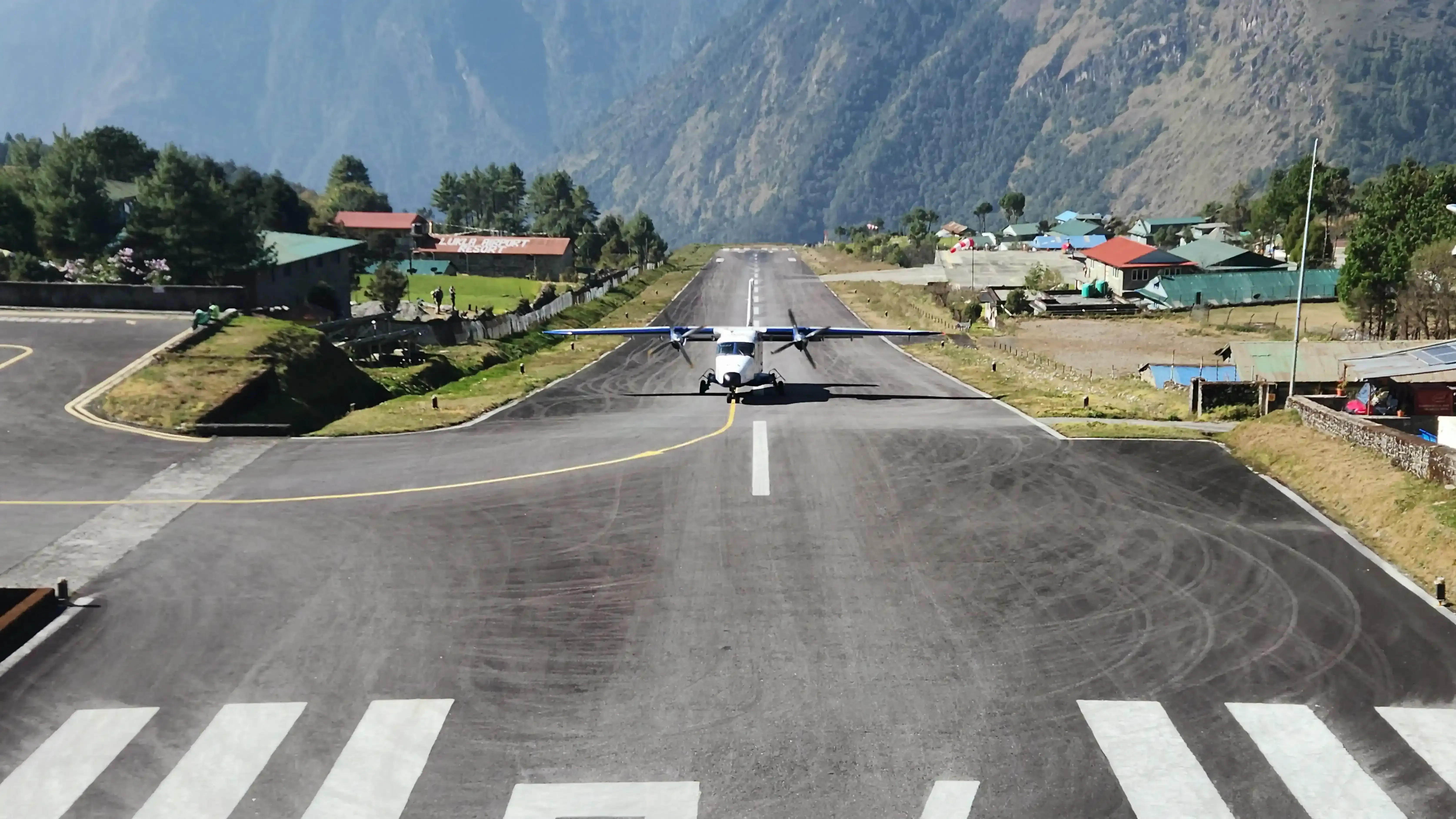 Flying to Lukla
The first day of trekking from Lukla descends gently to Phakding at 2,610 meters through pine forest alongside the Dudh Koshi River.
The descent is intentional: sleeping at a lower altitude than you arrived gives your body a gentle first night of altitude exposure.
Walking time is three to four hours.
The suspension bridges on this section, some stretching 60 to 80 meters above the river, provide an early introduction to the scale of the Khumbu landscape.
Day 2: Phakding to Namche Bazaar
This is the hardest day of the trek in terms of pure elevation gain, and it is important to approach it with that knowledge rather than be surprised by it.
The trail climbs approximately 830 meters from Phakding to Namche Bazaar at 3,440 meters, with the final 600 meters involving a steep, sustained ascent from the Hillary Suspension Bridge.
Walking time is five to six hours.
The Hillary Bridge crossing is a highlight of this day: a long, swaying suspension bridge strung with prayer flags above the rushing Dudh Koshi River, with the trail climbing steeply into the forest above.
Take this day slowly. Start early, take regular short breaks, eat and drink consistently, and do not race the altitude.
The reward for the climb is Namche Bazaar itself, a genuinely remarkable town tucked into a natural amphitheater above the Khumbu valley, with its own bakeries, gear shops, cultural museum, and Saturday market.
Day 3: Acclimatization Day in Namche Bazaar
The acclimatization day in Namche is one of the most physiologically important days of the entire trek, and it should be treated as active preparation rather than a rest day.
Your itinerary will include a hike to the Everest View Hotel at 3,880 meters, approximately 440 meters above Namche.
This hike, combined with sleeping back at Namche, follows the "climb high, sleep low" principle that is central to healthy acclimatization at altitude.
The view from the hotel terrace encompasses Everest, Lhotse, Nuptse, and Ama Dablam simultaneously on a clear morning.
This is likely your first direct view of Everest, and for most trekkers, the moment the mountain appears above the ridge is one of the most emotionally significant moments of the entire journey.
Use the rest of the acclimatization day to explore Namche. Visit the Sherpa Culture Museum (also known as the Sherwi Khangba Center) to understand the history and heritage of the people whose homeland you are walking through.
Attend the Saturday market if your timing coincides with it. Eat well. Sleep early.
Day 4: Namche Bazaar to Tengboche
The trail from Namche to Tengboche climbs through rhododendron and juniper forest, passes through the village of Khumjung, descends to the Dudh Koshi River crossing, and then climbs again to the forested ridge where Tengboche Monastery stands at 3,860 meters.
Walking time is five to six hours.
The descent and re-ascent between Namche and Tengboche surprises first-time trekkers who expect the outward journey to be continuously uphill.
It is not. The Khumbu terrain involves genuine descents and climbs throughout the route, and losing and regaining altitude is a regular part of the experience.
The arrival at Tengboche in the late afternoon, when low cloud often moves through the pine trees and the smell of juniper incense drifts from the monastery courtyard, is one of the most atmospheric moments of the trek.
If you arrive before dark, walk to the monastery front and look south at Ama Dablam rising above the valley. It is extraordinary.
Day 5: Tengboche to Dingboche
The trail continues past Pangboche, the oldest Sherpa village in the Khumbu, and climbs into the open high-altitude valley to Dingboche at 4,410 meters.
Above the treeline now, the landscape changes dramatically.
Stone-walled fields, yak pastures, and vast mountain walls replace the forests of the lower trail. The scale of the surrounding peaks becomes impossible to ignore.
Walking time is five to six hours.
At 4,410 meters, most trekkers notice a clear increase in the effects of altitude compared to Tengboche.
Appetite decreases. Breathing requires more conscious effort on uphill sections. Sleep may be more disrupted than at lower elevations.
These are normal acclimatization responses, not warning signs.
Day 6: Acclimatization Day in Dingboche
The acclimatization hike from Dingboche to Nagarjun Hill at approximately 5,083 meters is a genuinely significant day.
It takes you above 5,000 meters for the first time on the trek, giving your body and mind a direct preview of the altitude category that the remaining days of the trek will operate in.
The views from Nagarjun Hill across to Makalu, Lhotse, Island Peak, and the upper Khumbu are extraordinary.
Return to Dingboche for the night, following the climb-high-sleep-low principle for the second time on the trek.
Day 7: Dingboche to Lobuche
The trail climbs from Dingboche to the Thukla Pass at approximately 4,830 meters, where the Everest Memorial Park stands on the ridge above.
The memorial is a collection of stone cairns honoring climbers who have died on Everest and in the Khumbu. Spend time here. Read the names. Let the place be what it is.
The trail continues to Lobuche at 4,910 meters, arriving in the early afternoon.
The landscape around Lobuche is raw and lunar: grey moraine, permanent glacier, and rock walls on every side. There are no trees. No green. Just altitude and stone and sky.
Walking time is five to six hours.
Day 8: Lobuche to Gorak Shep, Everest Base Camp, and Back
This is the big day, and it is long.
The trail crosses the lateral moraine of the Khumbu Glacier to Gorak Shep at 5,164 meters, then continues across the rocky glacier terrain to Everest Base Camp at 5,364 meters.
Walking time is seven to nine hours total, including the round trip from Gorak Shep to Base Camp and back.
Arriving at Base Camp is a profound moment for every trekker, regardless of how they imagined it would feel.
The Khumbu Icefall rises directly above, groaning and cracking audibly as the glacier moves beneath it. Prayer flag cairns mark the traditional Base Camp location. The surrounding peaks create a bowl of rock and ice that makes you feel simultaneously very small and very far from the ordinary world.
You cannot see the Everest summit from Base Camp. The West Ridge blocks the upper mountain from view. The summit is visible from Kala Patthar the following morning.
Return to Gorak Shep for the night. Eat as much as you can manage. Sleep as well as altitude allows.
Day 9: Kala Patthar at Sunrise, Descend to Pheriche
The alarm goes off at 4 AM.
It is dark and cold. The temperature outside your sleeping bag is somewhere around minus 15 degrees Celsius. Every rational instinct suggests staying where you are.
Get up anyway.
The pre-dawn climb from Gorak Shep to Kala Patthar at 5,545 meters is the most demanding single experience of the entire EBC Trek.
Your headlamp illuminates a narrow cone of rocky trail. The air is thin. Every step is deliberate. The cold at this hour at this altitude is precise and penetrating.
And then you arrive at the cairn at the top of Kala Patthar, and the sky begins to lighten in the east.
The Everest summit, the actual summit, becomes visible above the West Ridge.
As the sun rises, the upper slopes of Everest transition from dark grey to deep gold to blazing white.
Lhotse and Nuptse glow beside it. The Khumbu Glacier spreads below, silver-blue in the early light. The sky above is a shade of blue that does not exist at lower elevations.
This is what you came for.
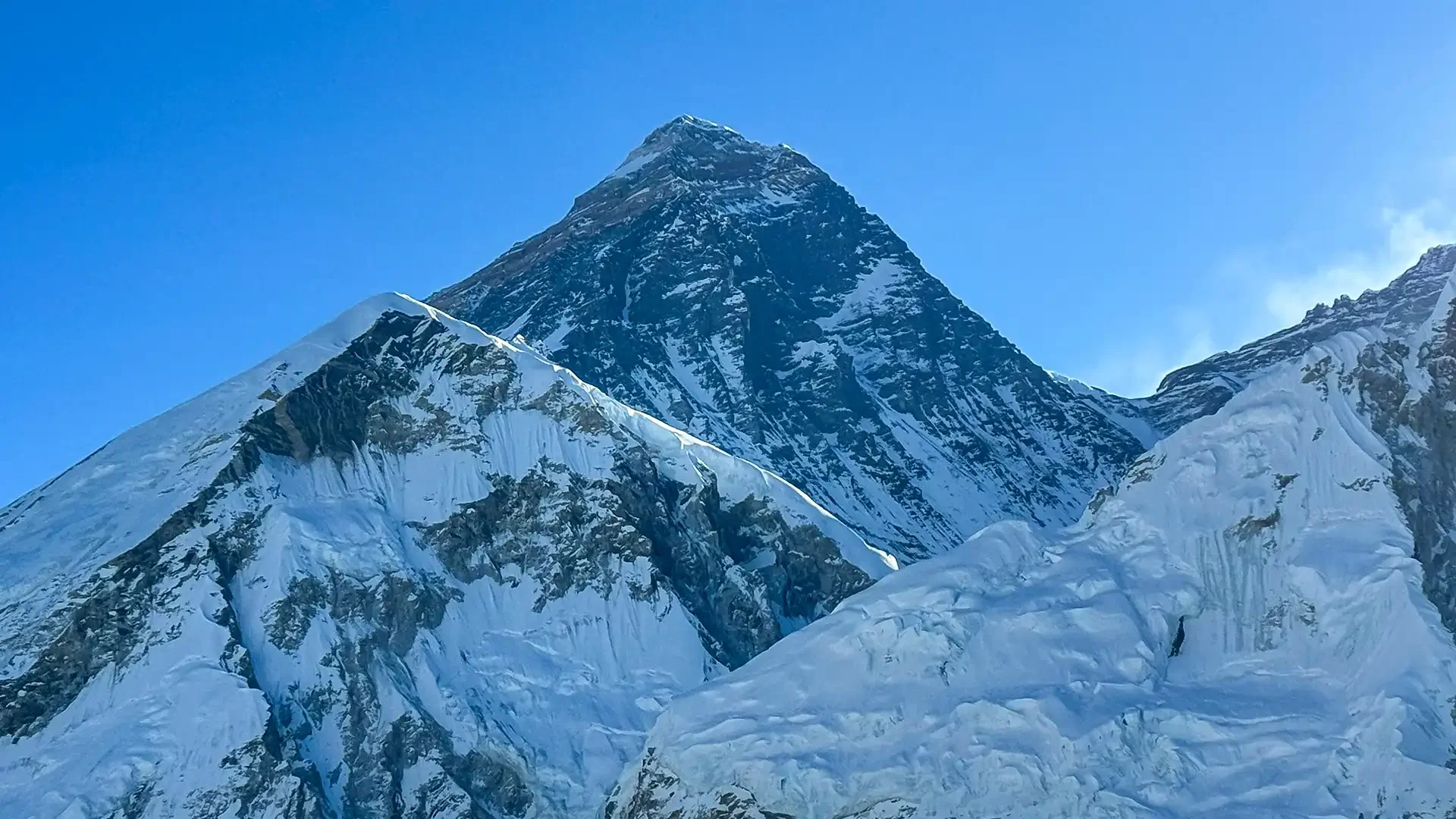
After the sunrise, descend all the way to Pheriche at 4,240 meters. The descent below 5,000 meters brings a noticeable improvement in breathing and energy.
Walking time is six to eight hours total.
Days 10 to 12: Return to Lukla
The return journey covers the outward trail in reverse and moves significantly faster.
What took eight to nine days to ascend is covered in three to four days of descent.
The returning trekker sees the same trail with different eyes. Familiar teahouses look different from the opposite direction. Villages that felt like quick stops on the way up become places worth exploring on the way down.
Most trekkers describe the return as a time of quiet reflection, of processing what the experience has meant and beginning the transition back toward the ordinary world.
Why Beginners Succeed on the EBC Trek
The most important thing to understand about the EBC Trek as a beginner is this: altitude is the great equalizer.
A highly trained athlete who ascends too quickly will develop altitude sickness.
A modestly fit person who follows acclimatization protocols carefully and moves at a steady pace will often outperform them.
The EBC Trek rewards patience, consistency, and self-awareness more than it rewards raw fitness.
This is genuinely good news for first-time trekkers, because patience, consistency, and self-awareness are learnable and practiceable skills that do not require years of athletic training.
Follow the itinerary. Take the acclimatization days seriously. Move slowly and steadily. Drink three to four liters of water per day. Never ascend with altitude sickness symptoms. Tell your guide if you feel unwell.
These principles, applied consistently, are what get first-time trekkers to Base Camp.
Physical Preparation for First-Time Trekkers
You have eight to twelve weeks before your departure date, and how you use that time directly determines how you feel on the trail.
Build Cardiovascular Endurance First
The EBC Trek requires sustained aerobic effort over many consecutive hours and days.
Your cardiovascular system needs to be conditioned to work at moderate intensity for extended periods before you arrive in Nepal.
Begin with 30-minute sessions of brisk walking, jogging, or cycling three times per week in weeks one to three.
Build progressively to 45-minute to 60-minute sessions by weeks seven to nine.
Add at least one long cardio session of 90 minutes or more per week in the final four weeks.
Add Practice Hikes
Hiking trains the specific combination of physical systems needed for the EBC Trek in a way that gym cardio cannot fully replicate.
Begin with one hike per week of one to two hours in weeks one to four.
Build to one hike per week of four to six hours with a 6 to 8 kilogram pack in weeks eight to twelve.
Prioritize terrain with genuine elevation gain. Your calves, quadriceps, and hip flexors need the specific training of sustained uphill walking.
Build Leg and Core Strength
Three strength sessions per week throughout your training period should focus on squats, lunges, step-ups, calf raises, and plank variations.
These exercises directly target the muscle groups most loaded on the EBC Trek and significantly reduce fatigue and injury risk on the trail.
Break In Your Boots
Begin wearing your trekking boots during training hikes from the first week of preparation.
New boots cause blisters. Blisters at 5,000 meters are genuinely miserable.
Eight to twelve weeks of regular boot use before departure is the most effective blister prevention strategy available.
Read More: Train for long hikes and treks without a gym
Altitude Sickness: What Every Beginner Needs to Know
Altitude sickness is the most significant health risk on the EBC Trek, and every first-time trekker should understand it clearly before departure.
What Causes It
Above 3,000 meters, each breath delivers significantly less oxygen to your body than at sea level, because atmospheric pressure decreases with altitude.
Your body compensates by breathing faster, increasing heart rate, and gradually producing more red blood cells over several days.
If you ascend faster than your body can complete these adaptations, you develop Acute Mountain Sickness (AMS).
Early Symptoms to Recognize
Headache is the most common early symptom of AMS and typically the first to appear on the first night at a new altitude.
Nausea, reduced appetite, fatigue beyond what the day's walking explains, dizziness, and disrupted sleep are all common early symptoms.
These symptoms are normal in the first 24 to 48 hours at a new altitude and typically improve with rest and hydration if you do not ascend further.
Serious Warning Signs
The symptoms that require immediate action are a worsening headache that does not respond to rest or pain relief, loss of coordination or difficulty walking in a straight line, confusion or unusual behavior, and a wet or bubbly cough at rest.
These signs indicate a potential progression to HAPE (High Altitude Pulmonary Edema) or HACE (High Altitude Cerebral Edema).
Both are life-threatening. The response to either is immediate descent, regardless of time of day or proximity to your destination.
The Non-Negotiable Rule
Never ascend to a higher sleeping altitude with active symptoms of altitude sickness.
Not even mild symptoms. Not even if you feel like you can push through. Not even if you are tantalizingly close to your goal.
The mountain will be there tomorrow. Descend, rest, recover, and reassess.
The Culture You Will Walk Through
The EBC Trek is not just a physical journey through Himalayan landscape. It is a cultural immersion through one of the most distinctive communities in the world.
The Sherpa People
The Sherpa people are the indigenous community of the Khumbu, descended from Tibetan migrants who crossed the Himalayan passes into Nepal several centuries ago.
Their culture is rooted in Tibetan Buddhism, shaped by centuries of high-altitude agricultural and pastoral life, and transformed in the last 70 years by the mountaineering industry that has made the Khumbu one of the most internationally connected mountain communities on Earth.
The warmth and generosity of Sherpa hospitality is something trekkers consistently describe as one of the most memorable aspects of the entire journey.
Cultural Practices to Respect
Always pass mani walls (long stone rows inscribed with Buddhist mantras) on the left.
Walk clockwise around chortens (white dome-shaped Buddhist shrines) at village entrances and trail junctions.
Remove your shoes before entering monasteries or temples.
Ask before taking photographs of people. A smile and a gesture toward your camera is all that is needed, and most people will respond warmly.
Spin prayer wheels clockwise as you pass them. Each spin releases the prayer carved into the wheel into the world.
These practices cost nothing. They communicate genuine respect for a living spiritual tradition, and they are noticed and appreciated.
Tengboche Monastery
The largest Buddhist monastery in the Khumbu sits at 3,860 meters on a forested ridge above the Dudh Koshi valley.
If you arrive during morning prayers (typically 6 to 7 AM), step quietly inside the monastery hall and sit.
The experience of monks chanting in low, overlapping voices while incense smoke rises toward the painted ceiling and Ama Dablam is visible through the windows is one of the most remarkable cultural moments available on any trekking route in the world.
What to Eat on the Trail
Food on the EBC Trek is better than most first-time trekkers expect, and making good nutritional choices has a direct impact on your energy levels, altitude tolerance, and overall experience.
Dal Bhat: The Trek's Best Meal
Dal bhat (rice, lentil soup, vegetable curry, and condiments) is the most recommended meal on any Nepal trek and for very good reason.
It is freshly cooked at every teahouse, nutritionally balanced for the high-calorie demands of sustained trekking, available with unlimited refills at most establishments, and perfectly suited to high-altitude digestion.
Eat dal bhat at least once per day from Dingboche onward. Your body will thank you.
What to Avoid
Avoid meat above Namche Bazaar. Supply chains become unreliable at higher elevations, and freshness cannot be guaranteed.
Avoid alcohol throughout the trek. Alcohol is a diuretic and vasodilator that worsens altitude sickness risk and disrupts the sleep quality your body needs for recovery and acclimatization.
Avoid large, heavy meals in the evenings at altitude. Your digestive system is less efficient above 4,000 meters, and overeating at night commonly causes nausea and disrupts sleep.
Eating When You Are Not Hungry
Altitude suppresses appetite noticeably above 4,000 meters.
Many trekkers find that food they enjoyed enthusiastically at lower elevations provokes genuine nausea or disinterest at Lobuche and Gorak Shep.
Eat anyway. Under-fueling at altitude significantly worsens fatigue, impairs judgment, and increases altitude sickness risk.
Soups, porridge, and plain rice are the most palatable options when appetite is severely suppressed.
Carry high-energy snacks (protein bars, nuts, dried fruit) for sections when teahouse food feels unmanageable.
Recommended: Full guide on eating habits and food for long treks
The Best Time to Trek for Beginners
Season choice has a direct impact on trail conditions, teahouse availability, flight reliability, and the visual experience of the trek.
For first-time trekkers, the recommended seasons are clear.
Autumn (September to November)
Autumn is the single best season for first-time EBC trekkers and the most popular overall.
The monsoon clears in early September, leaving the air exceptionally clean and the visibility extraordinary.
October is the peak month, with stable weather, dry trails, comfortable daytime temperatures at lower elevations, and the clearest mountain views of any season.
Teahouses are well-stocked and staffed throughout the route.
The primary consideration is that October is busy. Teahouses fill quickly on the popular sections of the trail, and the trail itself sees more traffic during peak weeks.
Book your trek and teahouse reservations in advance for October travel.
Spring (March to May)
Spring is the second ideal season and the choice of trekkers who want to see the rhododendron forests below Namche in bloom.
The lower trail between Lukla and Namche Bazaar is transformed in March and April by rhododendron forests flowering in deep red, pink, and white.
May is when the majority of Everest summit attempts take place, so Base Camp is at its most active and atmospherically charged during this month.
The weather is generally stable in spring, though slightly more variable than autumn.
Seasons to Avoid for First-Timers
Winter (December to February) brings extreme cold at altitude, snow on the upper trail sections, and the psychological difficulty of very long, cold nights above 4,000 meters. Not recommended for first-time high-altitude trekkers.
Monsoon (June to August) brings persistent rain, muddy and slippery trails, leeches on the lower trail, frequent Lukla flight disruptions, and limited mountain visibility. Not recommended for any trekkers who want clear mountain views and comfortable trail conditions.
Essential Gear for First-Time Trekkers
The most important gear decisions for first-time EBC trekkers are also the simplest.
Boots: Waterproof, mid-height or high-cut, with good ankle support. Broken in thoroughly before departure. This is the most important gear purchase you will make.
Sleeping bag: Rated to minus 15 degrees Celsius. Teahouse blankets are not sufficient above 4,000 meters on cold nights.
Down jacket: Essential from Dingboche upward and critical at Gorak Shep and on the Kala Patthar ascent.
Waterproof shell jacket and pants: Gore-Tex or equivalent. Your protection against rain and wind on exposed sections.
Trekking poles: Strongly recommended. They reduce knee stress on descents by approximately 25 percent and improve stability on rocky terrain.
Daypack: 30 to 35 liters with a hip belt. Your porter carries your main duffel bag.
Water purification: A SteriPen or Sawyer Squeeze filter eliminates the need for plastic bottles and saves significant money over 14 days on the trail.
Power bank: 20,000 mAh capacity. Teahouse charging is available but costs extra and is unreliable above Dingboche.
Sunscreen: SPF 50 or higher. UV radiation at 5,000 meters is roughly twice the intensity of sea level.
The Permits You Need
Two permits are required for the EBC Trek in 2026.
The Sagarmatha National Park Entry Permit costs approximately NPR 3,000 (around $25 USD) and is obtainable at the Nepal Tourism Board in Kathmandu or at the park entry in Monjo.
The Khumbu Pasang Lhamu Rural Municipality Permit has replaced the former TIMS card for the Everest region and costs approximately NPR 2,000 to 3,000. It is obtainable in Lukla or Kathmandu.
A licensed guide is now legally required for the EBC Trek under Nepal government regulations introduced in April 2023.
Your trekking agency will arrange all permits as part of the booking process.
The Moments That Will Stay With You
The EBC Trek is full of expected moments: the Lukla landing, the first view of Everest, the arrival at Base Camp, the sunrise from Kala Patthar.
But the moments that stay with trekkers longest are often the ones they did not anticipate.
The specific quality of light on the peaks at 6 AM from the teahouse doorway in Dingboche.
The sound of a yak bell echoing across a high stone-walled valley somewhere above Namche.
A conversation in a teahouse dining room with someone from the other side of the world, over shared dal bhat and bad Wi-Fi and the particular camaraderie that forms when strangers face the same mountain together.
The moment above 4,500 meters when the altitude and the landscape and the effort combine into something that is very hard to name: a clarity, a simplicity, a sense of being completely present in a way that is genuinely rare in modern life.
These moments do not appear in itineraries or gear lists. They appear when you are on the trail, and they are the reason so many trekkers describe the EBC Trek as the most significant journey of their lives.
Your First Step Starts Here: Trek with Nepal Visuals
At Nepal Visuals, we specialize in guiding first-time trekkers to Everest Base Camp safely, thoroughly, and memorably.
We are a locally owned trekking company based in Kathmandu, and every member of our guiding team has deep, current, firsthand knowledge of the EBC route in every season.
For first-time trekkers, we provide pre-trek guidance on preparation, gear, and altitude protocols specific to your departure date and fitness level.
On the trail, our licensed local guides monitor your health and acclimatization continuously, make real-time decisions about pace and rest, and provide cultural context that transforms the walk into an education.
We take a limited number of groups each year to maintain the quality and personal attention that first-time trekkers particularly deserve.
Spring and autumn slots fill quickly.
Contact Nepal Visuals today to start planning your first Everest Base Camp Trek.
Reach us at info@nepalvisuals.com to explore our EBC Trek packages and itineraries.
The trail is ready. The mountain is waiting. Your journey starts now.
Sharing route guides and trail experience from the high trails of Nepal.