 Nepal Visuals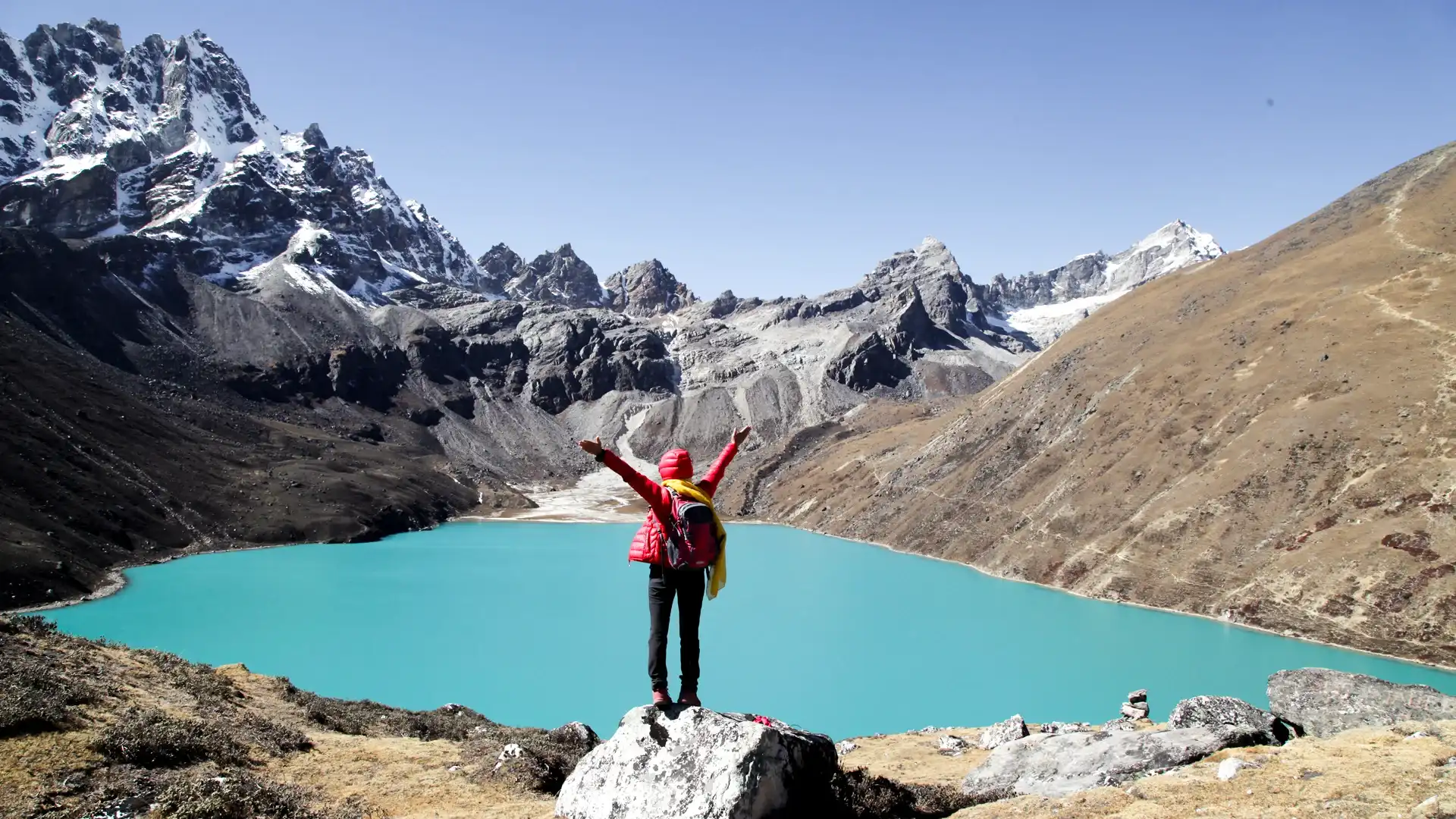
Discover why Gokyo Ri is considered the best 360° Himalayan viewpoint. Complete guide with day-by-day trek cost breakdown, itinerary, altitude tips, best season, and permits for 2026.
On this page(18)
If you have ever dreamed of standing on a peak that puts four of the world's five highest mountains directly in your line of sight, Gokyo Ri is your answer.
At 5,357 metres above sea level, this summit in Sagarmatha National Park offers what many seasoned trekkers believe to be the finest panoramic view in the entire Himalayan range.
This is not just a mountain to tick off a list. It is a place where the sheer scale of the Himalayas becomes fully real, and the reward is a perspective on the natural world that very few people ever get to experience.
What Is Gokyo Ri?
Gokyo Ri is a summit in the Khumbu region of Nepal, sitting directly above the village of Gokyo at the edge of the glaciated Gokyo Valley.
The word "Ri" in Sherpa and Tibetan simply means "peak." So Gokyo Ri translates, plainly, as "the peak above Gokyo."
It is not a technically demanding climb. There are no fixed ropes, no crevasse crossings, and no glacier navigation required.
What greets you instead is a steep but steady hiking trail that rewards effort with one of the most dramatic summit views on earth.
Gokyo Ri is the centrepiece of the Gokyo Valley trek, one of the most rewarding alternatives to the standard Everest Base Camp route. The region falls within Sagarmatha National Park, a UNESCO World Heritage Site.
Why Gokyo Ri Beats Everest Base Camp for Views
This comparison comes up constantly among trekkers, and it deserves a direct answer.
The Everest Base Camp Trek is undeniably iconic. The sense of history hanging over the Khumbu Icefall is extraordinary.
However, from Everest Base Camp itself, you cannot actually see the summit of Mount Everest. The base camp sits in a valley and the view is partially blocked by surrounding terrain.
Gokyo Ri changes everything.
Because it is a proper summit rather than a valley floor, the views are completely unobstructed. From the top, on a clear day, you can see:
Mount Everest (8,848.86 m) rising dramatically to the southeast, its triangular peak unmistakable against the sky
Cho Oyu (8,188 m) looming massively to the northwest, the world's sixth-highest peak dominating the near horizon
Lhotse (8,516 m) flanking Everest to the south, appearing as a broad, formidable wall of ice
Makalu (8,485 m) visible to the east, its distinctive four-sided pyramid rising from the distant ridgeline
Nuptse (7,861 m) completing the Everest massif, its long jagged ridge stretching alongside Lhotse
Gyachung Kang (7,952 m) an enormous peak on the ridge between Cho Oyu and Everest
Kangtega and Thamserku standing guard to the south, their dramatic double summits forming a classic Khumbu silhouette
You also look directly down onto the Ngozumpa Glacier, the longest glacier in the Himalayas outside the polar regions.
Threading through the valley beneath you are the six Gokyo Lakes, their colours shifting from deep jade to vivid turquoise depending on the light and season.
No other trekking summit in Nepal places this many 8,000-metre peaks in the same field of view. That is the core reason why experienced Himalayan trekkers consistently rank Gokyo Ri above Kala Patthar, Poon Hill, and even Island Peak as the finest viewpoint accessible to non-climbers.
The Gokyo Lakes: A Wonder in Their Own Right
Before discussing the trek, it is worth understanding the Gokyo Lakes because they form an inseparable part of the Gokyo Ri experience.
The entire region was designated a Ramsar Wetland of International Importance in 2007, one of the highest-altitude protected wetlands on earth.
There are six main lakes in the Gokyo Valley, each sitting above 4,700 metres. They are fed primarily by glacial meltwater and snowfall, which gives them their signature colour.
The water is remarkably clear, sometimes blue, sometimes intensely green, always striking.
The third lake, Dudh Pokhari, sits directly at Gokyo village. Its name translates to "Milk Lake," a reference to the white glacial silt that occasionally clouds its waters.
The fourth and fifth lakes require additional trekking beyond the village. They are quieter, more remote, and strikingly beautiful.
The sixth lake, Ngozumpa Tsho, sits at the foot of the glacier itself and rewards the extra effort richly.
How to Get to Gokyo Ri
The journey begins in Kathmandu. Most trekkers today fly from Manthali Airport in Ramechhap rather than directly from the capital, a change made to reduce air traffic congestion over Kathmandu.
The drive from Kathmandu to Manthali takes approximately 4 hours. Plan to leave your hotel around 3 AM to catch the first morning flight.
The flight from Manthali to Lukla (2,860 m) takes just 30 minutes. It lands on one of the most exhilarating runways in the world, a narrow uphill strip perched on a Himalayan ridgeline.
The 12-day Gokyo Lakes Trek follows a carefully constructed itinerary that builds altitude gradually, includes proper acclimatization at key stages, and brings you to the Gokyo Ri summit on Day 8 before a well-paced return to Kathmandu.
The key overnight stops on the route are:
Day 1: Kathmandu (1,350 m), arrival and briefing
Day 2: Phakding (2,610 m), after the Manthali to Lukla flight
Day 3: Namche Bazaar (3,440 m), via the Sagarmatha National Park checkpoint
Day 4: Namche Bazaar (3,440 m), acclimatization hike to Everest View Hotel (3,880 m)
Day 5: Dole (4,038 m), where the Gokyo Valley route branches off
Day 6: Machhermo (4,470 m), alpine meadows and Cho Oyu views
Day 7: Gokyo (4,790 m), first views of all six lakes
Day 8: Gokyo Ri summit (5,357 m), then descent to Machhermo (4,470 m)
Day 9: Namche Bazaar (3,440 m), long descent via Mong La
Day 10: Lukla (2,860 m), final trekking day
Day 11: Kathmandu, via Lukla to Manthali flight and drive
Day 12: Departure from Kathmandu
Flights from Manthali to Lukla are prone to weather delays. Always build at least one buffer day into your Kathmandu schedule before the trek begins.
Altitude and Acclimatization: What You Need to Know
Altitude sickness, known medically as Acute Mountain Sickness (AMS), is the single biggest risk on this trek. Understanding it is not optional. It is essential.
What Causes Altitude Sickness?
At altitude, the air contains the same percentage of oxygen (21%) as at sea level, but the air pressure drops significantly. This means each breath delivers fewer oxygen molecules to your lungs.
Above 3,000 metres, the body starts to respond to this lower oxygen availability. For most people, it adjusts within 24 to 72 hours through a process called acclimatization.
When the body does not have enough time to adjust, AMS develops.
Symptoms to Watch For
Mild AMS symptoms include:
Headache
Nausea and loss of appetite
Fatigue and disturbed sleep
Dizziness
These are common above 3,500 metres and not necessarily alarming, provided they do not worsen.
Severe AMS is a medical emergency. Warning signs include:
Extreme fatigue and inability to walk in a straight line
Severe persistent headache that does not respond to ibuprofen
Vomiting and confusion
A crackling or gurgling sound in the lungs
Bluish tinge to the lips or fingernails
Anyone showing severe symptoms must descend immediately, regardless of the time of day or night.
The Golden Rule: Climb High, Sleep Low
The universally accepted principle is simple: climb high, sleep low.
During acclimatization days, trekkers hike to a higher elevation during the day and return to a lower sleeping altitude. This stimulates red blood cell production without the sustained stress of sleeping at extreme altitude.
The 12-day itinerary follows this principle at every stage. Day 4 is a dedicated acclimatization day at Namche, and the descent from Gokyo to Machhermo after the summit on Day 8 deliberately avoids sleeping at the highest point.
Medications for Altitude
Acetazolamide (brand name Diamox) is a prescription medication used as a prophylactic against AMS. It stimulates faster and deeper breathing, helping the body acclimatize more efficiently.
Consult your doctor before the trek. Diamox is not suitable for everyone, particularly those with sulfa drug allergies.
Ibuprofen treats AMS headaches effectively, but pain relief should never be used to mask symptoms and push higher. If symptoms are worsening, the only safe response is descent.
Day-by-Day Trek Cost Breakdown: Gokyo Lakes Trek (12 Days)
Understanding the real cost of this trek before you book is important. The breakdown below is based on the 12-day Gokyo Lakes Trek itinerary and reflects realistic 2026 rates for a fully guided, fully serviced package.
All daily figures include a licensed senior Sherpa guide (USD 40/day) and one porter per two trekkers (USD 28/day), combined daily service cost of USD 68. Accommodation, meals, transport, and permit costs are added per day as applicable.
All costs are shown per person in USD.
Day | Route | Sleep Altitude | Meals | Accommodation | Guide + Porter | Transport / Permits | Day Total |
|---|---|---|---|---|---|---|---|
1 | Arrival in Kathmandu. Airport transfer, welcome briefing, company gear issued | 1,350 m | Dinner | Hotel (twin sharing) | $40 (guide only) | Airport transfer + company gear: $25 | $110 |
2 | 3 AM drive to Manthali. Flight to Lukla. Trek to Phakding (7.5 km, 3-4 hrs) | 2,610 m | B, L, D | Teahouse | $68 | Flight + drive: $180 | $286 |
3 | Phakding to Namche Bazaar (10 km, 5-6 hrs). Enter Sagarmatha National Park at Monjo | 3,440 m | B, L, D | Teahouse | $68 | NP Permit $25 + Khumbu fee $15 = $40 | $148 |
4 | Acclimatization day. Hike to Everest View Hotel (3,880 m), Khumjung village, Hillary Hospital and Monastery | 3,440 m | B, L, D | Teahouse | $68 | nil | $113 |
5 | Namche to Dole via Mong La (11 km, 5-6 hrs). Branch onto the Gokyo Valley route | 4,038 m | B, L, D | Teahouse | $68 | nil | $113 |
6 | Dole to Machhermo (6.8 km, 4-5 hrs). Alpine meadows, Cho Oyu views | 4,470 m | B, L, D | Teahouse | $68 | nil | $116 |
7 | Machhermo to Gokyo (7 km, 5-6 hrs). Ngozumpa Glacier, first full views of the six Gokyo Lakes | 4,790 m | B, L, D | Teahouse | $68 | nil | $120 |
8 | Summit Gokyo Ri (5,357 m). 4:30 AM start. 360-degree views of Everest, Lhotse, Makalu and Cho Oyu. Descent to Machhermo | 4,470 m | B, L, D | Teahouse | $68 | nil | $122 |
9 | Machhermo to Namche via Mong La (17 km, 6-7 hrs) | 3,440 m | B, L, D | Teahouse | $68 | nil | $118 |
10 | Namche to Lukla (18 km, 5-6 hrs). Final trekking day | 2,860 m | B, L, D | Teahouse | $68 | nil | $108 |
11 | Lukla to Manthali flight. Drive to Kathmandu | 1,350 m | B, D | Hotel (twin sharing) | $68 | Return flight + drive: $180 | $298 |
12 | Departure from Kathmandu. Airport transfer | -- | Breakfast | -- | -- | Airport transfer: $10 | $20 |
Trek Package Subtotal: approximately USD 1,672 per person
Additional Costs Not Included in the Package
Item | Estimated Cost (USD) |
|---|---|
Travel insurance (high-altitude + helicopter evacuation cover) | $100 to $200 |
Nepal tourist visa (30-day) | $50 |
Guide and porter tips (TAAN recommended rate, 12 days) | $100 to $150 |
Personal expenses, hot showers, snacks, charging fees | $50 to $100 |
Estimated total trip cost: USD 1,950 to 2,100 per person
This cost analysis is an estimate delivered just to give you an idea of how much the trip might cost.
Do remember that trekking with Nepal Visuals ensures that you do not need to pay many of the costs associated above (like the Khumbu permits & fees). For more on what is included and not included in the cost of Gokyo Ri trek with Nepal Visuals, visit our Gokyo Ri Trek page.
Why Costs Rise with Altitude
Accommodation and meal costs increase as the trek gains altitude. This is not arbitrary.
Every item of food, every blanket, every gas canister above Namche Bazaar must be carried in by porter or yak. There are no roads, no delivery trucks, and no supply chain beyond human and animal muscle.
The premium charged at high-altitude teahouses is a direct and fair reflection of the enormous logistical effort required to keep those lodges stocked and running.
Difficulty Level: Who Can Do This Trek?
The Gokyo Ri trek is classified as moderate to strenuous. It requires no technical climbing skills, mountaineering experience, or specialist equipment.
It does require a solid baseline of fitness and a genuine respect for altitude.
A practical fitness guide: if you can comfortably hike for 5 to 7 hours a day over several consecutive days, including steep ascents and descents, you are likely fit enough.
Age is not a barrier. Trekkers in their 60s and 70s complete this route regularly.
What matters far more than age or athletic ability is patience, willingness to go slowly, and honesty about your own condition each day.
Best Time to Visit Gokyo Ri
The Khumbu region has two primary trekking seasons and two periods that are generally unsuitable for the Gokyo Valley route.
Spring: March to May (Best Season)
This is the most popular and arguably the best time to visit.
Days are long, temperatures are warming, and rhododendrons bloom at lower elevations
Mountain views are clearest in the morning before afternoon clouds build
April coincides with the peak Everest mountaineering season, adding a remarkable energy to the region
Morning temperatures at Gokyo in April range from approximately minus 5 to plus 5 degrees Celsius
Autumn: Late September to November (Equally Excellent)
The monsoon rains wash the atmosphere clean, resulting in crystal-clear mountain views. October is particularly special, with long clear days and intensely blue skies.
The main downside is that nights become progressively colder as November approaches. Early snowfall can occasionally affect the higher trail sections.
Monsoon: June to August (Not Recommended for Most)
Heavy rainfall makes trails slippery, leeches are common at lower altitudes, and views are frequently obscured by cloud and mist.
A small number of experienced trekkers visit during the monsoon for solitude and vivid green scenery, but this requires real flexibility and preparation.
Winter: December to February (For Experienced Trekkers Only)
The trails are dramatically quiet and the views on clear days are exceptional. However, overnight temperatures at Gokyo can drop to minus 20 degrees Celsius or below.
Many lodges above Namche reduce hours or close entirely in winter. Four-season gear and prior cold-weather trekking experience are essential.
Permits Required for the Gokyo Ri Trek
Two permits are required before entering the restricted zone. Missing either one can result in fines, delays, or being turned back at checkpoints.
Sagarmatha National Park Entry Permit
Cost: approximately NPR 3,000 (USD 22 to 25) per person for foreign nationals
SAARC nationals pay a reduced rate
Checked at the official gate in Monjo on Day 3 of the trek
Can be obtained at the Nepal Tourism Board office in Kathmandu or at the Monjo checkpoint
Khumbu Pasang Lhamu Rural Municipality Entry Fee
Cost: approximately NPR 2,000 (USD 15) per person
Collected at a designated checkpoint in the Khumbu region
Directly supports local infrastructure and conservation
When booking through a registered agency, both permits are handled on your behalf and included in the package price. Independent trekkers must arrange them personally.
Nepal's Guide Requirement
Nepal introduced a regulation in 2023 requiring all foreign trekkers to be accompanied by a licensed guide. This applies to the Gokyo Valley trek.
Using a licensed guide is strongly recommended regardless, both for safety and for the cultural and practical knowledge an experienced Sherpa guide brings to every day on the trail.
Guided vs. Independent Trekking
The Case for a Guided Trek
A licensed, experienced Sherpa guide provides far more than trail navigation. Key benefits include:
Real-time altitude assessment and AMS monitoring
Communication with local lodges and villagers in Nepali and Sherpa
Deep cultural context about the Khumbu, its monasteries, and its traditions
Emergency response capability and access to helicopter evacuation contacts
A pulse oximeter and basic medical kit carried on the trail every day
The Case for Independent Trekking
The trail to Gokyo and Gokyo Ri is one of the most well-marked routes in Nepal. Teahouses are available every few hours of walking.
For trekkers with strong prior Himalayan experience and genuine altitude knowledge, independent logistics are manageable. However, the 2023 guide requirement means solo independent trekking is technically no longer permitted for foreign nationals.
Hiring a Porter
Hiring a local porter is one of the best decisions you can make on this trek.
A porter carries your main bag (up to 15 kg), leaving you with only a daypack. This reduces fatigue significantly and dramatically improves your ability to acclimatize.
Sherpa porters are extraordinary in their strength and efficiency. Treating them well, including fair pay, proper gear, and good accommodation, is a core ethical responsibility for every trekker.
What to Pack for Gokyo Ri
Packing right is one of the most important practical preparations for this trek. Essentials include:
Base layer: Moisture-wicking thermal top and bottom
Mid layer: Fleece or down jacket for warmth
Outer layer: Waterproof and windproof shell jacket and trousers
Footwear: Waterproof ankle-supporting hiking boots, properly broken in before the trek
Gaiters: Useful for snow on upper trail sections in spring and autumn
Sleeping bag: Rated to minus 15 degrees Celsius
Trekking poles: Essential on the steep descent from Gokyo Ri and on icy morning sections
Sun protection: High-SPF sunscreen, UV-blocking sunglasses with side shields, sun hat, and glacier glasses for summit day
Medical kit: Pulse oximeter, ibuprofen, oral rehydration sachets, blister treatment, and Diamox if prescribed
Power bank: Charging in teahouses above Namche costs extra and is unreliable
Cash (NPR): No ATMs above Namche Bazaar. Carry all spending money from Kathmandu
Teahouse Accommodation: What to Expect
The teahouse system along the Gokyo Valley is one of the most developed lodge networks in the Nepal Himalayas. From Lukla all the way to Gokyo, a warm bed and a hot meal are available at every overnight stop.
Teahouses range from basic rooms with foam mattresses and shared pit toilets to more comfortable lodges with attached bathrooms and solar-heated showers.
In general, the higher you climb, the more basic and more expensive the accommodation becomes. This reflects the enormous effort required to supply goods to remote high-altitude villages, where everything arrives on the backs of porters or yaks.
The standard trekking menu includes dal bhat (Nepali lentil soup and rice), noodle soups, pasta, pancakes, omelettes, and a range of hot drinks. Dal bhat is always the best value and comes with unlimited refills.
Bringing water purification tablets or a filtered water bottle reduces both plastic waste and ongoing water costs.
The Cultural Landscape of the Khumbu
Trekking to Gokyo Ri is not just a physical journey. It passes through one of the most culturally rich landscapes in Asia.
The Khumbu region is the homeland of the Sherpa people, an ethnic group who migrated from Tibet to Nepal several centuries ago.
The Sherpas are Tibetan Buddhist by faith. Their culture is woven through every aspect of life in this region, from the prayer flags on every ridge to the monasteries perched on impossible outcrops above the valley.
Monasteries, prayer wheels, mani walls (stone walls engraved with Buddhist mantras), and colourful prayer flags are constant companions on the trail.
On Day 4 of the trek, the acclimatization hike to Khumjung passes the Edmund Hillary Hospital, the Edmund Hillary Secondary School, and Khumjung Monastery. The monastery houses what is claimed to be the only Yeti skull in the world.
In Gokyo village, you are surrounded by active yak herding culture. Yaks and their crossbreeds, dzos and dzopkyos, are the transport backbone of the upper Khumbu.
Watching yak caravans navigate the steep trails above the glacial lakes is a reminder of how ancient and resilient this mountain economy truly is.
Responsible Trekking in the Gokyo Valley
The Khumbu receives tens of thousands of trekkers every year. The environmental pressure this creates is real and growing.
Trekking responsibly here matters not just as an ethical principle but as a practical one. The landscape only remains this beautiful because people choose to protect it.
Key principles to follow:
Carry out your waste. Everything you bring in should leave with you
Choose lodges over camping. Staying in teahouses keeps economic benefits within the community
Respect water sources. The Gokyo Lakes are a Ramsar protected wetland. Swimming, washing clothes, and disposing of waste near the lakes is prohibited
Tip your guide and porter fairly. Refer to the Trekking Agencies Association of Nepal (TAAN) tipping guidelines for the recommended amounts
Respect Buddhist customs. Walk clockwise around mani walls, chortens, and prayer wheels. Ask permission before photographing monks or ceremonies. Remove footwear before entering any monastery
Gokyo Ri vs. Kala Patthar: Which Is Better?
Kala Patthar (5,545 m) is the classic Everest viewpoint on the standard Everest Base Camp Trek route. It is slightly higher than Gokyo Ri and offers a famously close view of Everest's south face.
Here is the direct comparison:
Kala Patthar delivers a closer, more powerful view of Everest specifically. If Everest alone is your goal, Kala Patthar wins
Gokyo Ri delivers a far broader panorama, with four 8,000-metre peaks simultaneously visible alongside the Ngozumpa Glacier and the full spread of the Gokyo Lakes below
If the experience of seeing the full sweep of the Himalayan range matters most to you, Gokyo Ri wins convincingly.
The ideal answer is to do both. The Everest Base Camp with Gokyo Lakes Trek connects both valleys in a single itinerary, crossing the Cho La Pass (5,420 m) and allowing you to summit both Gokyo Ri and Kala Patthar.
This combined route is widely regarded as the finest high-altitude trekking experience in Nepal.
Practical Tips From Experienced Trekkers
Start Gokyo Ri at 4:30 to 5:00 AM. Clear mornings give way to cloud and afternoon snowfall in Nepal. An early start is the single best guarantee of a clear summit view
Drink 3 to 4 litres of water daily from Namche upward. Dehydration accelerates AMS and is easy to underestimate in cold conditions where you feel less thirsty
Go slowly. The Nepali phrase "bistari bistari" means "slowly, slowly." It is the unofficial philosophy of Himalayan trekking and the most effective acclimatization strategy available to you
Monitor your blood oxygen saturation daily. A pulse oximeter clips onto a finger and reads the percentage of oxygen in your blood. A reading consistently below 70 percent warrants an immediate conversation with your guide
Book ahead in peak season. In April and October, lodges at Gokyo, Machhermo, and Namche fill up fast. Confirmed reservations at key stops are strongly advisable
Learn a few words. "Namaste" (greeting), "Dhanyabad" (thank you), and "Bistari" (slowly) will earn warm smiles from every local you meet on the trail
Final Thoughts: Why Gokyo Ri Belongs on Every Trekker's List
There are many beautiful places in Nepal. There are many challenging treks.
But Gokyo Ri combines something that very few places anywhere in the world can match: genuine accessibility alongside a panorama so vast and so raw that it permanently changes how you understand the physical world.
You do not need to be a mountaineer to stand on Gokyo Ri. You do not need specialist equipment, years of training, or an enormous budget.
What you need is a willingness to walk slowly, respect the altitude, embrace the discomfort of cold mornings and thin air, and allow yourself the time to reach a summit that will give you back far more than you put in.
The view from Gokyo Ri does not just show you mountains. It shows you four of the highest places on the surface of the earth, gathered together in a single horizon, wrapped in glaciers and clouds.
Go slowly. Breathe deeply. And give yourself the chance to stand there.
Frequently Asked Questions About Gokyo Ri
How long does it take to climb Gokyo Ri from Gokyo village?
The ascent typically takes 2.5 to 4 hours depending on pace and fitness. The descent takes 1.5 to 2.5 hours. Most trekkers complete the full round trip in 5 to 7 hours including time at the summit.
Is Gokyo Ri dangerous?
The main risk is altitude sickness, which is manageable with proper acclimatization and a sensible itinerary. The trail is non-technical and requires no climbing equipment. Trekking with a licensed guide significantly reduces all risk.
Can beginners trek to Gokyo Ri?
Yes, with proper preparation. A physically fit beginner who follows the acclimatization schedule and treks with an experienced guide can successfully reach the summit. The 12-day itinerary is specifically designed with enough rest days and a gradual ascent profile to make this achievable.
What is the best month to visit Gokyo Ri?
April, May, October, and November offer the best combination of stable weather and clear mountain views. October is widely considered the single best month for mountain photography and atmospheric clarity.
Do I need a visa for Nepal?
Yes. Most nationalities require a tourist visa for Nepal. Visas are available on arrival at Tribhuvan International Airport in Kathmandu or through Nepal's online visa application system. Standard tourist visas allow stays of 15, 30, or 90 days.
Can I combine Gokyo Ri with Everest Base Camp?
Yes. The Everest Base Camp with Gokyo Lakes Trek combines both routes in a single trip, crossing the Cho La Pass (5,420 m) to connect the two valleys. This lets you summit both Gokyo Ri and Kala Patthar on the classic Everest Base Camp Trek side, and is considered one of the finest long-distance trekking experiences in all of Nepal.
How much does the Gokyo Ri trek cost in total?
A fully guided, fully serviced 12-day Gokyo Lakes Trek from Kathmandu costs approximately USD 1,950 to 2,100 per person. This includes guide and porter fees, all accommodation, all included meals, domestic flights, permits, and standard package inclusions. Personal travel insurance, Nepal visa fees, and guide and porter tips are additional.
Sharing route guides and trail experience from the high trails of Nepal.