 Nepal Visuals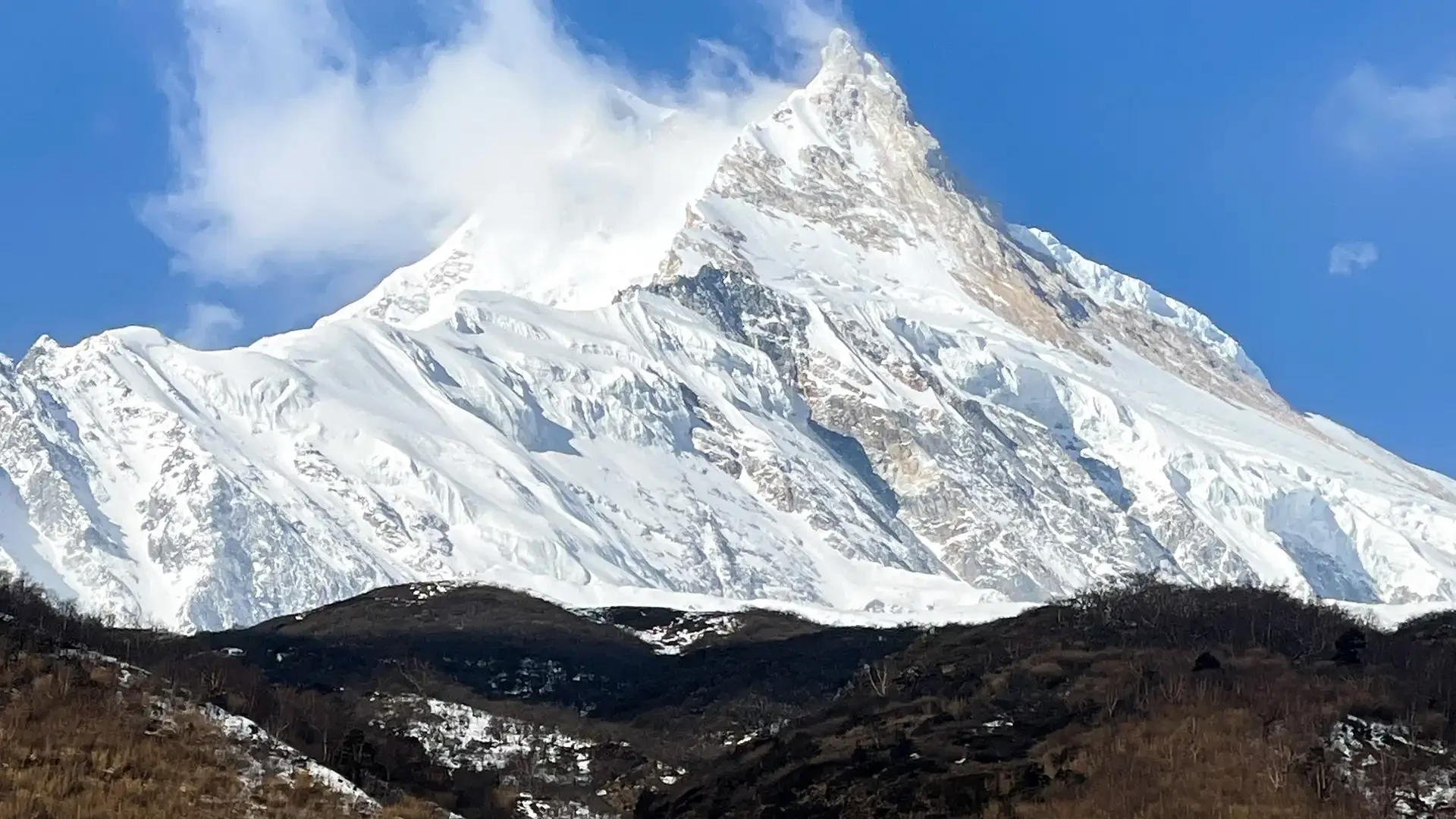
Mount Manaslu; also called the Mountain of the Spirit, is one of the tallest mountains in the world. Learn more about this mountain.
On this page(14)
There is a particular kind of mountain that does not announce itself loudly.
Mount Manaslu is that kind of mountain. It is the eighth-highest peak on Earth, standing at 8,163 meters (26,781 feet), and yet it carries none of the commercial noise that surrounds Everest or the well-worn familiarity of Annapurna. It sits in the Gorkha District of west-central Nepal, quietly enormous, drawing in the people who do their research and decide they want something more than a famous name on their itinerary.
The name comes from the Sanskrit word "Manasa," meaning soul or spirit.
People who have been there say the name fits.
This guide covers everything worth knowing about Mount Manaslu: where it is located, what mountain range it belongs to, how it was formed, how tall it is, how difficult it is to climb, how many people have climbed it, and why it continues to matter to both mountaineers and trekkers.
Where Is Mount Manaslu Located?
Mount Manaslu is located in the Gorkha District of Gandaki Province in west-central Nepal.
It sits approximately 64 kilometers east of Annapurna and lies along the Nepal-Tibet border. The nearest significant town is Gorkha, historically important as the birthplace of Nepal's founding dynasty.
The coordinates place Manaslu at approximately 28.55 degrees North, 84.56 degrees East.
On a map of Nepal, it occupies the northern section of Gorkha District, surrounded by the Manaslu Conservation Area, which covers over 1,663 square kilometers of alpine terrain, glacial valleys, and remote Buddhist villages.
What country is Mount Manaslu in? It is in Nepal, though its northern flanks brush the Tibetan border. All permitted climbing routes and trekking approaches are managed through Nepal's Department of Tourism, and all permits are issued by the Nepali government.
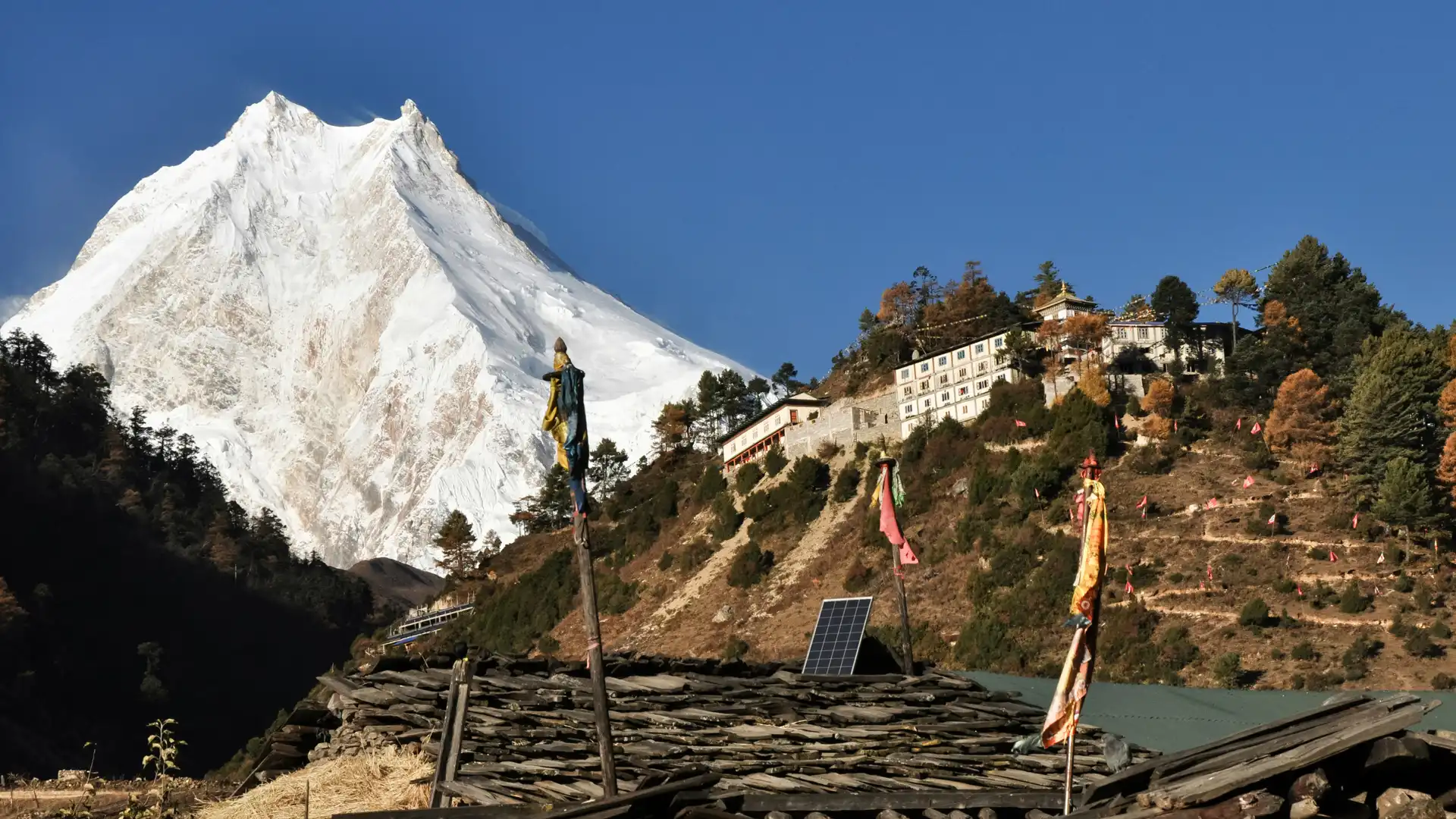 Manaslu in all its glory
What Mountain Range Is Manaslu In?
Mount Manaslu belongs to the Mansiri Himal, a subrange of the greater Nepal Himalayas.
The Mansiri Himal is a compact but formidable group of peaks in the Gorkha region. Manaslu is the dominant peak of the range, flanked by Himalchuli (7,893 meters) to the southeast and Ngadi Chuli (7,871 meters) to the north.
Is Manaslu a fold mountain? Yes.
Like all peaks in the Himalayan range, Manaslu is a fold mountain, formed by the compressional forces of colliding tectonic plates. The rocks that make up its massif were once part of the seafloor of the ancient Tethys Ocean, folded and thrust upward over tens of millions of years into one of the highest points on Earth.
Read More: Manaslu Region and Treks on the Region
How Was Manaslu Formed?
The story of how Manaslu was formed begins roughly 50 million years ago.
At that point, the Indian tectonic plate was moving northward at speed and collided with the Eurasian plate. The collision was not a single event but an ongoing, slow-motion compression that continues today.
The crust buckled under the pressure.
What had been ocean floor and shallow sea sediments was folded, compressed, and thrust upward over millions of years, forming the Himalayan range. Manaslu, like Everest and Annapurna, is a product of this collision.
The rocks that make up the Manaslu massif are primarily metamorphic: schist, gneiss, and quartzite that were transformed by extreme heat and pressure deep within the crust before being pushed to the surface.
Manaslu is part of the Greater Himalayan Sequence, the same geological formation that includes Everest and the other highest peaks on Earth.
The mountain is still rising.
GPS measurements show the Himalayas gaining a few millimeters of elevation per year as the Indian plate continues to push northward. Erosion by glaciers, rivers, and wind works in the opposite direction, constantly wearing the peaks down.
The Budi Gandaki River, which the Manaslu Circuit Trek follows for much of its length, has carved one of the deepest gorges in Nepal over hundreds of thousands of years. Trekking through it, you are walking through a geological timeline that spans tens of millions of years.
The Manaslu Thrust System, a key segment of the Main Central Thrust, is visible in the exposed fault lines and sheer rock faces along the circuit route. Most trekkers walk past these features without realizing what they are looking at.
How Tall Is Mount Manaslu?
Mount Manaslu stands at 8,163 meters (26,781 feet) above sea level.
That makes it the eighth-highest mountain in the world, sitting behind Everest (8,849 meters), K2 (8,611 meters), Kangchenjunga (8,586 meters), Lhotse (8,516 meters), Makalu (8,485 meters), Cho Oyu (8,188 meters), and Dhaulagiri (8,167 meters).
The difference between Manaslu and Dhaulagiri, the peak directly above it on the list, is just four meters.
To put the elevation in perspective: commercial aircraft typically cruise at around 10,000 to 12,000 meters. Manaslu's summit sits at roughly 80 percent of that altitude, in air that contains approximately 37 percent of the oxygen available at sea level.
What Does Manaslu Mean?
Manaslu comes from the Sanskrit word "Manasa," which translates as soul, mind, or spirit.
The mountain is commonly referred to in Nepal as the Mountain of the Spirit.
This is not just a poetic label applied by tourism marketers. The communities of the Manaslu region, particularly those with Tibetan Buddhist heritage in the Nubri and Tsum Valleys, regard the mountain as sacred. In their cosmology, high peaks are not simply geographical features. They are inhabited by powerful spirits and deities that demand respect.
This belief has had practical consequences in the history of Manaslu's climbing.
During early Japanese expeditions in the 1950s, local communities in Sama Gaun initially resisted climbing attempts on the mountain, believing that disturbing its slopes had caused misfortune in their villages. The relationship between the Japanese mountaineering teams and the local communities took years to build, and that effort is part of what makes Manaslu's climbing history distinct from the more transactional atmosphere of some other high peaks.
The Climbing History of Mount Manaslu
Mount Manaslu was first summited on May 9, 1956.
The successful team was a Japanese expedition led by Toshio Imanishi and Gyalzen Norbu Sherpa. Their ascent came after several unsuccessful attempts by Japanese teams in the early 1950s, during which the relationship with local communities had to be carefully rebuilt.
The first ascent made Manaslu the last of the eight-thousanders to be climbed in the 1950s, and it cemented a special connection between Japan and the mountain that persists in mountaineering culture today. Manaslu is still sometimes referred to informally as "the Japanese mountain."
Some notable moments in the mountain's climbing history:
In 1971, Reinhold Messner, who would go on to become the first person to summit all fourteen eight-thousanders, made one of his early Himalayan attempts on Manaslu. It was a formative experience in what became one of the most significant mountaineering careers in history.
By the 1990s and 2000s, commercial expeditions began using Manaslu as an alternative to the increasingly crowded Everest routes. Its reputation as a technically demanding but logistically accessible eight-thousander made it attractive as both a standalone objective and a preparation climb for Everest.
How many people have climbed Mount Manaslu?
As of 2026, Manaslu has seen over 400 successful ascents. It is a relatively accessible eight-thousander by the standards of technical difficulty, but the mountain has also recorded over 80 deaths in its climbing history, making it one of the more statistically dangerous peaks in the world.
The deadliest single incident in Manaslu's recent history occurred in September 2012, when an avalanche struck Camp 3 and killed eleven climbers. The disaster highlighted how quickly conditions on the mountain can turn, regardless of preparation.
Avalanches and unstable seracs are the primary hazards. The weather window for safe climbing is narrow, and conditions change with little warning.
How Hard Is It to Climb Manaslu?
Manaslu is a serious and technically demanding eight-thousander.
It is not considered the most technically difficult peak in Nepal, and for that reason it has developed a reputation as a stepping stone toward Everest. But describing it as easy or accessible by normal standards would be misleading.
The standard route is the Northeast Face, which involves glacier travel, fixed rope sections, and multiple high camps above 6,000 meters. Climbers need solid experience with crampons, ice axes, and high-altitude camping before attempting the summit.
Is Manaslu difficult to climb?
Yes. The combination of altitude, objective hazard from avalanches, and the technical demands of the upper mountain make Manaslu a peak that requires genuine preparation, proper acclimatization, and experienced high-altitude support.
The death rate on Manaslu is not low.
At the same time, among the fourteen eight-thousanders, Manaslu sits somewhere in the middle of the difficulty spectrum. It is more approachable than K2 or Annapurna, but should not be treated as a beginner's high-altitude objective.
Most climbers who attempt Manaslu have already summited peaks in the 6,000 to 7,000 meter range and have spent time at high altitude on multiple previous expeditions.
The climbing season for Manaslu follows the same windows as other Himalayan peaks: spring (April to May) and autumn (September to October). Spring is generally the more popular season.
Is Manaslu Better Than Annapurna?
This is a question that comes up often among trekkers planning a Nepal expedition.
The short answer is that they are different in ways that matter, and the better choice depends entirely on what you are looking for.
Annapurna is more developed.
The Annapurna Circuit has been one of Nepal's flagship trekking routes for decades. Tea houses are comfortable, trail infrastructure is well-established, and the route is familiar enough that independent trekkers with limited Himalayan experience navigate it successfully every year.
Manaslu is more remote.
The Manaslu Circuit requires a restricted area permit, a licensed guide, and a minimum group size of two. The tea houses are simpler. The trails are less maintained. The cultural encounters feel less rehearsed.
For trekkers who want solitude, raw landscape, and a genuine sense of being far from the mainstream, Manaslu consistently delivers something that the more developed Annapurna Circuit no longer can in the same way.
For trekkers who want reliable infrastructure, diverse food options, easier logistics, and the option to adjust their itinerary on the fly, Annapurna is the stronger practical choice.
Neither is objectively better. They are different experiences aimed at different kinds of traveler.
Trekking the Manaslu Region
The Manaslu Circuit Trek is the primary trekking route in the region and one of Nepal's most complete wilderness experiences.
The trail covers approximately 177 kilometers and typically takes 13 to 17 days to complete, depending on acclimatization stops and side trips. It circles Mount Manaslu entirely, beginning in the lower subtropical valleys of Soti Khola or Macha Khola and ending in Dharapani in the Annapurna region.
How many miles is the Manaslu Circuit?
The circuit is approximately 110 miles (177 kilometers) in total length, though this varies slightly depending on the specific start and end points used.
The highest point on the trek is Larkya La Pass at 5,160 meters, which is covered in detail in a separate guide.
The route passes through a remarkable variety of terrain and culture.
In the lower sections, you walk through warm river valleys with terraced farms and suspension bridges over the Budi Gandaki. In the mid-section, Tibetan Buddhist villages like Lho, Samagaun, and Samdo offer views of Manaslu's north face and access to ancient monasteries. In the upper section, the landscape becomes increasingly barren and glacial as you approach the pass.
The Tsum Valley, a remote side valley rich in Tibetan Buddhist heritage, can be added to the circuit for a longer and culturally deeper route.
Trekking permits for the Manaslu Circuit:
Manaslu Restricted Area Permit (RAP): USD 100 per person for the first seven days (September to November), USD 75 per person (December to August)
Manaslu Conservation Area Permit (MCAP): NPR 3,000 per person
Annapurna Conservation Area Permit (ACAP): NPR 3,000 per person
A licensed guide is mandatory. Solo trekking is not permitted in the restricted area.
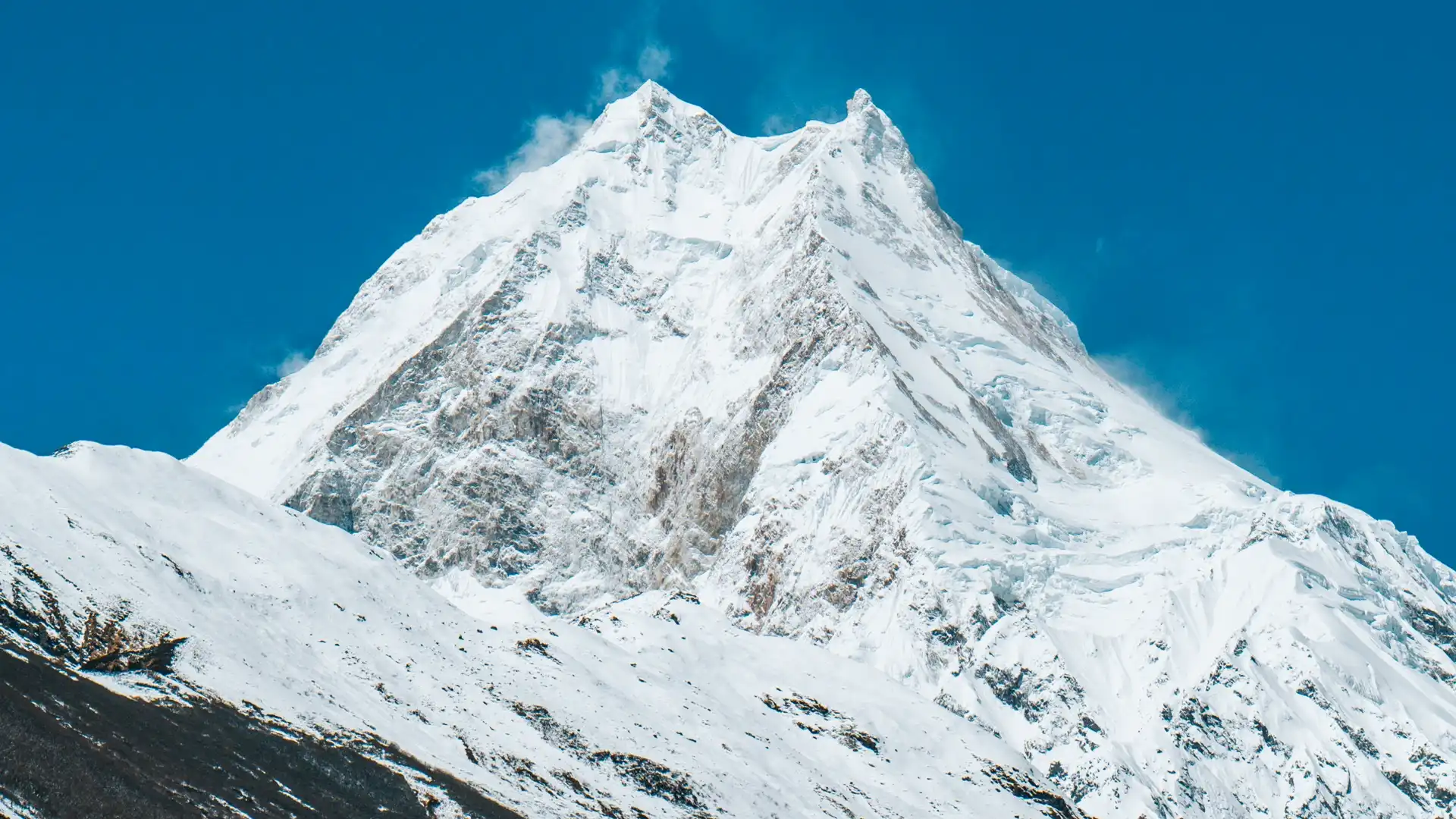 Trekking the Manaslu Circuit
Manaslu Base Camp Trek
The Manaslu Base Camp sits at approximately 4,800 meters and is typically accessed as a side trip from Samagaun during the Manaslu Circuit Trek.
The hike from Samagaun to base camp and back takes one long day or can be split into two days with an overnight at a higher camp.
From base camp, the view of Manaslu's north face is extraordinary.
The mountain fills the horizon in a way that photographs struggle to convey. The scale of the glaciers, the steepness of the upper slopes, and the silence of the high-altitude basin combine to create an experience that most people describe as one of the most affecting moments of their entire trek.
The base camp area is also the starting point for expeditions attempting the summit via the standard Northeast Face route.
Climbing Permit for Manaslu Summit
For those planning a full summit expedition rather than a trekking approach, the climbing permit for Manaslu is issued by Nepal's Department of Tourism.
Permit costs as of 2026:
Autumn season (September to November): USD 1,800 per person
Spring season (March to May): USD 900 per person
Winter and summer seasons: USD 750 per person
These fees cover the royalty component of the permit only.
Logistics including base camp services, high-altitude porters, Sherpa support, fixed rope operations, supplemental oxygen, and expedition insurance are all separate costs. A fully supported commercial Manaslu expedition typically costs between USD 25,000 and USD 45,000 per person depending on the operator and inclusions.
The Manaslu Conservation Area
The Manaslu Conservation Area surrounds the mountain and covers 1,663 square kilometers of protected Himalayan terrain.
It was established in 1998 under the management of the National Trust for Nature Conservation (NTNC) and is managed through the Manaslu Conservation Area Project (MCAP). The area is home to over 1,500 plant species, 110 bird species, and 33 mammal species including snow leopards, red pandas, Himalayan tahr, musk deer, and blue sheep.
The conservation area is not a national park in the strict sense.
It operates on a community-based model that allows local people to live within its boundaries and benefit from the tourism that passes through. Revenue from trekking permits contributes to schools, health posts, and infrastructure in remote villages.
The Nubri and Tsum Valley communities within the conservation area maintain Tibetan Buddhist traditions that have remained largely intact despite decades of outside contact. Monasteries, mani walls, prayer wheels, and chortens are woven into the landscape throughout the region.
Read More: A Comprehensive Guide on Manaslu Conservation Area
Why Manaslu Stands Apart
There are fourteen mountains in the world above 8,000 meters.
Manaslu is eighth on that list, which in one sense places it behind seven others. But elevation rankings do not capture what makes a mountain significant.
Manaslu has a climbing history that spans seven decades and includes some of the most important figures in Himalayan mountaineering. It has a cultural context that predates trekking by centuries. It sits at the center of one of Nepal's most carefully managed conservation areas. And the trekking route that circles it is widely considered one of the best wilderness circuits in Asia.
It is not the most famous mountain in Nepal.
It is not the easiest to reach, the cheapest to permit, or the most photographed. But for those who spend time in its shadow, whether trekking the circuit, visiting base camp, or attempting the summit, it tends to leave a particular kind of impression.
The Mountain of the Spirit earns its name.
Frequently Asked Questions
Where is Mount Manaslu located?
Mount Manaslu is located in the Gorkha District of Gandaki Province in west-central Nepal, approximately 64 kilometers east of Annapurna along the Nepal-Tibet border.
What country is Manaslu in?
Manaslu is in Nepal. All climbing and trekking permits are issued by the Government of Nepal.
How tall is Mount Manaslu?
Manaslu stands at 8,163 meters (26,781 feet) above sea level, making it the eighth-highest mountain in the world.
What does Manaslu mean?
The name comes from the Sanskrit word "Manasa," meaning soul or spirit. The mountain is commonly known as the Mountain of the Spirit.
What mountain range is Manaslu in?
Manaslu belongs to the Mansiri Himal, a subrange of the Nepal Himalayas in the Gorkha District.
Is Manaslu a fold mountain?
Yes. Like all Himalayan peaks, Manaslu is a fold mountain formed by the collision of the Indian and Eurasian tectonic plates approximately 50 million years ago.
How was Manaslu formed?
Manaslu was formed by the collision of the Indian and Eurasian tectonic plates, which compressed and folded ancient seafloor sediments upward over tens of millions of years to form the Himalayan range.
How hard is it to climb Manaslu?
Manaslu is a serious and technically demanding eight-thousander. It involves glacier travel, fixed ropes, and multiple high camps above 6,000 meters. It is considered more accessible than peaks like K2 or Annapurna I, but it is not suitable for inexperienced high-altitude climbers. The death rate in its climbing history reflects genuine objective hazard.
How many people have climbed Mount Manaslu?
As of 2026, Manaslu has recorded over 400 successful ascents since its first summit in 1956.
Is Manaslu better than Annapurna?
They are different experiences. Manaslu offers more solitude, rawer terrain, and a less developed infrastructure. Annapurna offers more comfort, easier logistics, and a more established trail network. The better choice depends on what kind of trekking experience you are looking for.
How many miles is the Manaslu Circuit?
The Manaslu Circuit Trek covers approximately 177 kilometers, or roughly 110 miles.
When was Manaslu first climbed?
Manaslu was first summited on May 9, 1956, by Toshio Imanishi and Gyalzen Norbu Sherpa as part of a Japanese expedition.
Sharing route guides and trail experience from the high trails of Nepal.