 Nepal Visuals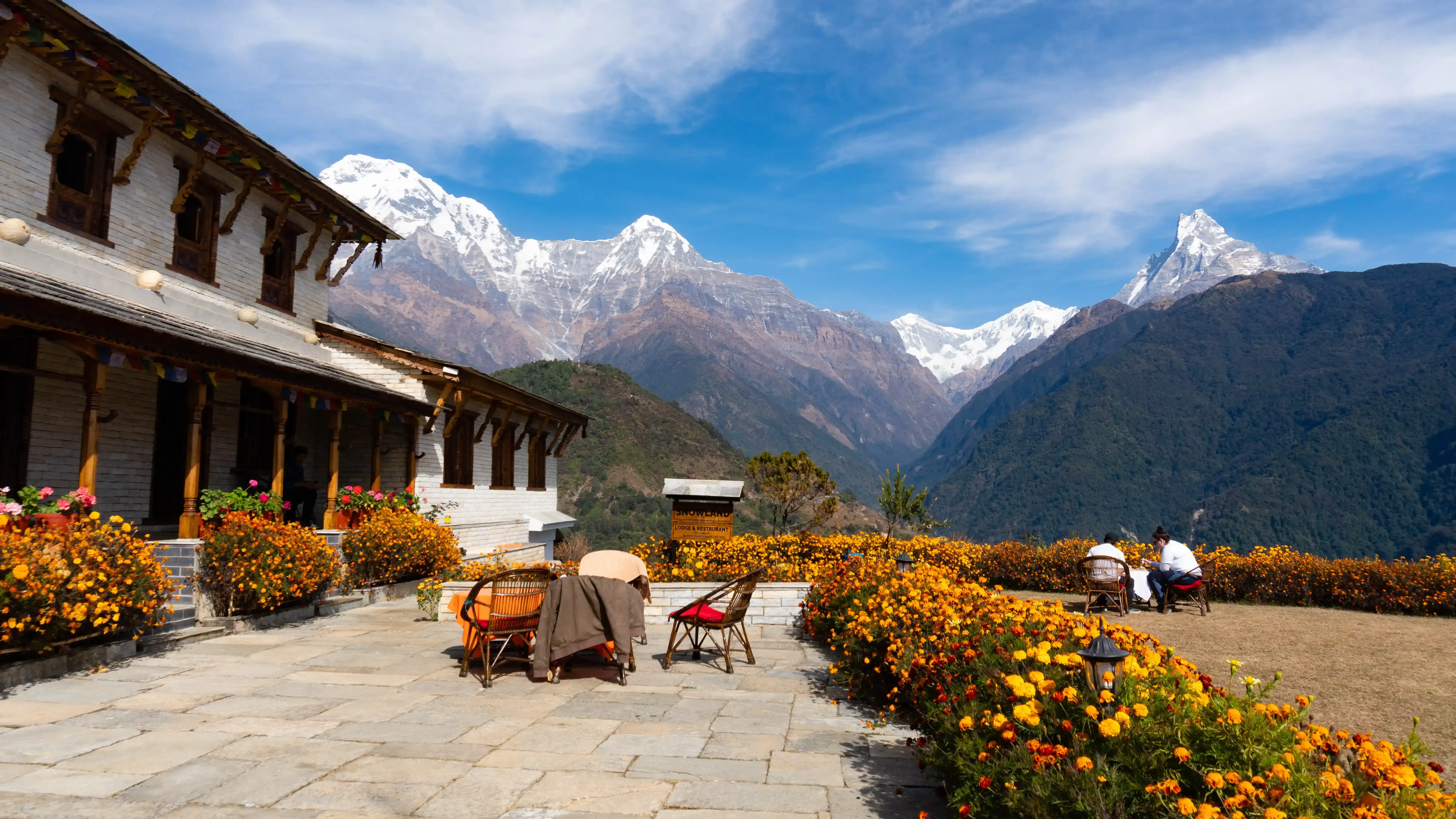
Annapurna Region · Easy grade
Ghorepani Poon Hill Trek
The route
What the walk is.
The Ghorepani Poon Hill Trek (9 Days) is Nepal’s most popular beginner friendly Himalayan trek, offering a perfect introduction to trekking with rewarding mountain views and cultural experiences. This easy adventure combines the famous Poon Hill sunrise viewpoint (3,210 m), traditional Gurung villages, blooming rhododendron forests, and comfortable travel arrangements from Kathmandu and Pokhara.
The journey begins in Kathmandu with arrival support, a trek briefing, and time to prepare before heading to the lakeside city of Pokhara. From there, the trek starts with a gradual ascent through terraced farmland, charming villages, and dense forests filled with rhododendrons that bloom beautifully during spring.
A major highlight is the early morning hike to Poon Hill, where trekkers witness a spectacular sunrise over Annapurna South, Dhaulagiri, Machapuchare, and Hiunchuli. The changing colors of the Himalayas during dawn create one of the most memorable mountain experiences in Nepal.
The trek also includes a visit to Ghandruk, a beautiful Gurung village known for its traditional stone houses and rich cultural heritage. Here, trekkers can explore the local museum, experience warm hospitality, and enjoy impressive mountain backdrops.
With a maximum altitude of 3,210 meters, the trek keeps altitude risks low while still delivering impressive Himalayan scenery. Daily walking hours of about 4 to 7 hours make it achievable for beginners, families with children, and older trekkers with reasonable fitness.
This nine day package includes accommodation, transport, permits, guide and porter services, making it a hassle free trekking experience. Overall, the Ghorepani Poon Hill Trek is ideal for anyone seeking a comfortable, scenic, and culturally rich first Himalayan adventure.
General Information
Detail | Information |
Best Season | March-May, September-November |
Start Point | Tikhedhunga (via Nayapul) |
End Point | Nayapul (return to Pokhara) |
Daily Walking | 4-7 hours |
Ideal For | Beginners, families, photographers |
Why Poon Hill Remains Nepal's #1 Beginner Trek
Despite newer routes emerging annually, Ghorepani Poon Hill maintains its position as Nepal's most popular beginner trek for excellent reasons:
Low Altitude, High Rewards: Maximum 3,210m significantly reduces altitude sickness risk while still delivering spectacular Himalayan panoramas. Most trekkers experience zero altitude symptoms, making this ideal introduction to high-elevation trekking.
Short Duration: Only 4 actual trekking days (within 9-day package) fits perfectly into one-week vacation for international travelers unable to commit 2-3 weeks for longer treks.
Excellent Infrastructure: Decades of trekking traffic created comprehensive teahouse network offering comfortable accommodation, varied meals, hot showers, charging facilities, and WiFi. Well-maintained trails require no technical skills.
Family-Friendly: Suitable for children 8+ with moderate fitness, seniors in good health, and anyone between seeking manageable Himalayan experience. Multi-generational family groups successfully complete this annually.
Cultural Richness: Gurung and Magar villages preserve traditional lifestyles, architecture, and customs. Ghandruk, in particular, offers exceptional cultural insights through its museum, traditional houses, and welcoming community.
Year-Round Accessibility: Unlike high-altitude treks closing in winter, Poon Hill remains accessible throughout the year (though spring and autumn are best). Even monsoon season is possible for hardy trekkers.
Rhododendron Glory: The spring rhododendron blooms create one of Nepal's most spectacular natural displays, with forests exploding in red, pink, and white creating natural cathedrals of color.
Why choose Nepal Visuals for the Ghorepani Poon Hill Trek?
One of Nepal's most beloved treks, done properly
The Ghorepani Poon Hill route is popular for good reason. Our 9-day itinerary gives it the breathing room it deserves, with unhurried days through rhododendron forests and well-timed arrivals at each stop.
The Poon Hill sunrise is our responsibility, not yours
Getting to the viewpoint at 3,210 m before first light requires precise timing and a guide who has done it dozens of times. We handle the wake-up, the trail conditions, and the pace so you simply show up and look up.
Nine days shaped around enjoyment, not just distance
With more days than the standard version of this trek, our itinerary allows for slower mornings, village exploration, and genuine rest rather than arriving at each teahouse too tired to take anything in.
All permits, transfers, and teahouses arranged in advance
ACAP permits, road transfers from Pokhara, and accommodation in Tikhedhunga, Ghorepani, and beyond are all confirmed before you arrive so every morning starts with clarity rather than scrambling.
What you are quoted is what you pay
There are no permit fees, guide costs, or teahouse charges waiting to be added later. The full price of your 9-day trek is presented clearly at the start so your budget stays exactly as planned.
Magar and Gurung village life is part of the journey
Passing through Ulleri, Ghorepani, and Tadapani means walking through living communities with distinct traditions. Our guides introduce you to the people and stories behind the stone houses and terraced fields.
Ideal for first-time trekkers and returning visitors alike
The trail's moderate difficulty and maximum altitude of 3,210 m make it accessible to most fitness levels, while the scenery and cultural richness ensure it never feels like a beginner compromise.
City luggage stored safely while you walk the hills
Leave anything you do not need for the trail at our secure Kathmandu facility free of charge and head to Pokhara carrying only what belongs in the mountains.
Support available every day, not just during office hours
Our team is reachable via WhatsApp, Email, and Zoom throughout your 9 days so any question, whether practical or last-minute, gets a timely response without you having to wait.
Solo travellers and small groups trek with full certainty
Every confirmed booking departs as scheduled regardless of group size. Your Poon Hill sunrise and your 9 days in the Annapurna foothills are guaranteed the moment you book.
Day by day
Where you sleep, night by night.
Kathmandu → Jhinu Danda · highest point 4,130 m
- Day 013-star hotel, Kathmandu · Welcome Dinner1,350 m
Representative greets you at Tribhuvan International Airport with traditional Khada scarf. Transfer to 3-star hotel in Thamel. Afternoon rest. Evening welcome dinner with cultural dance performance. Meet your guide for comprehensive briefing.
- Day 02Tea House (Twin Sharing) · Breakfast, Lunch, Dinner1,495 m
Drive to Nayapul (6-7 hours). Begin trekking through terraced farmlands toward Tikhedhunga. The first steps on the trail offer gentle forest and village walking as you warm up for the days ahead.
- Day 03Tea House (Twin Sharing) · Breakfast, Lunch, Dinner2,874 m
Climb the famous stone staircase from Tikhedhunga through Ulleri (3,000+ steps) into rhododendron and oak forest. Arrive at Ghorepani on the ridge. Early dinner preparing for the pre-dawn Poonhill sunrise tomorrow.
- Day 04sleep 2,630 m · Tea House (Twin Sharing) · Breakfast, Lunch, Dinner3,210 m
Pre-dawn climb to Poon Hill by headtorch for the most celebrated Himalayan sunrise: Dhaulagiri, Annapurna South, Annapurna I, Machhapuchhre, and Manaslu all illuminated together. After breakfast, descend and contour through lush rhododendron forests to Tadapani with excellent Annapurna South views.
- Day 05Tea House (Twin Sharing) · Breakfast, Lunch, Dinner2,170 m
Descend through forest toward the Modi Khola river valley and climb to Chhomrong, a large Gurung village perched on a ridge with spectacular Annapurna South and Machhapuchhre views. Cross the famous Chhomrong Khola suspension bridge.
- Day 06Tea House (Twin Sharing) · Breakfast, Lunch, Dinner3,230 m
Descend from Chhomrong, cross Chhomrong Khola, and climb into the bamboo and rhododendron gorge of the Modi Khola. Pass Sinuwa, Bamboo, and Doban before emerging at Deurali where the tree line transitions to alpine terrain. Tomorrow you enter the Sanctuary.
- Day 07Highest point · Tea House, ABC · Breakfast, Lunch, Dinner4,130 m
Gradual climb through barren alpine terrain to Machapuchare Base Camp (3,700m). Continue 2-3 hours to Annapurna Base Camp (4,130m) where the full 360-degree amphitheater reveals itself. Annapurna I, Annapurna South, Hiunchuli, Gangapurna, and Machhapuchhre surround you. Watch sunset alpenglow on the peaks.
- Day 08Tea House (Twin Sharing) · Breakfast, Lunch, Dinner2,310 m
Early sunrise at the Sanctuary then begin descent retracing through Machapuchare Base Camp and Deurali. Warmer temperatures return and the forest becomes lush again. Reach Bamboo by afternoon.
- Day 09Tea House (Twin Sharing) · Breakfast, Lunch, Dinner1,780 m
Continue descent through bamboo and rhododendron forest, climb back to Chhomrong for lunch, then descend steeply to Jhinu Danda. Optional: hike down 20 minutes to the natural hot springs, perfect for sore muscles after days of trekking.
Fixed departures
12 group dates open.
144 places across them. Or start on any flexible date in the calendar below.
| Departure | Booked | Filling | Left | Status | Book |
|---|---|---|---|---|---|
| Sat, Mar 6, 2027 | 0/12 | 12 | Available | ||
| Sat, Mar 20, 2027 | 0/12 | 12 | Available | ||
| Sat, Apr 3, 2027 | 0/12 | 12 | Available | ||
| Sat, Apr 17, 2027 | 0/12 | 12 | Available | ||
| Sat, May 1, 2027 | 0/12 | 12 | Available | ||
| Sat, May 15, 2027 | 0/12 | 12 | Available | ||
| Sat, Sep 4, 2027 | 0/12 | 12 | Available | ||
| Sat, Sep 18, 2027 | 0/12 | 12 | Available | ||
| Sat, Oct 2, 2027 | 0/12 | 12 | Available | ||
| Sat, Oct 16, 2027 | 0/12 | 12 | Available | ||
| Sat, Nov 6, 2027 | 0/12 | 12 | Available | ||
| Sat, Nov 20, 2027 | 0/12 | 12 | Available |
Prices are per person, twin share, in USD. Book with a 20 % deposit — the balance is due 7 days before departure. Scheduled departures show places left; flexible departures can be booked on any listed start date. Booking terms
| Su | Mo | Tu | We | Th | Fr | Sa |
|---|---|---|---|---|---|---|
| 1 | 2 | 3 | ||||
| 4 | 5 | 6 | 7 | 8 | 9 | 10 |
| 11 | 12 | 13 | 14 | 15 | 16 | 17 |
| 18 | 19 | 20 | 21 | 22 | 24 | |
| 25 | 26 | 28 | 29 | 30 |
- Selected trip dates
- Available
- Filling fast
- Almost sold out
- Sold out
Fri, Oct 23Sat, Oct 31, 2026
9 days · flexible departure
- StartsFri, Oct 23, 2026 · Kathmandu
- EndsSat, Oct 31, 2026 · Jhinu Danda
USD $650 per person, twin share · Deposit today USD $130 (20 %)
On the trail
Photographs from the route.
The whole number
What the price covers.
14 things are in the price and 9 more are named as excluded.
In the price
Transportation & Logistics
- ✓City & Arrival Transfers · All airport pickups and drop-offs for your arrival and departure.
- ✓Overland Travel · All necessary ground transport via tourist bus or jeep (Kathmandu–Pokhara–Trek–Kathmandu).
- ✓Official Permits · All required trekking permits, including the Annapurna Conservation Area Project (ACAP) fee and TIMS card.
Professional Support & Safety
- ✓Expert Leadership · A government-certified, English-speaking trekking guide.
- ✓Porter Service · Professional porter support (1 porter per 2 trekkers, with a 10 kg limit per person).
- ✓Staff Welfare · All wages, meals, insurance, and lodging for your guide and porter team.
- ✓Health & Safety Monitoring · Provision of a first aid kit and an oximeter for daily vitals and health checks.
- ✓Emergency Coordination · Full support in coordinating emergency evacuations if required.
Accommodation & Meals
- ✓City Stays · 5 nights total in 3-star hotel accommodation in Kathmandu and Pokhara (twin-sharing), including breakfast.
- ✓Trek Nutrition · Full board meals (Breakfast, Lunch, and Dinner) during the 4 active trekking days.
- ✓Cultural Welcome · A traditional welcome dinner at a typical Nepalese restaurant.
- ✓Trail Lodging · Best available teahouse or lodge accommodation during the trek (twin-sharing).
Gear & Recognition
- ✓Trekking Essentials · Complimentary use of durable duffel bags and trekking poles for the journey.
- ✓Official Achievement · A formal Trek Completion Certificate to commemorate your journey to Poon Hill.
Not included
Flights, Visas, and Logistics
- ×International Travel · International flight fares and airport departure taxes.
- ×Entry Requirements · Nepal Entry Visa fees and any necessary extensions.
- ×Baggage Overages · Any extra baggage charges exceeding the standard weight limits.
Personal Protection & Equipment
- ×Mandatory Insurance · Comprehensive Travel and Medical Insurance (Compulsory), covering trekking and emergency evacuation.
- ×Individual Gear · All personal trekking clothing, footwear, and specialized equipment.
Trail & City Expenses
- ×City Dining · Main meals (lunch and dinner) in Kathmandu and Pokhara, excluding the welcome dinner and daily breakfasts.
- ×Teahouse Amenities · Personal expenses at lodges, such as hot showers, battery/device recharging, and Wi-Fi/internet.
- ×General Extras · Any alcoholic or non-alcoholic beverages, extra snacks, and expenses not listed in the inclusions.
Professional Tips and Gratuity
- ×Staff Appreciation · Customary tips for your guide and porter as a gesture of thanks for their hard work and service.
Easy grade
Is this trek right for you?
You can do this if…
- ✓Walk 3–5 hours a day at an easy pace
- ✓Carry a light daypack (around 5 kg)
- ✓Well-formed trails, no exposed or technical ground
Recommended preparation
- ✓Regular walking for 4–6 weeks beforehand
- ✓A few longer weekend walks
- ✓Break in your boots
Experience & support
- ✓No trekking experience needed
- ✓Guided throughout — a licensed guide is required on Nepal treks
- ✓Unsure about age, health or fitness? Ask us — we tailor the pace
About three months out? Follow our free 12-week trek fitness plan.
Good to know
Additional information.
The Poon Hill Sunrise Experience
Why does Poon Hill attract hundreds of trekkers daily during peak season? The sunrise panorama rivals any in Nepal:
Mountain Views: Dhaulagiri (8,167m, world's seventh highest), Annapurna South (7,219m), Annapurna I (8,091m, tenth highest), Machhapuchhre/Fishtail (6,993m, sacred peak never summited), Hiunchuli (6,441m), Gangapurna, Annapurna III, Nilgiri, Tukuche Peak, and countless others create 180-degree Himalayan amphitheater.
The Dawn Show: Pre-dawn darkness slowly gives way to first light touching highest peaks. Watch as golden sun rays progressively descend mountain faces, transforming white snow to pink, then gold, then brilliant white as full daylight arrives. The color transformation and scale create profound emotional impact impossible to convey through photographs alone.
The Experience: Wake at 4:30 AM (challenging but essential), quick breakfast or tea, join throngs of trekkers climbing stone steps from Ghorepani to Poon Hill (45 minutes, headlamps creating moving light trail), arrive before dawn, claim viewing spot, watch magic unfold as hundreds stand in reverent silence witnessing nature's daily miracle.
Photography Paradise: The sunrise lighting creates photographer's dream: dramatic side-lighting on peaks, alpenglow effects, clear air (especially autumn), foreground interest with prayer flags, and fellow trekkers providing scale. Bring proper camera equipment and arrive early for best positions.
Ghandruk: Cultural Jewel of the Annapurnas
Your trek passes through Ghandruk, arguably the Annapurna region's most beautiful and culturally significant Gurung village. This large settlement (population ~5,000) perched at 2,000m offers extraordinary insights into Gurung culture:
Traditional Architecture: Stone-paved streets wind between slate-roofed houses built in traditional style. Many families maintain ancestral homes centuries old, showcasing indigenous building techniques perfectly adapted to mountain climate.
Gurung Museum: Small but fascinating museum displays traditional Gurung dress, weapons, household items, musical instruments, and historical photographs. Learn about Gurkha military tradition (many Ghandruk men serve in British or Indian Gurkha regiments), marriage customs, festivals, and daily life.
Mountain Views: Annapurna South and Hiunchuli loom spectacularly close, creating dramatic backdrop to village life. Sunrise and sunset views from Ghandruk rival Poon Hill for intimate scale and beauty.
Cultural Authenticity: Despite heavy trekker traffic, Ghandruk maintains genuine village character. Observe farmers working terraced fields, children playing traditional games, women weaving, and daily rhythms unchanged for generations.
Rhododendron Forests: Natural Cathedral
The trail between Tikhedhunga and Poon Hill passes through extensive rhododendron forests that define the trek's character:
Spring Bloom (March-May): Nepal's national flower explodes into spectacular color during spring months, with peak bloom usually mid-April. The rhododendrons grow as massive trees at these elevations (unlike low shrubs elsewhere), creating colorful forest canopies filtering sunlight through red, pink, and white petals. Walking through blooming rhododendron forest on sunny spring day creates ethereal atmosphere impossible to forget.
Forest Ecology: The rhododendron forests support diverse ecosystem: Himalayan monals (national bird, iridescent pheasants), blood pheasants, langur monkeys, occasional red pandas (rare sightings), and countless bird species. The thick forests also provide important watersheds feeding rivers below.
Trail Atmosphere: Even outside bloom season, the forests create peaceful trekking atmosphere with dappled sunlight, bird calls, rustling leaves, and occasional mountain glimpses creating meditation-like experience.
Who Should Choose This Trek
Ideal for:
First-time Himalayan trekkers seeking authentic introduction
Families with children 8+ having moderate fitness
Seniors (up to 70+) in good health wanting achievable challenge
Busy professionals with limited vacation (9 days total)
Photographers seeking classic Himalayan sunrise shots
Cultural enthusiasts wanting village immersion
Groups seeking shared beginner experience
Anyone nervous about higher altitude treks
Not ideal for:
Experienced trekkers seeking extreme challenge (too easy)
Those specifically wanting high altitude (max 3,210m)
Trekkers seeking complete solitude (Poon Hill very popular)
Anyone unable to walk 5-7 hours daily
Accommodation and Meals
Kathmandu/Pokhara (Days 1-2, 7-8): 3-star hotels, private bathrooms, hot showers, WiFi, restaurants, comfortable beds.
Tikhedhunga (Day 3): Basic but comfortable teahouses, shared bathrooms, simple meals.
Ghorepani (Day 4-5): Well-established lodges, better facilities, hot showers available (fee), busy atmosphere.
Tadapani (Day 5): Good teahouses, mountain views, comfortable.
Ghandruk (Day 6): Excellent village lodges, traditional Gurung hospitality, cultural atmosphere.
Meals: Dal bhat (unlimited refills), fried rice, chowmein, momos, noodle soups, pasta, eggs, pancakes, Tibetan bread. Vegetarian always available. Simple but hearty.
Locations Covered
Kathmandu (Days 1, 8-9): Capital city, cultural heart, preparation/recovery
Pokhara (Days 2, 7): Lakeside city, gateway to Annapurnas, relaxation
Tikhedhunga (1,480m, Day 3): Trek start village
Ghorepani (2,874m, Days 4-5): Main base for Poon Hill
Poon Hill (3,210m, Day 5): Famous sunrise viewpoint
Tadapani (2,630m, Day 5): Ridge village with views
Ghandruk (2,012m, Day 6): Beautiful Gurung cultural village
Nayapul (Day 6): Trek end, road access
Trek Difficulty
Rating: Easy
Why It's Easy:
Low maximum altitude (3,210m)
Short trekking duration (4 days)
Well-maintained trails throughout
Excellent infrastructure support
Gradual ascent profile
No technical skills required
Physical Requirements: Basic fitness, ability to walk 4-7 hours daily, comfortable with some stairs and hills.
Success Rate: 99%+ (virtually everyone completes successfully)
Before you book
Questions we get most.
Highlights & Culture
Why is this trek 9 days when many websites say it's 4 or 5?
Our 9-day version includes arrival/departure days in Kathmandu and a full day of sightseeing. It is designed to be a complete "Nepal Experience" rather than just a quick walk in the mountains.
What is the cultural significance of Ghandruk village?
Ghandruk is a major hub of the Gurung people. Staying there on day 7 allows you to visit their local museum and learn about the "Gurkha" soldiers who have been recruited from these hills for centuries.
Will I see 8,000-meter peaks on this "easy" trek?
Yes! Even though you stay at lower altitudes, you will see Dhaulagiri (8,167m) and Annapurna I (8,091m) clearly from the Poon Hill summit. It is the best "bang-for-your-buck" trek in Nepal.
Pace & Difficulty
Is the Ghorepani Poon Hill trek suitable for seniors?
This is the number one choice for senior trekkers. The trails are well-paved with stone steps, the altitude is safe, and the teahouses are very comfortable with frequent rest stops along the way.
How hard is the climb to Poon Hill for sunrise?
It is a 45-minute to 1-hour steep uphill walk from Ghorepani. It is done in the dark with headlamps, which adds to the adventure, but the trail is wide and safe for all ages.
What is the "Ulleri Staircase" challenge?
You will climb over 3,000 stone steps on day 3. It is a legendary part of the trek that tests your quads, but our 9-day pace allows you to take as many "tea breaks" as you need to reach the top comfortably.
Comfort & Amenities
What level of hotels do we stay in during the 9 days?
In Kathmandu and Pokhara, we use 3-star standard hotels. On the trek, you stay in the "Best Available" teahouses, which often feature heated dining halls and extensive menus with Western and Nepali food.
Can I get a private room with an attached bathroom?
In many villages on this route, like Ghorepani and Ghandruk, we can arrange attached bathrooms for an extra fee. This makes the 9-day Poon Hill trek the most "comfortable" option in our catalog.
Is there laundry service on the trek?
Official laundry services are rare, but most teahouses will provide you with a bucket of hot water for a few dollars so you can wash your base layers and dry them by the central fire.
Logistics & Health
Do I need to worry about altitude sickness on this trek?
The risk is very low because the maximum sleeping altitude is only 2,870m in Ghorepani. Most people only feel AMS symptoms above 3,500m, making this a very safe choice for those nervous about altitude.
How do we travel between Kathmandu and Pokhara?
In the 9-day package, we typically use a deluxe tourist bus for a scenic 7-hour drive. However, we can upgrade you to a 25-minute domestic flight if you prefer to save time and enjoy mountain views from the air.
What is the best "souvenir" to buy on this route?
The villages of the Annapurna foothills are famous for hand-woven woolen goods and local honey. Supporting the small shops in Ghandruk is a great way to give back to the local community.
Kathmandu & Pokhara Experience
What does the "Full Sightseeing" day in Kathmandu include?
Our 9-day package includes a guided tour of UNESCO World Heritage sites like the Monkey Temple (Swayambhunath) and the Pashupatinath temple complex. This provides a deep spiritual and historical context to the mountains you will eventually trek through.
How is the evening in Pokhara different from the trek?
Pokhara’s "Lakeside" is a vibrant hub of cafes, live music, and gear shops. Spending Day 8 here allows you to celebrate your trek’s success with a boat ride on Phewa Lake and a premium dinner before returning to the bustle of Kathmandu.
Wellness & Pace
Is the "9-day" pace better for active recovery?
Yes. While 5-day versions push you to walk 7+ hours daily, our 9-day schedule limits walking to 4–5 hours. This prevents "trekker burnout," leaving you with plenty of energy to explore the villages and take photos in the afternoons.
How do we manage hydration on the stone stairs?
Because the climb to Ulleri is steep, we recommend drinking 3 liters of water daily. Most teahouses on this "Classic" route offer "Safe Drinking Water" stations where you can refill reusable bottles for a small fee, reducing plastic waste in the hills.
Cultural Immersion
Can I try local Gurung food in Ghandruk?
Absolutely. While menus have pasta and pizza, we encourage you to try "Kodo ko Roti" (millet bread) or local forest ferns (Saag). These organic, village-grown meals are the traditional fuel of the hill people and are incredibly nutritious.
Are there religious sites along the Poon Hill trail?
The trail is dotted with small Hindu shrines and Buddhist chortens. On Day 6, you will pass several "Mani" stones carved with prayers. Your guide will explain the local etiquette, such as walking to the left of these sacred structures as a sign of respect.
Gear & Technology
Do I need heavy boots for this 9-day loop?
Since the trails are mostly well-paved stone steps, heavy "mountaineering" boots aren't necessary. A pair of sturdy, waterproof mid-cut hiking boots with good grip is perfect. We also suggest bringing lightweight sneakers for relaxing in the teahouses each evening.
Will my phone work throughout the trek?
Coverage on the Poon Hill circuit is excellent. Because these villages are relatively low and face the Pokhara valley, Ncell and NTC mobile data often work better here than in the high Himalayas. Most lodges also offer Wi-Fi for a very small daily fee.
Weather & Timing
What is the "Wildflower" season for this trek?
March and April are spectacular because the hills are covered in blooming red and pink rhododendrons. On Day 4, you will walk through one of the world's largest rhododendron forests, creating a "fairytale" tunnel of flowers that is unique to the spring season.
Can we see the sunrise if it’s cloudy in Ghorepani?
Mountain weather changes rapidly. Even if it looks cloudy at 4:00 AM, our guides usually suggest making the climb to Poon Hill. Often, the summit is above the cloud layer, offering a "sea of clouds" view that many trekkers find even more magical than a clear sky.
Still have a question? WhatsApp us →